Acoramidis Significantly Improves Heart Failure-Related Quality of Life in Transthyretin Amyloid Cardiomyopathy: Insights from the ATTRibute-CM Trial
Highlight
Acoramidis, a transthyretin stabilizer, significantly improves heart failure-related health status in patients with transthyretin amyloid cardiomyopathy (ATTR-CM).
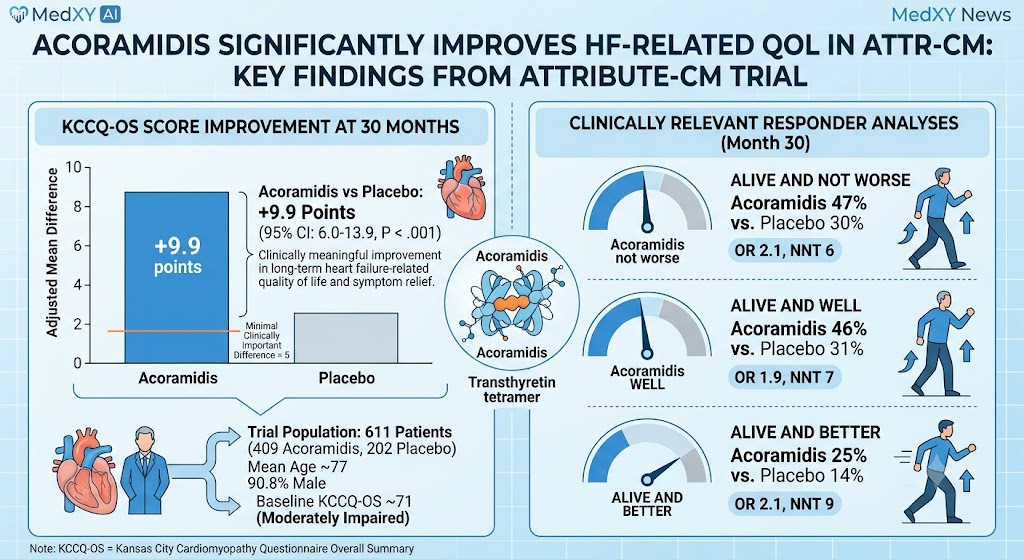
The phase 3 ATTRibute-CM trial demonstrated a clinically meaningful increase of nearly 10 points in Kansas City Cardiomyopathy Questionnaire Overall Summary (KCCQ-OS) scores over 30 months compared to placebo.
Secondary analyses showed higher proportions of acoramidis-treated patients were “alive and not worse,” “alive and well,” and “alive and better,” indicating durable patient-centered benefits.
These findings emphasize acoramidis’ potential to alter disease trajectory and improve quality of life beyond traditional clinical endpoints.
Study Background
Transthyretin amyloid cardiomyopathy (ATTR-CM) is a progressive, life-threatening condition caused by the deposition of misfolded transthyretin protein in cardiac tissue, leading to restrictive cardiomyopathy and heart failure. Patients often experience symptoms such as fatigue, dyspnea, and reduced exercise tolerance, profoundly impacting quality of life. While acoramidis, a transthyretin stabilizer, has demonstrated efficacy in reducing mortality and cardiovascular hospitalizations in ATTR-CM by stabilizing the transthyretin tetramer and preventing amyloid formation, its effect on patient-reported health status has not been fully elucidated. Given the chronic and debilitating nature of ATTR-CM, assessing interventions’ impact on heart failure-related health status is crucial for comprehensive patient care and treatment evaluation.
Study Design
The ATTRibute-CM trial was a rigorous, phase 3, international, multicenter, placebo-controlled randomized clinical trial enrolling 632 adult patients diagnosed with ATTR-CM. Eligibility was based on established diagnostic criteria for transthyretin amyloid cardiomyopathy.
Participants were randomized to receive either acoramidis hydrochloride 800 mg twice daily or a placebo for a prolonged duration of 30 months. This extended treatment period allowed assessment of long-term benefits and safety profiles.
The primary focus of this secondary analysis was the effect on heart failure-related health status as measured by the Kansas City Cardiomyopathy Questionnaire Overall Summary score (KCCQ-OS), a validated, patient-centered instrument that evaluates symptoms, physical function, and quality of life.
The key prespecified secondary endpoint was the least-squares mean (LSM) difference in KCCQ-OS scores over 30 months analyzed with a mixed-effects model for repeated measures. Additional post hoc categorizations at month 30 included proportions of patients classified as “alive and not worse” (KCCQ-OS decline 60 and 5-point improvement).
Key Findings
Among 611 patients included in the modified intention-to-treat population (409 acoramidis, 202 placebo), baseline characteristics were well balanced with a mean age of approximately 77 years and predominantly male composition (90.8%). Baseline KCCQ-OS scores indicated moderately impaired health status (mean ~71 points) consistent with symptomatic heart failure.
At 30 months, acoramidis treatment produced a statistically significant and clinically meaningful improvement in KCCQ-OS compared to placebo. The adjusted mean difference was 9.9 points (95% CI, 6.0 to 13.9; P < .001), exceeding the generally accepted minimal clinically important difference of 5 points. This suggests that patients treated with acoramidis experienced better heart failure-related quality of life and symptom relief over the long term.
Clinically relevant responder analyses further supported these conclusions:
– 47% of acoramidis-treated patients were "alive and not worse" compared to 30% receiving placebo (odds ratio [OR] 2.1; 95% CI, 1.4–3.1; number needed to treat [NNT]=6).
– 46% were "alive and well" versus 31% on placebo (OR 1.9; 95% CI, 1.3–2.8; NNT=7).
– 25% were "alive and better" compared to 14% on placebo (OR 2.1; 95% CI, 1.3–3.4; NNT=9).
These patient-centric outcomes reflect both preservation and improvement of health status, indicating that acoramidis directly benefits aspects of living with heart failure beyond survival or hospitalization metrics.
The safety profile of acoramidis was consistent with previous reports, with no new adverse signals identified during the extended follow-up.
Expert Commentary
The ATTRibute-CM trial’s secondary analysis robustly establishes that acoramidis meaningfully improves patient-reported heart failure outcomes in ATTR-CM, a condition for which therapeutic options have been limited. The use of the KCCQ-OS, a validated tool widely accepted by regulatory agencies and clinicians, strengthens confidence in these findings.
The magnitude of KCCQ improvement observed aligns with benefits seen in other heart failure therapies known to improve morbidity and mortality, suggesting that transthyretin stabilization not only slows disease progression but enhances daily functioning and symptom burden.
Limitations include a predominantly male and elderly cohort, which may affect generalizability. Additionally, while the trial demonstrates durable benefit, further real-world data could help clarify broader applicability across diverse populations.
Mechanistically, acoramidis binds selectively to transthyretin, preventing dissociation and amyloid fibril formation, thus addressing the underlying pathophysiology and potentially enabling myocardial recovery or functional preservation, correlating with improved health status.
Conclusion
This secondary analysis of the ATTRibute-CM trial provides compelling evidence that acoramidis significantly improves heart failure-related health status in patients with transthyretin amyloid cardiomyopathy. By attenuating symptom progression and enhancing quality of life, acoramidis offers a meaningful advance in managing this challenging disease. These findings underscore the importance of integrating patient-reported outcomes in clinical trials and support the adoption of acoramidis as a disease-modifying therapy in ATTR-CM.
Ongoing research should focus on long-term real-world effectiveness, safety, and impact on diverse patient populations.
Funding and Clinical Trials Registration
The ATTRibute-CM trial was funded by the pharmaceutical sponsor responsible for acoramidis development. The trial is registered on ClinicalTrials.gov under identifier NCT03860935.
References
1. Sherrod CF, Fontana M, Gillmore JD, et al. Effect of Acoramidis on Heart Failure-Related Health Status: A Secondary Analysis of the ATTRibute-CM Randomized Clinical Trial. JAMA Cardiol. 2026 Jul 29. PMID: 42525404.
2. Maurer MS, Elliott P, Merlini G, et al. Design and rationale of ATTR-ACT: A phase 3, multicenter, randomized, double-blind, placebo-controlled study of tafamidis in patients with transthyretin amyloid cardiomyopathy. Circ Heart Fail. 2017;10(6):e003815.
3. Spertus JA, Jones PG, Sandhu AT, Arnold SV. The Kansas City Cardiomyopathy Questionnaire: a new tool to assess the impact of heart failure on patients’ health status. Heart Fail Clin. 2006 Jan;2(1):231-8.
4. Ruberg FL, Maurer MS. Transthyretin (ATTR) cardiac amyloidosis. Circulation. 2019;140(1):40-54.
This article was created using several editorial tools, including AI, as part of the process. Human editors reviewed this content before publication.