Highlight
A new data-driven weighted flare score for systemic lupus erythematosus (SLE) has been developed to improve prediction of organ damage accrual beyond traditional flare severity classifications. The score integrates specific clinical flare components, assigning higher weights to major organ involvement requiring high-dose glucocorticoids. Validation in an independent cohort demonstrated superior predictive accuracy, supporting clinical application in treat-to-target strategies and trials.
Study Background
Systemic lupus erythematosus (SLE) is a heterogeneous autoimmune disease characterized by periods of disease activity (flares) interspersed with remissions. These flares contribute significantly to organ damage, morbidity, and mortality. Conventional classifications categorize flares as mild/moderate or severe, yet this dichotomy inadequately reflects the risk of irreversible organ damage. Furthermore, the heterogeneity of flare manifestations complicates prognostication and management decisions. Hence, more precise and data-driven tools are needed to stratify flare severity for better risk prediction and treatment guidance.
Study Design
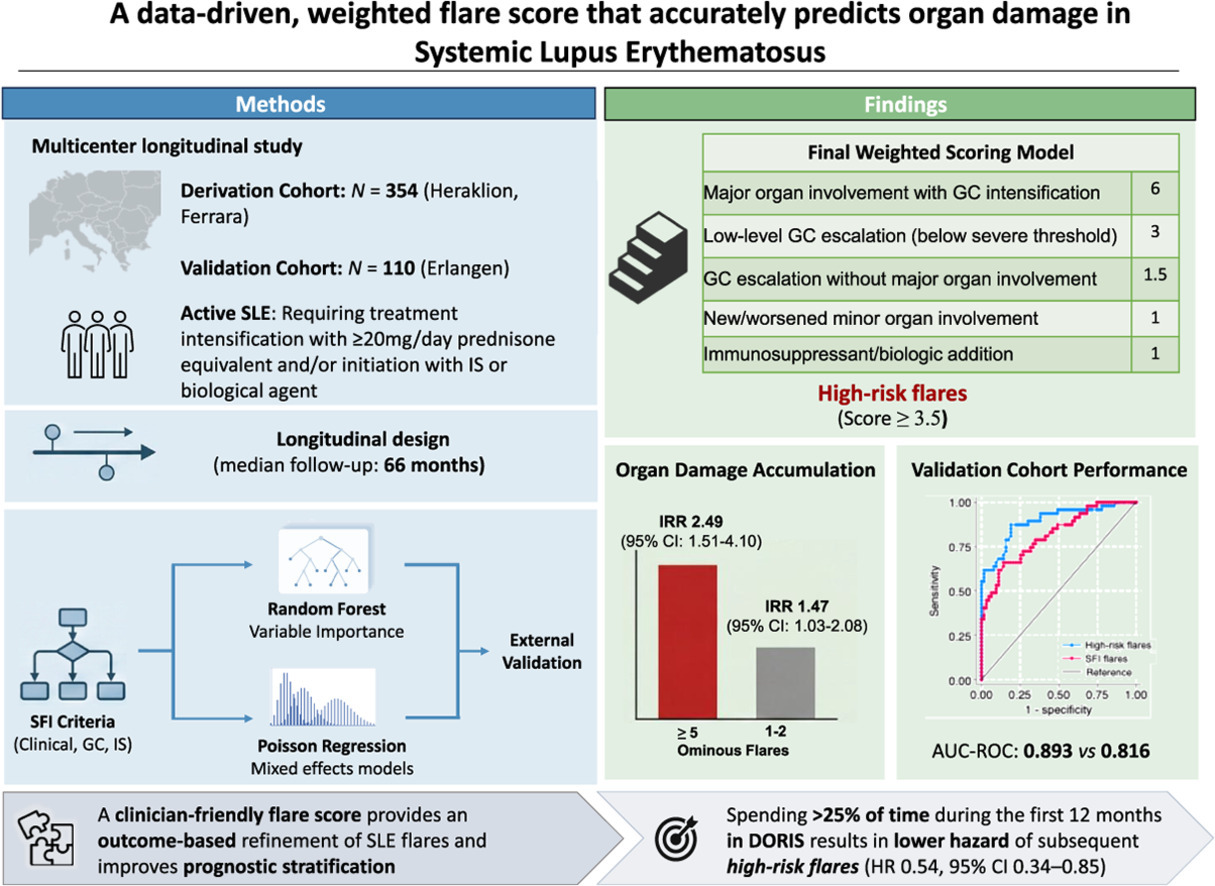
This study analyzed a multicenter longitudinal cohort comprising 354 patients with active SLE requiring treatment at baseline, followed for a median duration of 66 months. Flares were adjudicated using a modified version of the Safety of Estrogens in Lupus Erythematosus National Assessment-SLE Disease Activity Index Flare Index (SFI). The study employed machine learning techniques (Random Forests) and modified flare definitions to assess the contribution of individual flare components to subsequent organ damage risk. A weighted flare score was developed using bootstrap-validated mixed-effects models and externally validated in an independent cohort of 110 patients.
Key Findings
The study found that both mild/moderate and severe flares, as defined by the modified SFI, were associated with increased 12-month risk of accruing organ damage, with incidence rate ratios (IRR) of 1.42 and 1.54 respectively. Analysis of flare subcriteria revealed that major organ involvement necessitating high-dose glucocorticoid therapy had the highest predictive weight (weight = 6) for damage development. In contrast, isolated glucocorticoid dose escalations were assigned intermediate weights (1.5–3), while minor organ involvement and addition of immunosuppressants or biologics were weighted lowest (1 each).
Using these weighted components, a novel flare score was derived that demonstrated good calibration and discrimination with a Brier score of 0.07, indicating strong predictive accuracy. Setting a threshold flare score of ≥ 3.5 identified approximately 40% of flares categorized as “high-risk.” These high-risk flares showed the greatest association with subsequent organ damage (IRR 2.49, 95% confidence interval 1.51–4.10), outperforming the original SFI definitions. External validation confirmed superior performance of this weighted flare score, with an area under the receiver operating characteristic curve (AUC-ROC) of 0.893 compared to 0.816 for the original SFI score.
Furthermore, disease activity states reflecting remission and low disease activity (Definitions of Remission in SLE [DORIS] and Lupus Low Disease Activity State [LLDAS]) correlated with fewer flares overall. However, only sustained remission (DORIS maintained for more than 50% of the time) significantly reduced the occurrence of high-risk flares, supporting treatment targets emphasizing remission rather than low disease activity alone for optimal damage prevention.
Expert Commentary
This study provides a robust, evidence-based refinement of flare classification in SLE, moving beyond the simplistic mild/moderate vs severe categories to a nuanced weighted score that better predicts clinical outcomes. The use of random forests and mixed-effects modeling to assign differential weights to clinical flare components reflects a methodological advance in personalized disease activity measurement. The identification of high-dose glucocorticoid-requiring organ involvement as the strongest predictor underscores the importance of early aggressive intervention in severe organ manifestations.
Clinically, the weighted flare score aligns well with treat-to-target paradigms favoring remission and sustained low disease activity states. It may aid clinicians in identifying patients at higher risk for damage accrual and tailoring immunosuppressive and glucocorticoid therapies accordingly. The external validation and strong predictive metrics enhance the generalizability and reliability of this tool.
Nonetheless, implementation in routine practice will require integration into electronic health records and prospective evaluation in diverse populations. Limitations include dependence on accurate flare adjudication and potential variability in glucocorticoid dosing practices across centers. Future studies should explore incorporation of serologic and biomarker data to further refine predictive accuracy.
Conclusion
This study introduces and validates a new weighted flare score in SLE that improves upon traditional flare classifications by more accurately predicting organ damage accrual. Its superior performance and clinical relevance hold promise for enhancing treat-to-target strategies, informing clinical trial design, and ultimately improving patient outcomes through tailored flare management.
Funding and Clinical Trials
The study was conducted by an international multicenter team including the European academic and clinical rheumatology community. Specific funding sources were not disclosed in the abstract, but such cohorts are commonly supported by national and European research grants. No clinicaltrials.gov registration number was provided in the source publication.
References
1. Nikolopoulos D, et al. A data-driven, weighted flare score that accurately predicts organ damage in systemic lupus erythematosus. Ann Rheum Dis. 2026;85(10):1993-2003. doi:10.1136/annrheumdis-2023-42399124
2. Arnaud L, et al. Treat-to-target in SLE: strategies and outcomes. Nat Rev Rheumatol. 2020;16(6):365-376.
3. Franklyn K, et al. Definition and treatment targets in systemic lupus erythematosus: a European perspective. Lupus Sci Med. 2017;4(1):e000217.