WISP1 as a Therapeutic Target in Crohn’s Disease: Linking Metabolic Reprogramming to Intestinal Fibrosis
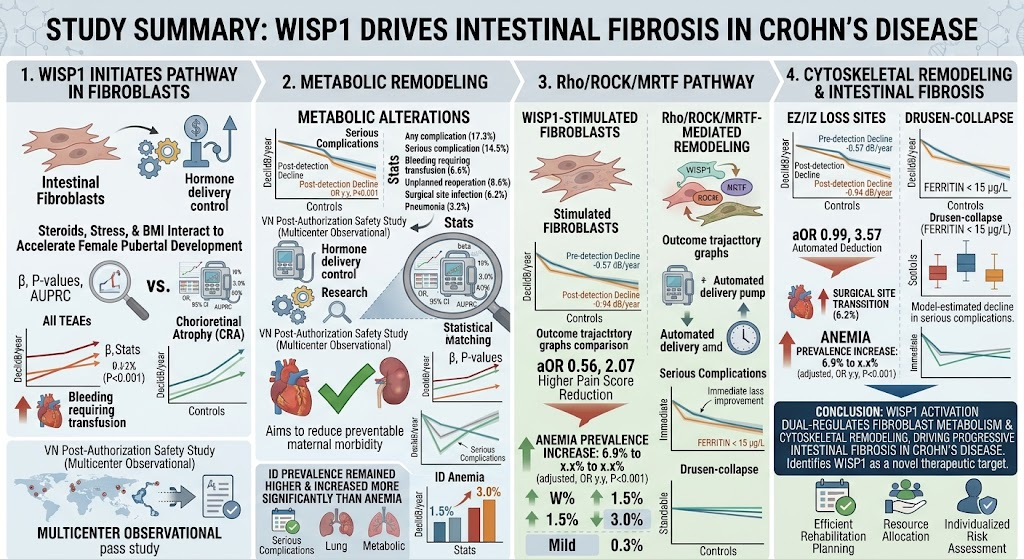
Highlight
WISP1 expression is markedly increased in fibrotic ileal regions of Crohn’s disease patients, correlating with fibroblast activation and extracellular matrix (ECM) deposition.
WISP1 orchestrates a metabolic switch in intestinal fibroblasts from fatty acid oxidation (FAO) to glycolysis, enhancing oxidative stress, adipokine secretion, and lipid accumulation, which promotes fibrosis.
The pro-fibrotic effect of WISP1 is mediated via the RHO/ROCK/MRTFA signaling pathway that drives cytoskeletal remodeling and ECM synthesis.
Neutralization of WISP1 in a murine fibrosis model attenuates collagen deposition, ECM complexity, inflammation, and MRTF target gene expression, underscoring its potential as a therapeutic target.
Study Background
Intestinal fibrosis is a severe and often irreversible complication of Crohn’s disease (CD), frequently leading to strictures and obstructive symptoms that require surgical intervention. Current therapies for CD primarily target inflammation but fail to prevent or reverse fibrosis, highlighting a significant unmet clinical need. WNT signaling pathways have been implicated in tissue remodeling and fibrosis in multiple organs, but the specific molecular mechanisms and potential therapeutic targets in intestinal fibrosis remain inadequately characterized. WISP1 (WNT1 inducible signaling pathway protein 1) is emerging as a key mediator linking WNT signaling to cellular functions involved in fibrosis, including fibroblast activation, metabolism, and cytoskeletal dynamics. This study by Buck et al. investigates the role of WISP1 in intestinal fibrosis in CD and explores its therapeutic potential.
Study Design
The investigators conducted a comprehensive analysis of matched ileal tissue samples from CD patients, encompassing fibrotic, inflamed non-fibrotic, and non-inflamed areas. They employed bulk RNA-sequencing, spatial transcriptomics, and lipidomics techniques to delineate gene expression profiles, cellular heterogeneity, and metabolic alterations in the fibrotic niche. Primary human intestinal fibroblasts were isolated for in vitro functional assays to dissect the metabolic and phenotypic changes upon WISP1 stimulation. Key assays included metabolic flux analysis focusing on fatty acid oxidation and glycolysis, ECM composition evaluation, ROS production measurement, and proteomic/secretomic profiling. Additionally, the therapeutic efficacy of a WISP1-neutralizing antibody was tested in an established murine model of intestinal fibrosis to verify in vivo relevance and translational potential.
Key Findings
WISP1 Expression and Fibroblast Heterogeneity in Crohn’s Fibrosis
Bulk and spatial transcriptomics demonstrated that WISP1 is highly upregulated in fibrotic ileal tissue compared to inflamed or non-fibrotic segments. Spatial analysis revealed distinct fibroblast subsets: a WISP1+ population enriched in fibrotic areas with a gene signature indicative of pro-fibrotic and glycolytic activity. Notably, these subsets co-expressed WNT-associated genes, linking canonical WNT signaling to fibrosis development. Histological assessment confirmed extensive ECM protein accumulation and lipid droplet formation, suggesting that metabolic remodeling accompanies fibrogenesis.
WISP1 Reprograms Fibroblast Metabolism Towards Glycolysis
In vitro experiments showed that WISP1 stimulation shifts fibroblast metabolism from FAO, a key catabolic and anti-fibrotic pathway, towards enhanced aerobic glycolysis (Warburg-like metabolism). This metabolic reprogramming increased reactive oxygen species (ROS) production and promoted secretion of adipokines—fatty acid-related signaling molecules implicated in tissue remodeling. WISP1-treated fibroblasts accumulated intracellular lipids, mimicking in vivo observations.
Link Between Metabolism and ECM Production
Functional assays revealed that suppression of FAO by chemical inhibition amplified collagen (ECM) production. Conversely, activation of peroxisome proliferator-activated receptor alpha (PPARα), which promotes FAO, mitigated collagen synthesis. These findings establish a mechanistic link where metabolic flux controls fibrogenic activity, positioning FAO restoration as a potential antifibrotic strategy.
Cytoskeletal Remodeling via RHO/ROCK/MRTFA Pathway
WISP1-driven fibrosis involved activation of the RHO/ROCK (Rho-associated protein kinase)/MRTFA (myocardin-related transcription factor A) pathway, essential for actin cytoskeleton remodeling and subsequent transcriptional activation of fibrosis-associated genes. Fibrotic CD tissues exhibited enriched MRTFA/serum response factor (SRF) signatures, indicating enhanced cytoskeletal dynamics fostering ECM deposition.
Therapeutic Potential of WISP1 Neutralization
In a murine collagen-induced fibrosis model, administration of a WISP1-neutralizing antibody significantly reduced collagen deposition and ECM architectural complexity. This was accompanied by decreased intestinal inflammation and downregulation of MRTF target genes. These in vivo results validate the pathogenic role of WISP1 in intestinal fibrosis and support its candidacy as a therapeutic target.
Expert Commentary
Buck et al. provide compelling evidence that WISP1 serves as a molecular nexus integrating WNT signaling, metabolic reprogramming, and cytoskeletal remodeling to drive intestinal fibrosis in Crohn’s disease. The demonstration that FAO suppression promotes fibrogenesis aligns with emerging paradigms in other fibrotic diseases, underscoring the translational relevance of modulating cellular metabolism. The identification of the RHO/ROCK/MRTFA axis as a downstream effector of WISP1 also opens avenues for combinational therapeutic approaches targeting both metabolic and cytoskeletal pathways.
While the study’s strength lies in the integration of multi-omics, spatial resolution, and functional validation, limitations include the use of primary fibroblasts in vitro that may not fully capture the complexity of the in vivo environment and the murine fibrosis model which may not recapitulate all features of human CD fibrosis. Further clinical studies are required to assess safety, efficacy, and long-term benefits of WISP1 neutralization in CD patients.
Conclusion
This comprehensive study sheds light on the pivotal role of WISP1 in orchestrating intestinal fibrosis in Crohn’s disease by inducing metabolic changes and cytoskeletal remodeling in fibroblasts. The dual impact on fibrogenesis and inflammation positions WISP1 as an attractive therapeutic target. Restoration of FAO and inhibition of the RHO/ROCK/MRTFA pathway downstream of WISP1 may provide innovative strategies to prevent or reverse intestinal fibrosis, addressing a significant clinical gap in CD management. Future clinical trials testing WISP1-neutralizing agents or metabolic modulators are warranted to translate these findings into effective antifibrotic therapies.
Funding and ClinicalTrials.gov
Details regarding funding sources and clinical trial registrations were not provided in the original publication. Future studies should delineate these aspects for enhanced clinical translation.
References
1. Buck A, Writz C, Umbach M, et al. WISP1 Drives Intestinal Fibrosis in Crohn’s Disease via Metabolic and Rho/ROCK/MRTF-mediated cytoskeletal Remodeling. Gastroenterology. 2026 Aug 18. PMID: 42612881.
2. Henderson NC, et al. Fibrosis: from mechanisms to medicines. Nature. 2020;587(7835):555-566.
3. Friedman SL. Liver fibrosis — from bench to bedside. J Hepatol. 2003;38 Suppl 1:S38-53.
4. Wynn TA. Cellular and molecular mechanisms of fibrosis. J Pathol. 2008 Jan;214(2):199-210.
This article was created using several editorial tools, including AI, as part of the process. Human editors reviewed this content before publication.