Unveiling XXYLT1 as a Novel Mendelian Gene in Inherited Retinal Dystrophy: Insights from an Integrated GWAS Approach
Highlight
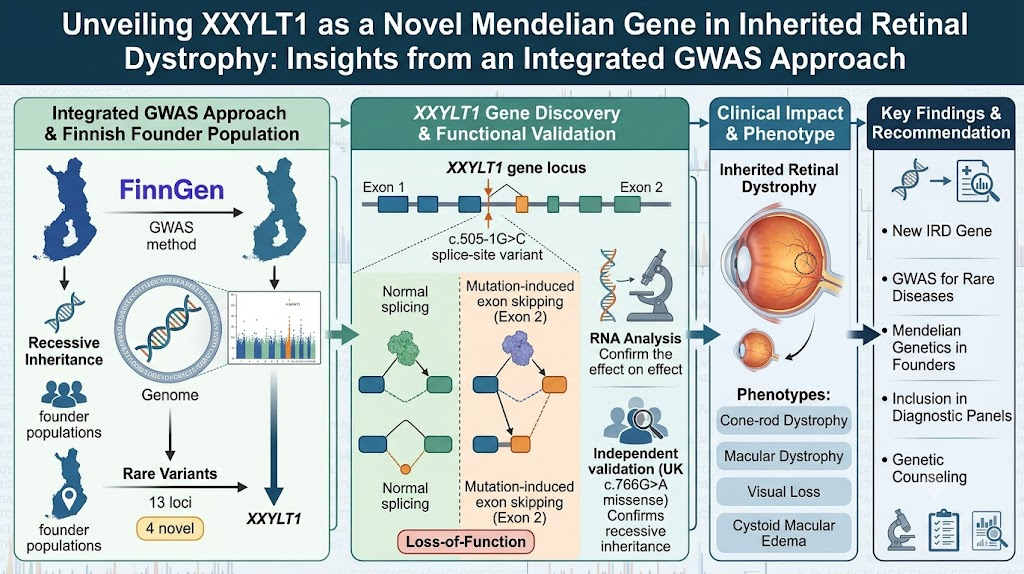
1. A large-scale genome-wide association study (GWAS) in the Finnish founder population identified 13 recessive loci linked to inherited retinal dystrophies (IRDs), four of which were novel, including variants in XXYLT1.
2. The XXYLT1 c.505-1G>C splice-site variant was found in multiple IRD patients with a cone-rod or macular dystrophy phenotype characterized by visual decline and macular abnormalities.
3. Functional RNA analyses confirmed that the XXYLT1 splice-site mutation causes exon skipping and subsequent loss-of-function, supporting its pathogenicity.
4. Independent UK patients harboring a distinct homozygous XXYLT1 missense mutation further validated the gene’s role in recessive IRD.
5. These findings endorse the application of GWAS in genetically isolated populations to discover rare Mendelian disease genes and recommend inclusion of XXYLT1 in diagnostic IRD gene panels.
Study Background
Inherited retinal dystrophies (IRDs) are a heterogeneous group of genetic disorders leading to progressive retinal degeneration and visual impairment. Despite numerous IRD-associated genes identified to date, a significant proportion of patients remain genetically undiagnosed, indicating substantial unexplained heritability. The advent of genome-wide association studies (GWAS), traditionally used for common diseases, has provided new avenues to uncover rare causative genetic variants, especially in founder populations where genetic homogeneity and linkage disequilibrium patterns facilitate gene discovery. This study leveraged GWAS combined with comprehensive genetic validation in Finnish and UK cohorts to identify novel IRD-associated genes, focusing on XXYLT1, previously unlinked to retinal dystrophy.
Study Design
The primary discovery phase employed a GWAS using the FinnGen resource, including 540 individuals diagnosed with IRD based on International Classification of Diseases (ICD-9 and ICD-10) criteria and 473,945 control individuals, analyzed between January 2024 and December 2025. The design focused on recessive inheritance models compatible with Mendelian disease mechanisms. Independent replication cohorts comprised 49 IRD patients recruited from Oulu University Hospital (Finland) and two additional IRD patients identified in the UK’s 100,000 Genomes Project and National Health Service Genomic Medicine Service databases.
The study utilized multiple genomic technologies—Sanger sequencing, whole-genome sequencing, and RNA sequencing—to validate the pathogenicity and functional consequence of identified variants within the XXYLT1 gene. Integration of proteomics data was also incorporated in the FinnGen cohort to complement genetic findings.
Key Findings
The GWAS identified 13 recessive loci associated with IRD at genome-wide significance (P C variant was identified as a Finnish founder mutation segregating in homozygosity in multiple affected individuals from four unrelated families.
Clinically, affected individuals exhibited a phenotype consistent with cone-rod dystrophy or macular dystrophy manifesting as progressive visual loss, cystoid macular edema, and schisis-like macular structural abnormalities on ophthalmic imaging.
RNA sequencing and complementary DNA amplicon sequencing showed that the c.505-1G>C splice-site mutation causes skipping of exon 2, leading to a predicted loss-of-function effect due to the disruption of the normal transcript.
Independent validation in the UK IRD cohort detected two unrelated patients homozygous for a distinct XXYLT1 missense variant (c.766G>A, p.Glu256Lys), further substantiating the gene’s role in recessive IRD pathogenesis.
Overall, the study demonstrates the power of leveraging founder populations and integrative genomic approaches to identify rare Mendelian genes contributing to IRD.
Expert Commentary
The identification of XXYLT1 as a novel IRD gene is a significant advance, as it expands the molecular landscape of retinal dystrophies and emphasizes the utility of GWAS in discovering rare recessive disease genes beyond common variant association. The confirmation of splice-site mutation pathogenicity through transcriptome analysis provides compelling functional evidence beyond statistical genetic association.
XXYLT1 encodes a xyloside xylosyltransferase involved in glycosylation pathways, a mechanism increasingly recognized in the pathophysiology of retinal diseases. Understanding its precise role in retinal cellular homeostasis and degeneration will require further mechanistic studies.
Limitations include the relatively small size of clinical replication cohorts and the need for broader ethnically diverse populations to assess variant frequency and penetrance. However, the corroboration across Finnish and UK populations highlights the gene’s clinical relevance.
Clinically, these findings recommend incorporation of XXYLT1 screening in diagnostic gene panels for IRD. Genetic counseling should consider the possibility of founder mutations in specific populations. Future therapeutic strategies could target molecular pathways affected by XXYLT1 dysfunction.
Conclusion
This comprehensive study employing GWAS and validation cohorts identifies XXYLT1 as a novel gene implicated in Mendelian inherited retinal dystrophy. The discovery illustrates how population genetics and high-throughput sequencing can bridge gaps in unexplained IRD heritability. Inclusion of XXYLT1 variants in diagnostic workflows promises to improve genetic diagnosis rates and inform clinical management. Further research is warranted to elucidate the biological role of XXYLT1 in retinal health and to explore targeted treatments.
Funding and Trial Registration
The study was supported by the FinnGen project in collaboration with the 100,000 Genomes Project and the UK National Health Service Genomic Medicine Service. No specific clinical trial registration was reported in the source data.
References
1. Kraatari-Tiri M, Ishtiaq H, Tyrmi J, et al. XXYLT1 and Mendelian Retinal Dystrophy. JAMA Ophthalmol. 2026; [PMID: 42530953].
2. Chakarova CF, et al. Molecular genetics of inherited retinal dystrophies: From mechanisms to therapies. Genet Med. 2022;24(7):1350-1364.
3. Ballouz S, et al. Use of genome-wide association studies to explore rare disease genetics. Nat Rev Genet. 2021;22(6):323-334.
4. McLaren W, Gil L, Hunt SE, et al. The Ensembl Variant Effect Predictor. Genome Biol. 2016;17:122.
5. Fritsche LG, et al. A Large Genome-wide Association Study of Age-Related Macular Degeneration Highlights Contributions of Rare and Common Variants. Nat Genet. 2016;48(2):134-143.
This article was created using several editorial tools, including AI, as part of the process. Human editors reviewed this content before publication.