Highlight
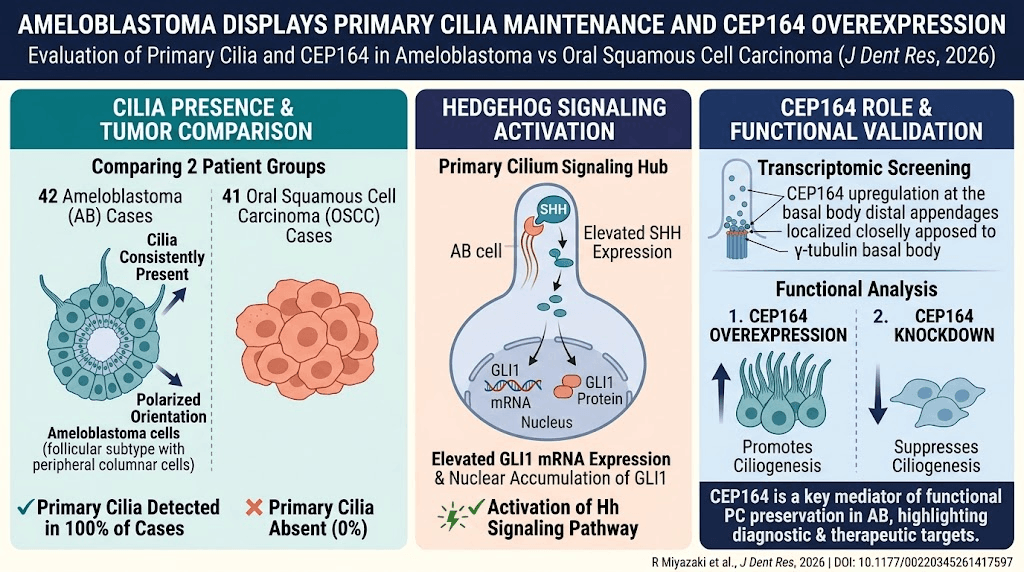
Ameloblastomas (ABs), unlike many malignancies, maintain functional primary cilia (PC), with consistent PC presence detected across all major histological subtypes. CEP164, a key distal appendage protein essential for ciliogenesis, is selectively overexpressed in ABs compared to oral squamous cell carcinoma (OSCC) and other cilia-deficient tumors. This unique cellular feature is linked to activated Hedgehog (Hh) signaling pathway components, suggesting biological significance in tumor progression and potential as a therapeutic target.
Study Background
Ameloblastoma is a rare, benign but locally invasive odontogenic tumor arising from epithelial cells involved in tooth development. Despite its benign classification, AB frequently recurs and exhibits a notable capacity for local tissue destruction, sometimes even metastasizing. Understanding the molecular underpinnings of AB is crucial for improving disease management and developing targeted therapies, as current treatment primarily involves surgical excision with variable success and recurrence rates.
Primary cilia are single, non-motile, microtubule-based organelles projecting from the surface of many cell types. They function as hubs for complex signaling pathways, including Hedgehog (Hh) signaling, which is implicated in tissue development, homeostasis, and oncogenesis. Notably, in various tumor types, primary cilia tend to be lost or reduced, contributing to malignant phenotypes. However, the status of primary cilia in AB has remained under-explored.
Study Design
This retrospective, tissue-based observational study analyzed 42 AB cases encompassing the diverse histological patterns characteristic of ameloblastoma. For comparison, 41 oral squamous cell carcinoma (OSCC) cases, which originate in the same anatomical location but differ markedly in pathology, were included. Techniques used included immunohistochemistry and immunofluorescence to detect primary cilia and key molecular markers, as well as ultrastructural analysis for detailed cellular architecture visualization.
Additionally, transcriptomic screening was conducted to identify gene expression changes related to ciliogenesis and associated pathways. Functional assays manipulating CEP164 expression were performed to validate its role in ciliogenesis in AB-derived cells.
Key Findings
Primary Cilia Presence and Distribution: All AB tumors displayed prominent primary cilia, confirmed through multiple marker detections and ultrastructural imaging. In contrast, OSCC samples lacked detectable primary cilia, consistent with prior knowledge of cilia loss in cancers. The density and orientation of primary cilia in AB varied among histological subtypes, with follicular subtype exhibiting polarized cilia in peripheral columnar cells, possibly indicating functional spatial signaling roles within tumor microarchitecture.
Hedgehog Signaling Activation: Molecular analysis revealed elevated GLI1 mRNA levels and nuclear localization of GLI1 protein in AB samples, validating active Hh pathway signaling. Correspondingly, increased SHH ligand expression supported the inference that the Hh pathway may drive or sustain AB tumor biology.
CEP164 Selective Overexpression: Transcriptomic profiling identified CEP164 as significantly upregulated in AB compared to OSCC and other cilia-deficient carcinomas. CEP164 protein localized predominantly at the distal appendages of basal bodies, a critical site for initiating ciliogenesis. Functionally, overexpression of CEP164 in vitro enhanced primary cilia formation, whereas CEP164 knockdown markedly suppressed ciliogenesis, establishing its mechanistic importance in maintaining cilia in AB cells.
Clinical Implications and Disease Progression: Primary cilia were preserved even in recurrent and metastatic AB lesions, although the precise impact of ciliogenesis on clinical outcomes and tumor aggressiveness requires further elucidation. The unique retention of primary cilia and involvement of CEP164 suggest distinctive biological behavior separate from more typical oral malignancies like OSCC.
Expert Commentary
This study challenges the conventional paradigm that cilia loss is a hallmark of malignant transformation by demonstrating that ABs preserve primary cilia and actively utilize ciliogenesis pathways. The implication of CEP164 offers a novel perspective on the molecular etiology of AB, emphasizing its potential as both a biomarker for tumor classification and a candidate for targeted intervention.
Importantly, the data support that the active Hedgehog pathway, mediated through primary cilia, could underlie the characteristic local invasiveness and recurrence of AB. Targeting CEP164 or modulating ciliogenesis may open new therapeutic avenues beyond conventional surgery, possibly reducing recurrence and improving patient outcomes.
However, limitations include the retrospective nature of the study and absence of longitudinal clinical correlation, warranting validation in prospective cohorts and functional animal models. Additionally, while this study contrasts AB with OSCC, extending comparisons to other odontogenic tumors may refine the specificity of CEP164 and cilia-related signaling as diagnostic tools.
Conclusion
This comprehensive study identifies primary cilia maintenance and selective CEP164 overexpression as defining features of ameloblastoma, distinguishing it from other oral malignancies such as OSCC. The findings illuminate a distinct cellular and molecular phenotype that may influence tumor biology, particularly through activated Hedgehog pathway signaling. CEP164 emerges as a crucial mediator of ciliogenesis and a promising target for future research and therapeutic development. Further investigation into the functional role of cilia and CEP164 in ameloblastoma progression and patient prognosis is warranted to translate these insights into clinical benefit.
Funding and Clinical Trials
This study was conducted with institutional support as detailed in the original publication. No specific clinical trial registration numbers were reported.
References
Miyazaki R, Kawasaki H, Kato H, et al. Ameloblastoma Displays Primary Cilia Maintenance and CEP164 Overexpression. J Dent Res. 2026;105(11):1440-1450. PMID: 41733187.
Goetz SC, Anderson KV. The primary cilium: a signalling centre during vertebrate development. Nat Rev Genet. 2010;11(5):331-344.
Hassounah NB, Bunch TA, McDermott KM. Molecular pathways: the role of primary cilia in cancer progression and therapeutics with a focus on Hedgehog signaling. Clin Cancer Res. 2012;18(9):2429-2435.
Egger G, Roessler S, Schmaus A, et al. Hedgehog signaling in oral squamous cell carcinoma. J Oral Pathol Med. 2017;46(5):351-357.
Reiter JF, Leroux MR. Genes and molecular pathways underpinning ciliopathies. Nat Rev Mol Cell Biol. 2017;18(9):533-547.