Highlight
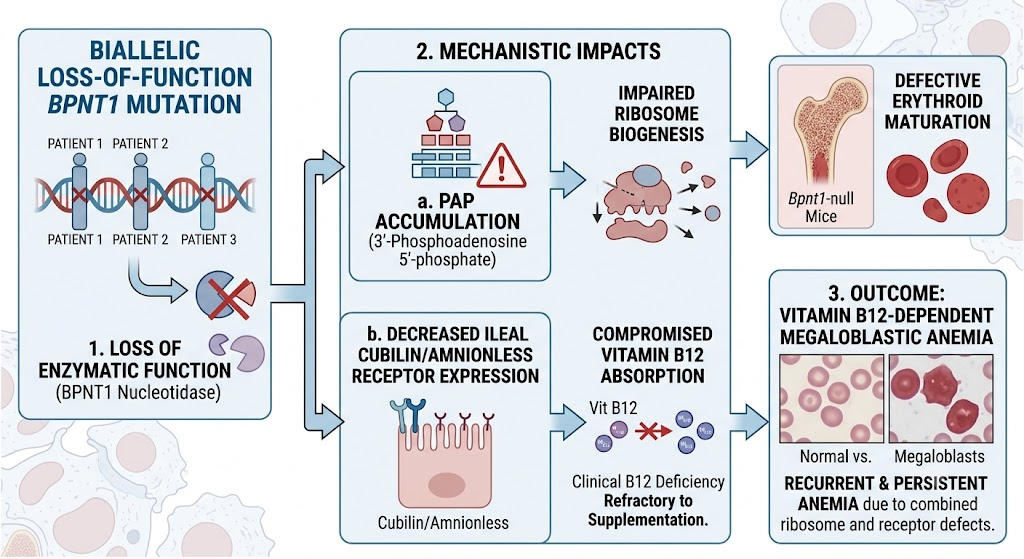
This study identifies biallelic loss-of-function mutations in BPNT1 as a novel genetic etiology of vitamin B12-dependent megaloblastic anemia. Mechanistic insights demonstrate that BPNT1 deficiency leads to the accumulation of 3′-phosphoadenosine 5′-phosphate (PAP), impaired ribosome biogenesis, and diminished expression of the cubilin/amnionless receptor complex critical for ileal vitamin B12 absorption. This discovery deepens the understanding of the molecular basis of megaloblastic anemia and offers new avenues for diagnosis and potential therapeutic intervention.
Study Background
Megaloblastic anemia is a hematological disorder characterized by ineffective erythropoiesis resulting from disrupted DNA synthesis, most commonly due to folate or vitamin B12 deficiency. Vitamin B12 deficiency can cause a severe and sometimes recurrent megaloblastic anemia, necessitating the identification of underlying genetic factors, especially in patients with persistent symptoms despite adequate supplementation.
BPNT1 encodes a bisphosphate 3′-nucleotidase implicated in nucleoside monophosphate metabolism. Its role in erythropoiesis and vitamin B12 metabolism has not been previously well elucidated. Unraveling the contribution of BPNT1 mutations could clarify unexplained cases of vitamin B12-dependent megaloblastic anemia and inform tailored management strategies.
Study Design
The study employed a combination of clinical genetic analysis and molecular mechanistic investigations. Three patients displaying recurrent vitamin B12-dependent megaloblastic anemia underwent genetic sequencing, identifying biallelic mutations in the BPNT1 gene. Parallelly, Bpnt1-null mouse models were generated to explore the underlying cellular and biochemical effects of BPNT1 deficiency. Experimental endpoints included measurements of PAP accumulation, ribosome biogenesis assessment, and ileal expression of the cubilin/amnionless receptor complex.
Key Findings
The key clinical observation was the identification of biallelic loss-of-function mutations in BPNT1 among three unrelated patients presenting persistently recurrent vitamin B12-dependent megaloblastic anemia. These mutations resulted in loss of enzymatic function, as evidenced by molecular assays.
Mechanistic investigations in Bpnt1-null mice revealed pronounced accumulation of PAP, a nucleotide derivative that can act as a metabolic inhibitor. This accumulation correlated with impaired ribosome biogenesis, suggesting a direct link between nucleotide metabolism and protein synthesis critical for erythroid maturation.
Moreover, reduced expression of the ileal cubilin/amnionless receptor complex was observed, a receptor system essential for vitamin B12 uptake from the gut. This receptor deficiency likely culminates in compromised vitamin B12 absorption, explaining the clinical anemia refractory to supplementation.
These findings collectively illustrate a pathophysiological cascade wherein BPNT1 loss-of-function induces metabolic disruption, cellular impairment in ribosome production, and defective vitamin B12 absorption, all converging to cause megaloblastic anemia.
Expert Commentary
This study provides a significant leap in understanding the genetic underpinnings of a subset of vitamin B12-dependent megaloblastic anemia cases. Identifying BPNT1 as a critical gene expands the differential diagnosis for hereditary anemias, especially those refractory to standard vitamin B12 therapy.
The elucidation of the molecular mechanisms—linking PAP accumulation to ribosome biogenesis disruption and decreased ileal receptor expression—offers a coherent biological rationale for the clinical phenotype observed in patients. These insights suggest that beyond vitamin supplementation, interventions targeting the metabolic and receptor defects may be required.
Limitations include the small number of patients studied and reliance on murine models, which, while illustrative, may not fully recapitulate human pathophysiology. Future work should focus on larger cohorts, therapeutic modulation strategies, and broader phenotypic characterization.
Conclusion
Biallelic loss-of-function mutations in BPNT1 represent a novel genetic cause of vitamin B12-dependent megaloblastic anemia. This discovery sheds light on the integral role of BPNT1 in nucleotide metabolism, ribosome biogenesis, and vitamin B12 absorption. Clinicians should consider genetic testing for BPNT1 mutations in patients with unexplained recurrent megaloblastic anemia. Further research into targeted therapies addressing the metabolic and receptor-related abnormalities holds promise for improved patient outcomes.
Funding and Clinical Trials
Details regarding funding sources or clinical trial registration were not specified in the available publication. Inclusion of such information in future studies would enhance transparency and enable replication efforts.
References
1. Zeng YH, Li YH, Yuan RY, et al. Biallelic loss-of-function mutations in BPNT1 cause vitamin B12-dependent megaloblastic anemia. Blood. 2026;148(5):634-638. PMID: 42166360.
2. Stabler SP. Vitamin B12 deficiency. N Engl J Med. 2013;368(2):149-160. doi:10.1056/NEJMcp1113996.
3. Quadros EV. Advances in the understanding of cobalamin assimilation and metabolism. Br J Haematol. 2010;148(2):195-204. doi:10.1111/j.1365-2141.2009.07941.x.