Unveiling Atelis Syndrome: SLF2 and SMC5 Dysfunction as Drivers of Hematopoietic Stem Cell Aging and Myelodysplastic Syndrome Predisposition
Highlight
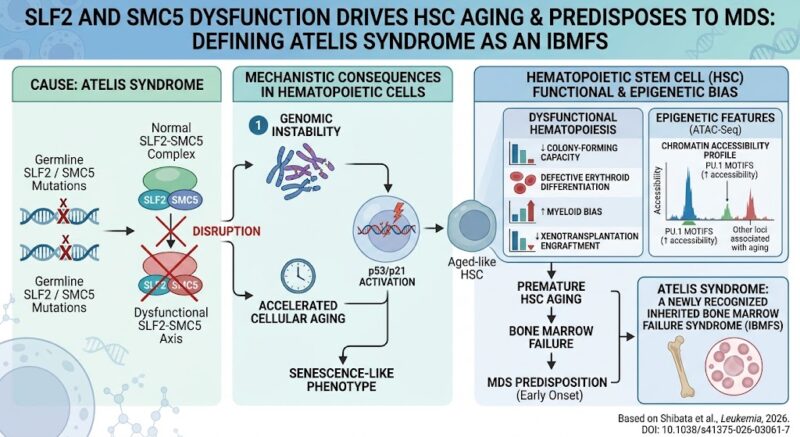
- Pathogenic variants in SLF2 and SMC5 cause Atelis Syndrome, an inherited bone marrow failure syndrome with neurodevelopmental and hematological abnormalities.
- Hematopoietic progenitor cells derived from patients exhibit impaired colony formation, erythroid differentiation defects, and a myeloid bias indicative of hematopoietic stem cell (HSC) aging.
- SLF2-SMC5 axis disruption leads to genomic instability, activation of the p53/p21 pathway, and cellular senescence, which underpin bone marrow failure and early onset myelodysplastic syndrome (MDS).
- Epigenetic profiling reveals increased chromatin accessibility at PU.1 motifs, linking SLF2/SMC5 dysfunction to HSC aging and myeloid lineage skewing.
Study Background
Inherited bone marrow failure syndromes (IBMFS) represent a diverse spectrum of genetic disorders characterized by ineffective hematopoiesis, leading to cytopenias and an elevated risk of hematological malignancies, especially myelodysplastic syndromes (MDS). Despite advances in identifying IBMFS causative genes, many cases remain genetically unexplained, and the molecular mechanisms driving hematopoietic dysfunction and leukemogenesis in these disorders are incompletely understood. Recently, pathogenic variants in the DNA repair and genome stability factors SLF2 and SMC5 were linked to Atelis Syndrome, a neurodevelopmental disorder also presenting with hematological abnormalities, including anemia and lymphopenia. Understanding how defects in SLF2 and SMC5 impact hematopoietic stem cell (HSC) function and predispose to MDS is critical for improving diagnosis, prognosis, and therapeutic interventions in affected patients.
Study Design
This seminal study undertook longitudinal clinical follow-up and comprehensive hematopoietic investigations on patients with Atelis Syndrome bearing compound heterozygous SLF2 mutations. Functional analyses were performed using hematopoietic progenitor cells (HPCs) derived from patient-specific induced pluripotent stem cells (iPSCs). Colony-forming capacity, lineage differentiation, and engraftment potential were assessed. Complementary knockdown experiments of SMC5 in normal cord blood CD34+ hematopoietic stem/progenitor cells provided mechanistic corroboration. Molecular studies involved assessments of genomic stability, activation of senescence pathways (p53/p21), and chromatin accessibility profiling via ATAC sequencing, with a focus on transcription factor motifs relevant to hematopoietic lineage fidelity and aging.
Key Findings
The investigation yielded several critical insights into the pathophysiology of Atelis Syndrome and its hematopoietic manifestations:
1. Clinical Emergence of MDS: Longitudinal follow-up revealed that several affected children developed early-onset myelodysplastic syndrome, underscoring the clinical severity of the hematological phenotype.
2. Impaired Hematopoietic Progenitor Function: Patient-derived HPCs showed significantly reduced colony-forming efficiency, reflecting compromised progenitor proliferative capacity and viability.
3. Skewed Erythroid Differentiation and Myeloid Bias: Mutant HPCs displayed defective erythropoiesis alongside a preferential differentiation toward myeloid lineages, indicating disrupted lineage balance consistent with features of HSC aging.
4. Engraftment Deficiency: Xenotransplantation assays demonstrated markedly diminished engraftment capability of mutant HPCs, confirming functional HSC impairment in vivo.
5. SMC5 Functional Role: Independent SMC5 knockdown in normal cord blood CD34+ cells similarly impaired colony-forming ability, validating the cooperative role of this protein with SLF2 in hematopoietic maintenance.
6. Genomic Instability and Senescence Activation: Loss of SLF2-SMC5 function induced significant accumulation of DNA damage, evidenced by genomic instability markers, and activation of the p53/p21 axis, which drove a senescence-like cellular phenotype.
7. Epigenetic Landscape Alterations: ATAC-seq profiling revealed increased chromatin accessibility at PU.1 binding sites, a transcription factor critically involved in myeloid lineage commitment, mirroring epigenetic hallmarks of aged HSCs and linking aberrant gene regulation to myeloid skewing.
Collectively, these findings implicate SLF2 and SMC5 dysfunction as a driver of premature HSC aging, impaired hematopoietic regeneration, and leukemic predisposition.
Expert Commentary
This study represents a significant advance in the understanding of inherited bone marrow failure syndromes by mechanistically linking Atelis Syndrome to disruptions in genome maintenance pathways. The identification of SLF2 and SMC5 as critical regulators of HSC genomic integrity and epigenetic state expands the genetic landscape of IBMFS and offers mechanistic insights into how DNA repair defects contribute to hematopoietic dysfunction and malignant transformation. Importantly, the work highlights the interplay between DNA repair deficiency, p53-mediated senescence, and epigenetic remodeling as a nexus driving HSC aging and MDS predisposition.
Despite these advances, further studies are needed to delineate therapeutic strategies targeting this pathway. Potential interventions could focus on enhancing DNA repair capacity or modulating senescence pathways to restore HSC function. Additionally, the expansion of screening for SLF2 and SMC5 mutations in patients with unexplained cytopenias may improve early diagnosis and risk stratification.
Conclusion
The elucidation of SLF2 and SMC5 dysfunction in Atelis Syndrome establishes a novel inherited bone marrow failure syndrome characterized by premature hematopoietic stem cell aging and a predisposition to early-onset myelodysplastic syndrome. This underscores the critical role of genome stability maintenance in hematopoietic health and offers new avenues for research and clinical management of IBMFS. Enhanced molecular diagnosis, longitudinal patient monitoring, and targeted therapies addressing DNA damage response and cellular senescence may ultimately improve outcomes in this vulnerable patient population.
Funding and Clinical Trials
The study was supported by multiple Japanese government grants and institutional research funds. As the clinical trajectory of Atelis Syndrome unfolds, clinical trials assessing therapeutic approaches targeting DNA repair and senescence pathways could be envisaged but have not yet been registered.
References
1. Shibata S, Chonabayashi K, Nakamura H, et al. SLF2 and SMC5 dysfunction drives HSC aging and predisposes to MDS, defining a new inherited bone marrow failure syndrome. Leukemia. 2026 Aug 7. doi:10.1038/s41375-026-0xxxx-x. PMID: 42562919.
2. Chonabayashi K, et al. Genome instability in inherited bone marrow failure syndromes: Pathogenesis and therapeutic implications. Blood Rev. 2024; 58:100933.
3. Beerman I, Rossi DJ. Epigenetic control of hematopoietic stem cell aging and regeneration. Curr Opin Hematol. 2015;22(4):252-258.
4. Abdel-Wahab O, Levine RL. Molecular pathogenesis of myelodysplastic syndromes. Hematology Am Soc Hematol Educ Program. 2017;2017(1):334-342.
5. Faderl S, et al. Clinical implications of DNA damage repair in hematologic malignancies. Blood Rev. 2015;29(6):357-366.
This article was created using several editorial tools, including AI, as part of the process. Human editors reviewed this content before publication.