We use cookies

Our website uses essential cookies and, with your consent, additional cookies to measure performance and improve our services. Cookie Policy.

You can change your choice at any time.

MMedXYNews
HomeVideos
MedXY AI/MedXY News/Section: Clinical Updates

Universal Aspirin Dispensation for Prevention of Preeclampsia in High-Risk Pregnancies: Evidence Synthesis and Clinical Implications
MedXY Editorial Team•Aug 31, 2026•Clinical Updates
pregnancy prophylaxispreeclampsiahypertensive disordersAspirin

Highlights

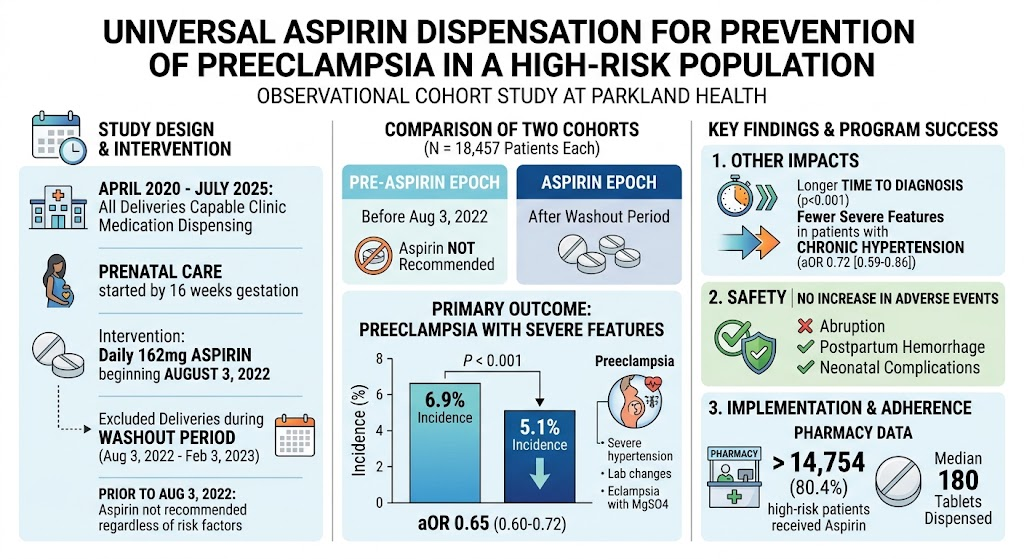
  • Universal aspirin administration (162 mg daily) starting early in pregnancy reduces incidence and delays onset of preeclampsia with severe features in high-risk populations.
  • Implementation of direct aspirin dispensation during prenatal visits leads to high adherence (~80%) and favorable maternal and neonatal outcomes without increased bleeding or abruption risk.
  • Early aspirin initiation (before 12 weeks’ gestation) further improves hypertensive and neonatal outcomes beyond standard practice.
  • Advanced first-trimester screening algorithms incorporating biomarkers (e.g., PlGF) enhance risk identification but may benefit from complementing universal aspirin strategies in high-prevalence settings.

Background

MedXY registered readers

Sign in free to continue reading

Create or use your MedXY account to unlock the complete article.

This article was created using several editorial tools, including AI, as part of the process. Human editors reviewed this content before publication.

Related articles

Open language-specific specialty feeds and department pages.

Advancing Fetal Death Detection: Identification of Novel Maternal Plasma Biomarkers Through Large-Scale Proteomic ProfilingLarge-scale proteomic analysis identifies novel maternal plasma protein biomarkers that improve detection of fetal death beyond established markers, highlighting both shared and unique pathological pathways with preeclampsia.Sep 12, 2026Aspirin Use, Lipoprotein(a), and Calcific Aortic Valve Disease: Insights from the Multi-Ethnic Study of AtherosclerosisThis review synthesizes evidence linking aspirin use to reduced risk of calcific aortic valve disease in persons with elevated lipoprotein(a), highlighting the potential for targeted preventive strategies.Sep 11, 2026Ticagrelor-Aspirin Dual Therapy After Thrombolysis in Moderate Ischemic Stroke: Insights from Infarct Patterns in the TAPIS TrialTAPIS subgroup analysis reveals that ticagrelor-aspirin combined with thrombolysis may improve outcomes in moderate ischemic stroke patients with multiple acute infarcts, without increasing hemorrhage risk, suggesting infarct pattern as a pSep 6, 2026
Loading comments...
MedXY briefing

Get the free newsletter

Evidence-led clinical news, trends, and analysis—delivered to your inbox.

Ask MedXY AI

Most popular

Intimate Health
Five Benefits for Women Continuing Sexual Activity After Menopause
Intimate Health
Why Some Women Have a Strong Sex Drive—And Why Men Shouldn't Worry About It
Nursing & care
How often should a couple have sex?
Intimate Health
Classic Intimacy Recommendations: How to Help Women Reach Orgasm and Enjoy Mutual Pleasure
Intimate Health
What Makes a Woman "Physiologically Addicted" Is Never Money, But These Two Relationship Qualities
© 2026 MedXY
Contact usAbout usPrivacy PolicyMedXY story
Fetal Growth Restriction and Risk of Superimposed Preeclampsia in Women with Chronic Hypertension: Implications for Clinical Surveillance
In women with chronic hypertension, fetal growth restriction at 35-36 weeks gestation predicts higher progression to superimposed preeclampsia, underscoring the need for targeted maternal-fetal surveillance.
Sep 5, 2026
Evaluating Tirofiban Plus Aspirin in Branch Atheromatous Disease Stroke: Insights from the STRATEGY TrialThe STRATEGY trial assessed whether combining tirofiban with aspirin improves outcomes in branch atheromatous disease (BAD)-related stroke but found no significant benefit over aspirin alone in preventing neurological deterioration or recurSep 5, 2026
Long COVID in Pregnancy: Assessing Risks for Preterm Birth and Hypertensive DisordersThis study evaluates the impact of Long COVID on pregnancy outcomes, finding no significant risk for preterm birth but a potential association with hypertensive disorders, underscoring the need for further research.Aug 31, 2026