Unexpected Prognostic Significance of FLT3-ITD Microclones in Young Adults with Acute Myeloid Leukemia Undergoing Intensive Chemotherapy
Highlight
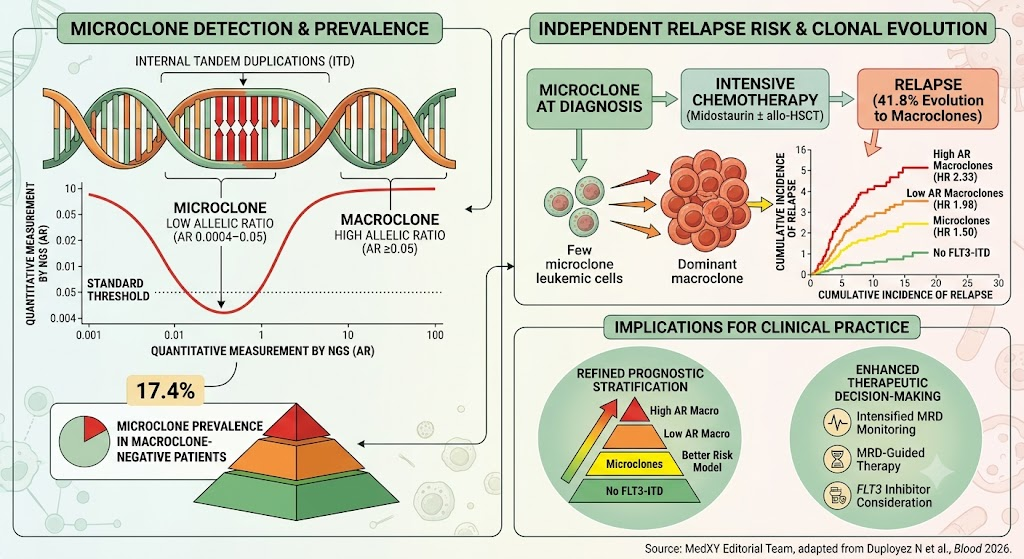
This study rigorously demonstrates that FLT3-ITD microclones—low allelic ratio subclonal mutations—are common in young adults with acute myeloid leukemia (AML) and independently associated with a significantly increased relapse risk comparable to classic FLT3-ITD macroclones. Integrating next-generation sequencing (NGS) for sensitive detection of these microclones into standard diagnostic workflows could refine prognostic stratification and impact therapeutic decision-making.
Key highlights include:
FLT3-ITD microclones detected in 17.4% of patients without macroclones by NGS.
Both microclones and macroclones independently elevated relapse risk, even after accounting for established prognostic factors and treatments.
Relapses in patients with microclones frequently evolved to FLT3-ITD macroclones, implying clonal expansion during disease progression.
Current AML risk models may underestimate risk in microclone-positive patients, supporting guideline updates.
Study Background
Acute myeloid leukemia (AML) is a heterogeneous hematologic malignancy characterized by clonal proliferation of immature myeloid cells. Among genetic alterations, internal tandem duplications of the FLT3 gene (FLT3-ITD) are prominent and known to impact prognosis and treatment outcomes. Traditional risk stratification classifies FLT3-ITD mutations largely by allelic ratio (AR), where clones with AR ≥0.05 (macroclones) confer poorer prognosis and guide therapy intensification, including targeted FLT3 inhibition and allogeneic hematopoietic stem cell transplantation (allo-HSCT).
However, the clinical relevance of low-frequency FLT3-ITD subclones (microclones with AR between 0.0004 and 0.05) has been unclear. Standard diagnostic assays often lack sensitivity to detect these subclones, potentially leading to underestimation of relapse risk. With the advent of next-generation sequencing (NGS), more sensitive detection is feasible, enabling this study to explore the prognostic impact of FLT3-ITD microclones in a large, well-characterized cohort.
Study Design
The analysis was conducted as a post hoc investigation using data from 1,733 young adults with newly diagnosed AML enrolled in the Backbone Intergroup 1 trial (ClinicalTrials.gov: NCT02416388). Patients received intensive chemotherapy regimens, with some treated with midostaurin, a FLT3 inhibitor, and others undergoing allo-HSCT based on clinician decisions and risk profiles.
FLT3-ITD mutations were assessed by NGS, allowing quantitative measurement of allelic ratios down to 0.0004. Patients were categorized as having no FLT3-ITD, microclones (AR 0.0004–0.05), or macroclones (AR ≥ 0.05). The primary endpoint was relapse risk, with secondary analyses examining measurable residual disease (MRD) levels, overall survival, and clonal evolution at relapse.
Key Findings
FLT3-ITD microclones were detected in 17.4% of patients originally classified as FLT3-ITD-negative by conventional assays, indicating a substantial prevalence of these low-level subclones. Importantly, both microclones and macroclones were independently associated with an increased relapse risk:
Cause-specific hazard ratio (HR) for relapse was 1.50 (95% CI, 1.18–1.91) for microclones, 1.98 (1.50–2.62) for low AR macroclones, and 2.33 (1.69–3.22) for high AR macroclones.
The 2-year cumulative incidence of relapse was 45.1% for microclones, 42.5% for macroclones, and 29.4% for FLT3-ITD-negative patients.
In patients harboring co-occurring NPM1 mutations, FLT3-ITD microclones similarly conferred increased MRD burden and relapse risk but did not independently affect overall survival after adjusting for MRD. This suggests MRD mediates much of the prognostic impact of these mutations.
Crucially, clonal analysis of paired diagnosis-relapse samples showed that 41.8% of relapsed cases with microclones at diagnosis evolved to display macroclones at relapse. This finding underscores the potential for microclones to expand under selective pressures such as chemotherapy, progressing to dominant clones driving relapse.
The prognostic significance of microclones was independent of other key clinical covariates, including age, baseline white blood cell count, co-mutations, exposure to midostaurin, and allogeneic transplantation, supporting robustness.
Expert Commentary
This study highlights a critical gap in current AML risk assessment: the underappreciated role of low-frequency FLT3-ITD subclones. Traditionally, mutation detection thresholds have excluded these microclones, which, while below conventional diagnostic limits, have now been demonstrated as biologically and clinically relevant. Their capacity to act as a reservoir for relapse clones aligns with current understanding of clonal hematopoiesis and evolutionary dynamics in leukemia.
From a mechanistic perspective, these findings emphasize the need to consider clonal architecture, not just presence or absence of mutations, in prognostication and treatment planning. The results lend strong biological plausibility to the clinical observations, given FLT3-ITD’s known role in promoting leukemic cell proliferation.
Regarding clinical practice, integration of ultra-sensitive NGS assays for FLT3-ITD detection should be prioritized. This would enable early identification of patients at elevated relapse risk who might benefit from intensified monitoring, MRD-guided management, or FLT3 inhibitor incorporation even when macroclones are absent.
Limitations include the retrospective nature of the analysis and potential variability in treatment beyond the trial protocol. Further prospective validation and exploration of optimal therapeutic strategies for microclone-positive patients are required. Additionally, the impact on long-term overall survival remains to be fully elucidated.
Conclusion
The detection of FLT3-ITD microclones via high-sensitivity NGS technology reveals a previously underrecognized group at substantial risk of relapse among young adults with AML undergoing intensive chemotherapy. This study challenges the binary classification of FLT3-ITD status based on traditional allelic ratio thresholds and underscores the need to revise risk stratification models accordingly.
Incorporation of NGS-based FLT3-ITD microclone detection should be considered for routine diagnostic and prognostic workflows. Clinical trials investigating risk-adapted strategies and targeted therapies in patients harboring microclones are urgently warranted. The European LeukemiaNet and other guideline bodies will need to integrate these insights to optimize AML management and improve patient outcomes.
Funding and Clinical Trials
This study was supported by collaborative funding mechanisms associated with the Backbone Intergroup 1 trial. The trial is registered at ClinicalTrials.gov under identifier NCT02416388.
References
Duployez N, et al. Prognostic impact of FLT3-ITD microclones in young adults with acute myeloid leukemia treated with intensive chemotherapy. Blood. 2026 Jul 30;148(5):598-609. PMID: 42166362.
European LeukemiaNet recommendations for diagnosis and management of AML, 2017.
Lee S et al. Clonal evolution and dynamics in AML: implications for prognosis and therapy. Leukemia. 2022.
Ravandi F. FLT3 inhibitors in AML: current status and future perspectives. HemaSphere. 2021.
This article was created using several editorial tools, including AI, as part of the process. Human editors reviewed this content before publication.