We use cookies

Our website uses essential cookies and, with your consent, additional cookies to measure performance and improve our services. Cookie Policy.

You can change your choice at any time.

MMedXYNews
HomeVideos
© 2026 MedXY
Contact usAbout usPrivacy PolicyMedXY story
MedXY AI/MedXY News/Tag: FLT3-ITD
MedXY News
EnglishTag

FLT3-ITD

Ask MedXY AI
type 2 diabetesclinical trialheart failureimmunotherapyobesitycardiovascular riskatrial fibrillationbiomarkerscritical careclinical trialsHypertensionartificial intelligenceCardiologyoncologypublic healthtype 1 diabetesdiabetesMortalityAlzheimer's diseasecardiovascular diseasebreast cancerepidemiology

Latest news

Tag

ELN‑DAVID technical recommendations: NGS-based FLT3‑ITD MRD testing in AML — what clinicians and labs need to know
Hematology-OncologyFLT3-ITDNGS

ELN‑DAVID technical recommendations: NGS-based FLT3‑ITD MRD testing in AML — what clinicians and labs need to know

By MedXY|Aug 15, 2026

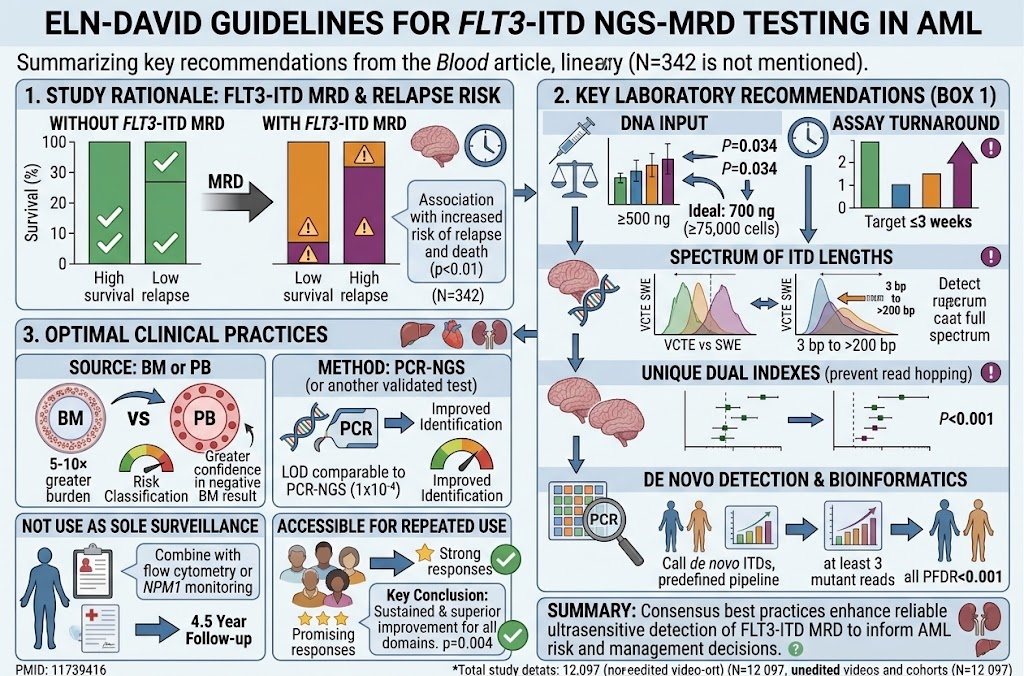
The ELN‑DAVID 2026 technical note establishes standards for NGS-based detection of FLT3‑ITD measurable residual disease (MRD) in AML, with lab validation, reporting, timing, and clinical-use recommendations to make FLT3‑ITD MRD testing acti

Unexpected Prognostic Significance of FLT3-ITD Microclones in Young Adults with Acute Myeloid Leukemia Undergoing Intensive Chemotherapy
Hematology-OncologyNext-Generation SequencingRelapse Risk

Unexpected Prognostic Significance of FLT3-ITD Microclones in Young Adults with Acute Myeloid Leukemia Undergoing Intensive Chemotherapy

By MedXY|Aug 5, 2026

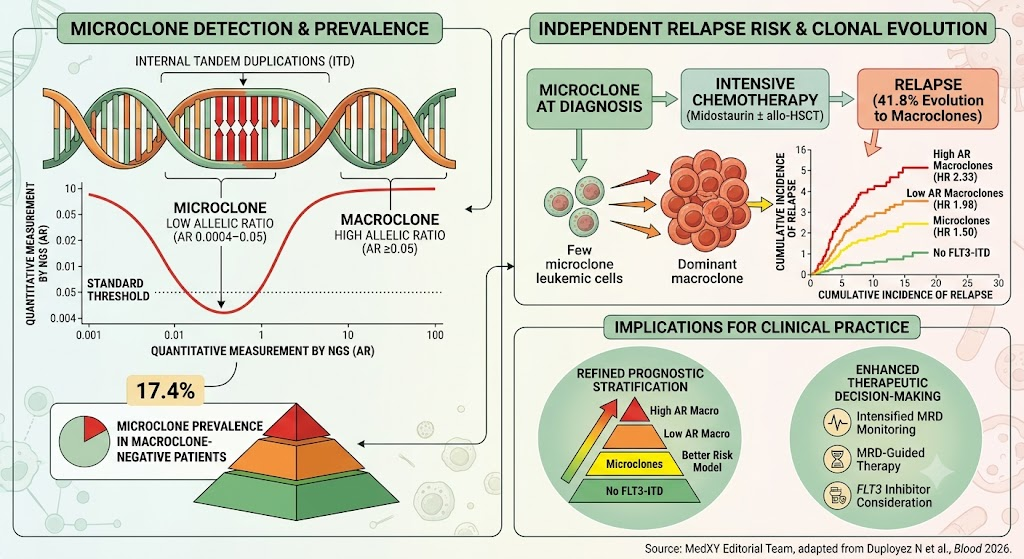
Low-level FLT3-ITD microclones, detected via NGS in young adults with AML, independently increase relapse risk comparable to macroclones, challenging current risk stratification and underscoring the need to integrate advanced genetic testin

Noncanonical FLT3-ITD Signaling Drives Immune Evasion via PKCι-STAT1–Mediated CD8+ T-Cell Exhaustion in Acute Myeloid Leukemia
Hematology-OncologyAMLCD276

Noncanonical FLT3-ITD Signaling Drives Immune Evasion via PKCι-STAT1–Mediated CD8+ T-Cell Exhaustion in Acute Myeloid Leukemia

By MedXY|Jul 15, 2026

FLT3-ITD mutations in AML promote immune evasion through a novel PKCι–STAT1 signaling axis that induces CD276-mediated CD8+ T-cell exhaustion, offering a promising target for combined FLT3 and CD276-directed therapies.

S1P Receptor Modulation Restores FLT3 Inhibitor Sensitivity in NRAS-Mutated FLT3-ITD Acute Myeloid Leukemia
Hematology-OncologyAMLfingolimod

S1P Receptor Modulation Restores FLT3 Inhibitor Sensitivity in NRAS-Mutated FLT3-ITD Acute Myeloid Leukemia

By MedXY|Jun 4, 2026

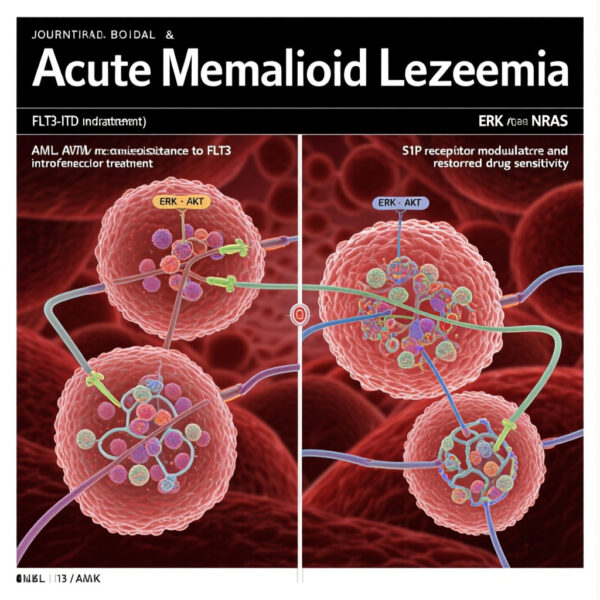
Preclinical data suggest fingolimod and mocravimod can resensitize NRAS-mutated FLT3-ITD AML to FLT3 inhibitors by suppressing ERK-SPHK1-AKT signaling, including activity in patient blasts and an orthotopic mouse model.

Comprehensive Mutational Profiling and Clinical Outcomes in Adult AML with NUP98 Rearrangement
Hematology-OncologyAMLFLT3-ITD

Comprehensive Mutational Profiling and Clinical Outcomes in Adult AML with NUP98 Rearrangement

By MedXY|May 18, 2026

Adult AML with NUP98 rearrangements is a high-risk subtype marked by frequent FLT3-ITD and WT1 mutations, poor survival, and potential benefit from FLT3 inhibitors and stem cell transplant.

Allogeneic Stem Cell Transplantation Improves Survival in High-Risk t(6;9) AML, Especially in Younger Patients and Those Achieving CR1
Hematology-OncologyAMLFLT3-ITD

Allogeneic Stem Cell Transplantation Improves Survival in High-Risk t(6;9) AML, Especially in Younger Patients and Those Achieving CR1

By MedXY|Apr 27, 2026

A large EBMT study shows allo-HSCT provides favorable 2-year survival (65.7%) in high-risk t(6;9) AML, with superior outcomes in CR1 and pediatric/AYA patients. FLT3-ITD positivity triples relapse risk but doesn’t impact overall survi

Tailoring Transplant Conditioning and Maintenance Therapy in FLT3-ITD AML: Insights on NPM1 Mutations and Measurable Residual Disease
Hematology-Oncologyacute myeloid leukemiaFLT3-ITD

Tailoring Transplant Conditioning and Maintenance Therapy in FLT3-ITD AML: Insights on NPM1 Mutations and Measurable Residual Disease

By MedXY|Nov 4, 2025

Posttransplant gilteritinib greatly benefits FLT3-ITD AML patients with NPM1 comutations, while myeloablative conditioning offers limited advantages over reduced-intensity conditioning in eradicating measurable residual disease.

Ask MedXY AI

Most popular

Intimate Health
Five Benefits for Women Continuing Sexual Activity After Menopause
Intimate Health
Why Some Women Have a Strong Sex Drive—And Why Men Shouldn't Worry About It
Nursing & care
How often should a couple have sex?
Intimate Health
Classic Intimacy Recommendations: How to Help Women Reach Orgasm and Enjoy Mutual Pleasure
Intimate Health
What Makes a Woman "Physiologically Addicted" Is Never Money, But These Two Relationship Qualities