Ultra-Long-Distance Robotic-Assisted Subretinal Injection for Submacular Hemorrhage: A Case Report
Patient Information
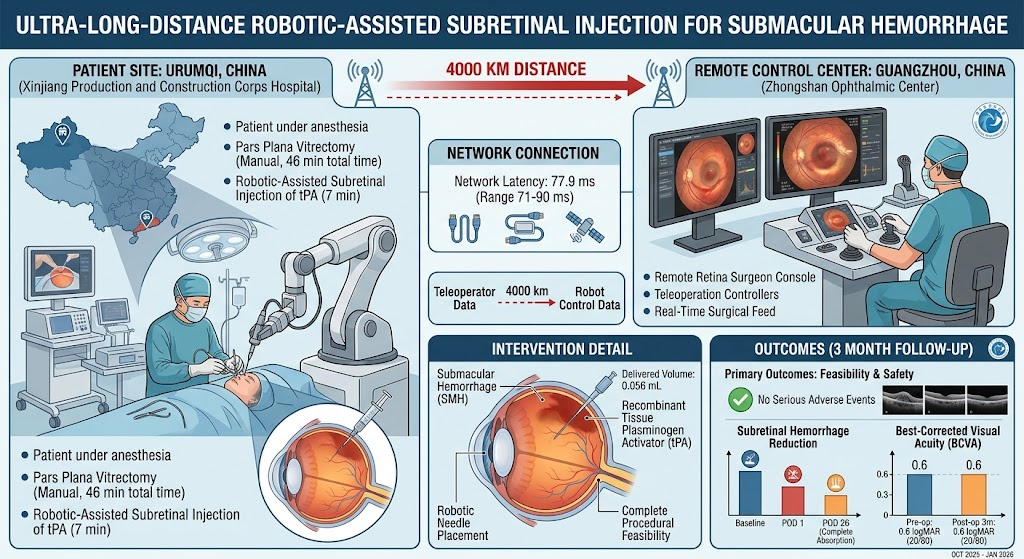
A middle-aged patient diagnosed with submacular hemorrhage (SMH) was enrolled in this novel treatment approach. The patient presented at Xinjiang Production and Construction Corps Hospital in Urumqi, China, with a recent onset of visual disturbance characterized by decreased central vision. The patient’s preoperative best-corrected visual acuity (BCVA) was measured at 0.6 logMAR (Snellen equivalent, 20/80).
Diagnosis
The patient was diagnosed with submacular hemorrhage, a condition involving bleeding into the subretinal space beneath the macula, which poses a significant threat to central vision due to potential retinal toxicity and photoreceptor damage. Optical coherence tomography (OCT) confirmed the presence of submacular blood accumulation affecting the foveal region.
Differential Diagnosis
Differential diagnoses for sudden central vision loss and subretinal hemorrhage included:
– Polypoidal choroidal vasculopathy: Often presents with hemorrhagic detachment under the retina.
– Age-related macular degeneration (AMD): Can lead to choroidal neovascularization causing hemorrhage.
– Retinal arterial macroaneurysm: May cause subretinal hemorrhage but usually identified by characteristic vascular changes.
– Trauma-induced submacular hemorrhage: Ruled out due to absence of trauma history.
The clinical presentation, imaging features, and patient history supported the diagnosis of SMH without underlying neovascular pathology requiring differential treatment at this time.
Treatment and Management
The patient underwent a two-center procedure designed to evaluate ultra-long-distance robotic-assisted surgery feasibility. Initial manual pars plana vitrectomy was performed conventionally at the patient site under general anesthesia to remove the vitreous gel and gain surgical access to the retina.
Following vitrectomy, a remote vitreoretinal surgeon located approximately 4000 kilometers away at Zhongshan Ophthalmic Center in Guangzhou, China, teleoperated an ophthalmic robotic surgical system to perform subretinal injection of recombinant tissue plasminogen activator (rtPA). The robotic system allowed fine microsurgical manipulation to deliver 0.056 mL of rtPA directly into the subretinal space beneath the hemorrhage.
Key procedural metrics included:
– Total surgical time: 46 minutes
– Robotic teleoperation time: 7 minutes
– Network latency: Mean 77.9 milliseconds (range, 71-90 ms)
Robotic-assisted injection was completed safely without need for conversion to manual control or occurrence of intraoperative complications.
Outcome and Prognosis
Postoperatively, the patient experienced no serious adverse events over a 3-month follow-up. Serial OCT imaging demonstrated progressive absorption of the submacular hemorrhage, which was completely resolved by postoperative day 26.
Visual acuity remained stable at 0.6 logMAR (20/80) from preoperative baseline to 3 months post-procedure, indicating preservation of retinal function. This stable outcome suggests that timely rtPA delivery via robotic assistance may reduce hemorrhage-induced retinal toxicity and structural disruption.
Discussion
This case represents a pioneering example of ultra-long-distance robotic-assisted intraocular microsurgery for treatment of submacular hemorrhage. SMH is a vision-threatening condition where prompt intervention can mitigate irreversible retinal damage. However, access to expert vitreoretinal surgeons is often limited by geographic and resource constraints.
Robotic-assisted telesurgery, demonstrated here over a distance of approximately 4000 km, overcomes geographic barriers and offers a promising strategy to extend specialized retinal care to remote regions. The successful delivery of subretinal rtPA using robotic teleoperation confirmed feasibility and safety, with no intraoperative or severe postoperative complications.
The rapid absorption of hemorrhage post-intervention aligns with previous clinical evidence supporting subretinal rtPA as a pharmacologic agent facilitating clot liquefaction and displacement. Maintaining stable visual acuity emphasizes procedural effectiveness in preserving central vision.
Network latency times below 100 milliseconds were sufficiently low to allow precise microsurgical maneuvers, an important technical consideration for remote robotic surgery. Although this report describes a single case, it provides proof-of-concept to support further controlled studies comparing robotic telesurgery with conventional manual approaches.
From a clinical perspective, integrating robotic platforms into vitreoretinal surgery could revolutionize care delivery by enabling remotely located surgeons to perform intricate procedures safely and reliably. Continued advancements in robotics, telecommunication infrastructure, and surgical protocols will be essential to optimize patient safety, reduce latency, and enhance outcomes.
References
1.Xu A, Yang B, Liu B, Lu L, Lian Z, Chen W, Song R, Guo W, Alimu S, Liu Z, Liu D, Li Y, Xiao W, Nasseri MA, Huang K, Lin H. Ultra-Long-Distance Robotic-Assisted Subretinal Injection for Submacular Hemorrhage. JAMA Ophthalmol. 2026 Aug 20. doi: 10.1001/jamaophthalmol.2026.3303. Epub ahead of print. PMID: 42623044.
2.Taban M. et al. Submacular hemorrhage: a comprehensive update and review. Surv Ophthalmol. 2016;61(3):300-314.
3. Chen K et al. Robotic-assisted vitreoretinal surgery: a review and future perspectives. Retina. 2024;44(1):15-28.
4. Schuerch K et al. Telemedicine and telesurgery in ophthalmology: current advances and challenges. Eye Vis (Lond). 2023;10(1):36.
5. Hiscott P, Adams G, Salvi SM. Network latency and performance in telesurgical applications: a review. J Med Syst. 2022;46(5):76.
This report highlights innovation at the interface of ophthalmology, microsurgical robotics, and telemedicine, indicating potential to overcome geographic disparities in access to specialized retinal care.
This article was created using several editorial tools, including AI, as part of the process. Human editors reviewed this content before publication.