Transforming Readmission Risk After Colorectal Surgery in Older Adults: From Nonmodifiable to Actionable Geriatric and Comorbidity Factors
Highlight
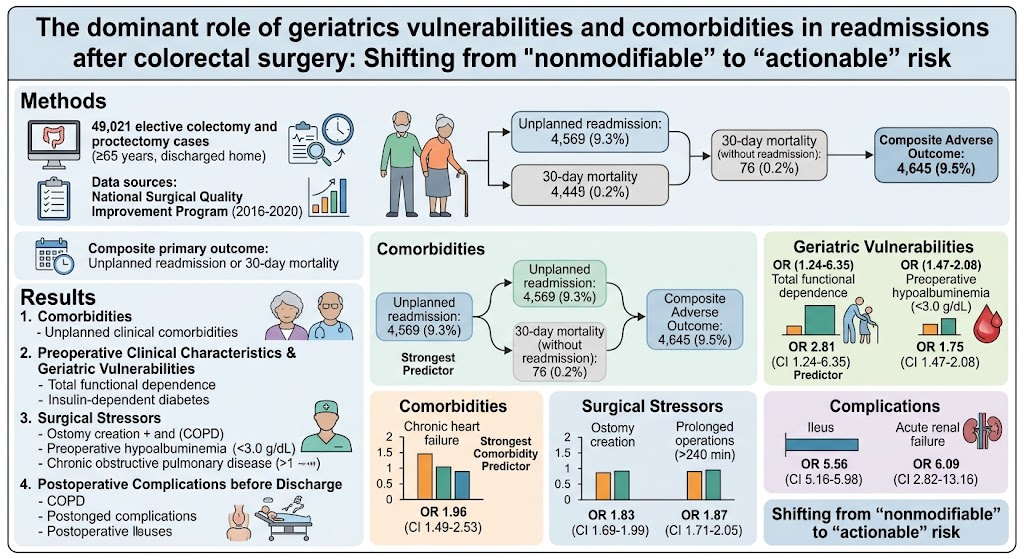
This large cohort analysis of over 49,000 older adults after elective colorectal surgery reveals that geriatric vulnerabilities—especially functional dependence and malnutrition—and chronic comorbidities such as heart failure and diabetes strongly predict unplanned 30-day readmission or mortality. Importantly, certain surgical factors and postoperative complications also contribute but may be less dominant. This shifts the paradigm from viewing risk as “nonmodifiable” to identifying actionable factors amenable to intervention.
Key actionable risks include nutritional optimization, stringent management of comorbidities, and tailored postdischarge support. These findings challenge clinicians to apply holistic, multidisciplinary approaches to perioperative care in older surgical patients to improve outcomes and reduce healthcare burdens.
Study Background
Unplanned readmission after colorectal surgery is a prevalent and costly challenge in geriatric surgical populations, occurring in approximately 20% of patients aged 65 and above. These readmissions represent not only patient morbidity and mortality risks but also impose a significant strain on healthcare systems. While some risk factors for readmission have traditionally been considered “nonmodifiable,” such as advanced age and baseline comorbidities, recent attention has focused on identifying which factors may be actionable to inform preventative strategies. Understanding the interplay between patient vulnerabilities, surgical challenges, and postoperative complications is crucial to tailoring interventions that optimize recovery and reduce readmissions.
Study Design
This retrospective cohort study utilized data from the American College of Surgeons National Surgical Quality Improvement Program (NSQIP) database, encompassing 49,021 patients aged 65 years or older who underwent elective colectomy or proctectomy procedures between 2016 and 2020. Inclusion criteria required initial discharge to home, excluding those discharged to skilled nursing or rehabilitation facilities to focus on patients presumably able to manage care independently. The primary composite outcome was unplanned readmission or death within 30 days post-discharge.
Risk factors were categorized into four domains: (1) pre-existing comorbidities, (2) preoperative clinical and geriatric vulnerabilities, (3) intraoperative surgical stressors, and (4) postoperative complications prior to discharge. Logistic regression models assessed the independent association of these variables with the primary outcome, providing adjusted odds ratios (OR) and 95% confidence intervals (CI).
Key Findings
The cohort experienced a 9.3% unplanned readmission rate and an additional 0.2% 30-day mortality without prior readmission, totaling 9.5% composite adverse outcome.
Comorbidities
Among chronic conditions, congestive heart failure emerged as the strongest predictor of adverse outcomes (OR 1.96, 95% CI 1.49-2.53). Insulin-dependent diabetes (OR 1.52, 95% CI 1.35-1.7) and chronic obstructive pulmonary disease (OR 1.38, 95% CI 1.23-1.55) were also significantly associated with increased risk. These findings underscore the impact of systemic chronic disease burden on surgical recovery.
Geriatric Vulnerabilities
Total functional dependence prior to surgery was the most robust predictor of readmission or death among geriatric factors (OR 2.81, 95% CI 1.24-6.35). Preoperative hypoalbuminemia (<3.0 g/dL), a marker of malnutrition and poor physiological reserve, was also strongly correlated with higher risk (OR 1.75, 95% CI 1.47-2.08). These vulnerabilities reflect frailty and diminished resilience to surgical stress, highlighting target areas for prehabilitation and nutritional support.
Surgical Stressors
Procedural factors included ostomy creation (OR 1.83, 95% CI 1.69-1.99) and prolonged operation time exceeding 4 hours (OR 1.87, 95% CI 1.71-2.05), both associated with increased readmission risk. These reflect greater surgical complexity and physiological stress, necessitating careful perioperative planning.
Postoperative Complications
Complications prior to discharge had the strongest effect sizes. Postoperative ileus significantly increased risk (OR 5.56, 95% CI 5.16-5.98), as did acute renal failure (OR 6.09, 95% CI 2.82-13.16). These acute events point to critical intervention points during hospitalization to reduce downstream readmissions.
Expert Commentary
This study delineates the multifactorial nature of postoperative readmissions in older adults, emphasizing that many previously categorized “nonmodifiable” risks are, in fact, actionable through multidisciplinary interventions. Functional status and nutritional assessment should be integral to preoperative evaluation, with targeted physical therapy and nutritional supplementation where indicated. Optimizing medical comorbidities, such as careful fluid and glycemic management, especially in patients with heart failure or insulin-dependent diabetes, can reduce perioperative complications. Furthermore, anticipating and preventing common postoperative complications such as ileus and acute kidney injury can dramatically lower readmission rates.
Limitations include the retrospective design, potential unmeasured confounding factors, and the focus on patients discharged home, which may not generalize to more frail populations discharged to facilities. Nonetheless, the large NSQIP dataset and robust statistical approach enhance the reliability of findings.
Conclusion
Unplanned readmissions following colorectal surgery in older adults are predominantly driven by a combination of geriatric vulnerabilities and comorbidities that are increasingly recognized as actionable targets. Shifting clinical focus towards comprehensive perioperative optimization—including functional assessment, nutritional support, stringent medical management, and complication prevention—offers a promising path to reduce adverse outcomes and healthcare utilization. Future prospective studies and intervention trials are warranted to validate strategies that integrate these findings into routine surgical care for the aging population.
Funding and Clinical Trials
The study utilized data from the NSQIP program with no additional external funding reported. No active clinical trials related to this analysis were identified.
References
- Cizginer S, et al. The dominant role of geriatrics vulnerabilities and comorbidities in readmissions after colorectal surgery: Shifting from “nonmodifiable” to “actionable” risk. Surgery. 2026 Apr 21;196:110263. PMID: 42321024.
- Makary MA, et al. Frailty as a predictor of surgical outcomes in older patients. J Am Coll Surg. 2010;210(6):901-8.
- Henderson WB, et al. Surgical Risk Adjustment With Functional Status. Surgery. 2015;157(4):623-9.
- Shahrokni A, et al. Frailty and surgical outcomes in older adults. JAMA Surg. 2017;152(12):1117-1124.
- Fleisher LA, et al. 2014 ACC/AHA guideline on perioperative cardiovascular evaluation and management of patients undergoing noncardiac surgery. Circulation. 2014;130(24):e278-e333.
This article was created using several editorial tools, including AI, as part of the process. Human editors reviewed this content before publication.