The FDA’s First AI Warning Letter: A Watershed Moment for Life Sciences Compliance
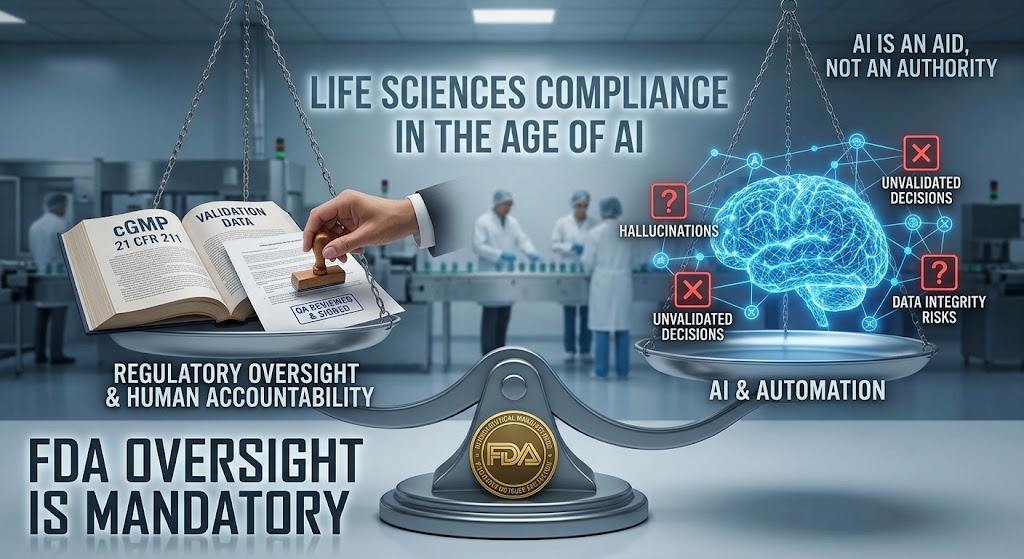
Introduction: The Collision of AI Hype and Life Sciences Compliance
The rapid adoption of artificial intelligence has officially collided with strict pharmaceutical regulation. On April 2, 2026, the U.S. Food and Drug Administration (FDA) issued its first-ever warning letter explicitly citing AI misuse as a cGMP violation to Purolea Cosmetics Lab. This historic enforcement action marks a dramatic regulatory shift, serving as a clear signal that unmonitored AI usage in quality operations will face direct compliance penalties.
Case Analysis: How AI Turned a GMP Quality System into a "Hallucination Disaster"
At Purolea Cosmetics Lab, autonomous AI agents were deployed to draft critical compliance and quality documents, including:
Drug product specifications
Standard operating procedures (SOPs)
Master production and control records
The critical compliance breakdown occurred when the company released drug products without performing mandatory process validation, operating under the assumption that the tool would notify them if validation were legally required. The FDA forcefully rejected this defense, stating under 21 CFR 211.22(c) that any AI-generated quality documentation must undergo thorough review and sign-off by qualified personnel within the Quality Unit.
"If you use AI as an aid in document creation, you must review the AI generated documents to ensure they were accurate and actually compliant with cGMP. Your failure to do so is a violation of 21 CFR 211.22(c)."
The FDA further specified that "any output or recommendations from an AI agent must be reviewed and cleared by an authorized human representative of your firm's QU [Quality Unit]."
Deep Dive: The 4 Core Vulnerabilities of AI Misuse in Life Sciences
Blind Pursuit of Cost Cutting: Under financial pressure, companies turn to AI as a shortcut to bypass the months of rigorous drafting and review traditionally required by experienced QA/RA teams. Bypassing human oversight for instant document generation fundamentally undermines cGMP principles.
Confusing Early Discovery with Strict cGMP Rules: While high error tolerance is acceptable in early drug discovery, manufacturing and pharmacovigilance demand strict adherence to ALCOA+ data integrity principles. Unvalidated automated systems cannot make quality decisions.
Algorithmic Black Boxes and Lost Traceability: Quality management requires complete auditability. AI outputs often lack controlled version tracking, source attribution, and human sign-offs, leaving companies unable to investigate root causes during product deviations or quality failures.
The Absence of Human-in-the-Loop Safeguards: Treating AI as a standalone authority rather than an assistive tool eliminates the critical layer of professional judgment, contextual awareness, and legal accountability required in regulated environments.
Regulatory Trends: Global Signals on AI Governance
The FDA's warning sets an international precedent that will rapidly extend to global authorities like the European Medicines Agency (EMA), the UK's MHRA, and Health Canada. Regulators are unified: AI can assist human professionals, but it cannot replace qualified decision-makers.
AI Compliance Matrix: Proper Application vs. Misuse
Application Area | Compliant AI Usage (Assistive Tool) | Non-Compliant AI Misuse (Standalone Authority) |
SOP & Document Creation | Generating initial drafts followed by mandatory human review and verification. | Publishing AI-generated SOPs directly into production without human review. |
Quality Oversight | Using validated AI to surface insights with source citations for QA review. | Relying on AI outputs as the sole compliance authority for batch releases. |
System Validation | Subjecting AI models to Computer System Validation (CSV) and ongoing monitoring. | Deploying unvalidated, general-purpose AI models in cGMP workflows. |
Future Compliance Strategy: 4 Steps to Mitigate AI Regulatory Risk
To navigate evolving regulatory expectations, life sciences organizations should immediately implement four safeguards:
Establish an Internal AI Policy: Define clear boundaries specifying which operations strictly prohibit unvalidated AI and where assistive AI is permitted.
Enforce Human-in-the-Loop Sign-offs: Mandate that qualified QA/RA professionals independently verify, approve, and sign off on all AI-assisted quality outputs before execution.
Apply Computer System Validation (CSV) to AI Tools: Validate data sources, model stability, and hallucination rates before integrating AI tools into quality management systems (QMS).
Upgrade Auditor and Regulatory Technical Capabilities: Train internal compliance teams to identify AI-generated document patterns and conduct targeted audits to prevent unmonitored AI usage.
Reference:
This article was created using several editorial tools, including AI, as part of the process. Human editors reviewed this content before publication.