Highlight
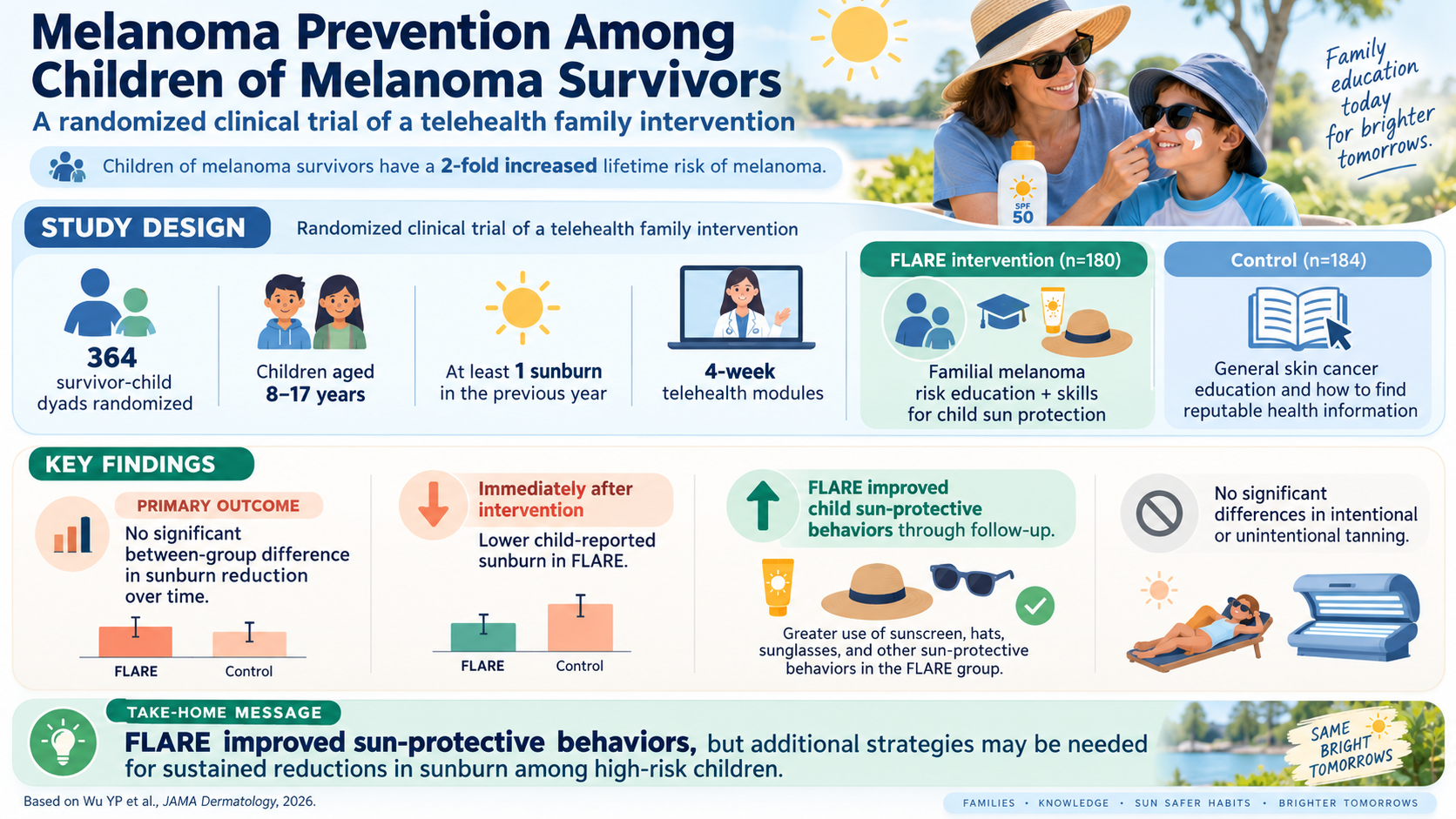
Children of melanoma survivors have double the lifetime melanoma risk but inconsistent sun protection practices.
The FLARE telehealth intervention improved sun-protective behaviors in children aged 8-17 years but did not significantly reduce sunburn rates over time compared to an educational control.
Initial postintervention reductions in sunburn were observed in the FLARE group, but these were not sustained.
Additional strategies beyond education may be necessary to achieve durable reductions in melanoma risk behaviors among high-risk pediatric populations.
Study Background
Melanoma remains a serious and potentially deadly skin cancer, with incidence rates rising in many populations globally. Early-life sun exposure and sunburns constitute major modifiable risk factors contributing to melanoma development. Children of melanoma survivors represent a distinct high-risk group with a twofold increased lifetime risk, likely due to a combination of genetic predisposition and shared environmental exposures. Despite this elevated risk, adherence to recommended sun protection behaviors among these children is variable, and preventable sunburns frequently occur. Given the critical window in childhood for modifying melanoma risk factors, interventions targeting this group are of high clinical and public health importance.
Study Design
This was a parallel-group randomized clinical trial conducted between April 2020 and October 2023 to assess the efficacy of a telehealth-delivered behavioral intervention aimed at improving sun protection and reducing sunburns in children of melanoma survivors. Participants were survivor-child dyads recruited via cancer registries and statewide clinical databases.
Eligible melanoma survivors had a confirmed diagnosis and one or more children aged 8 to 17 years who reported at least one sunburn in the past year. Among 520 eligible survivors, 364 dyads enrolled and completed baseline assessments before randomization: 180 dyads were assigned to the FLARE (Family, Lifestyles, Actions, and Risk Education) intervention, and 184 to an active control condition.
Both groups received telehealth education over four weeks. FLARE incorporated familial melanoma risk education along with skills-building modules focused on enhancing child sun protection. The control condition delivered general skin cancer education emphasizing how to identify reputable health information sources. The primary outcome was the change in child sunburn occurrence from baseline through two postintervention assessments. Secondary outcomes included sun-protective behaviors and tanning behaviors.
Key Findings
The study population included 364 dyads with survivor parents averaging 45.1 years of age (62.6% female) and children averaging 12.9 years (51.9% female). The intention-to-treat analysis revealed no statistically significant differences between FLARE and control groups in the trajectory of child sunburn occurrence over time.
Nevertheless, at the first postintervention assessment, children in the FLARE group reported a lower occurrence of sunburn (B = -0.17; 95% CI, -0.30 to -0.04; P = .01), suggesting an immediate beneficial effect of the behavioral intervention. Importantly, FLARE participants demonstrated significantly greater improvements in sun-protective behaviors sustained through the second postintervention assessment (B = 0.26; 95% CI, 0.14-0.38; P < .001), indicating successful modification of protective practices.
Tanning behaviors, both intentional and unintentional, were infrequent at baseline, and no significant differences emerged between groups during follow-up.
Expert Commentary
This trial addresses a critical gap in melanoma prevention by targeting a high-risk pediatric population through scalable telehealth modalities. The improvement in sun-protective behaviors achieved by FLARE supports the utility of tailored behavioral interventions incorporating familial risk education. However, the failure to sustain reductions in sunburn frequency highlights challenges inherent to behavioral interventions and the multifactorial nature of sun exposure risks.
Potential factors limiting sustained impact include behavioral fatigue, environmental and social influences, and possibly the limited duration of the intervention. Moreover, sunburn is an episodic event influenced by multiple contextual factors beyond personal behavior. These findings align with literature emphasizing the necessity for multifaceted, longitudinal approaches combining education, environmental supports (e.g., shade, policy changes), and possibly technological aids (e.g., UV exposure monitoring) to effectively mitigate sunburn risk.
Limitations of the study include reliance on self-reported sunburn and behavior data, which may be subject to recall or social desirability bias. The sample was primarily drawn from specific registries and clinical populations, possibly restricting generalizability. Further research could explore booster interventions, integration with school and community programs, and objective measures of UV exposure.
Conclusion
The FLARE telehealth intervention successfully enhanced sun-protective behaviors among children of melanoma survivors and temporarily reduced sunburn occurrence immediately after intervention. However, it did not produce sustained decreases in sunburn rates compared to an educational control, underscoring the complexity of behavior change for melanoma risk reduction in children.
Future prevention strategies should consider combining behavioral education with environmental modifications and ongoing engagement to achieve durable reductions in sunburn and, ultimately, melanoma incidence.
Funding and Trial Registration
This trial was registered at ClinicalTrials.gov under identifier NCT04201223. Funding details were provided in the original publication by Wu et al. in JAMA Dermatology.
References
Wu YP, Stump TK, Deboeck PR, Woodside LA, Moyano J, Hay JL, Aspinwall LG, Boucher KM, Grossman D, Mooney K, Leachman SA, Smith KR, Hancock SE, Wankier AP, Tercyak KP. Melanoma Prevention Among Children of Melanoma Survivors: A Randomized Clinical Trial. JAMA Dermatol. 2026 Oct 7:10.1001/jamadermatol.2026.3877. doi: 10.1001/jamadermatol.2026.3877. Epub ahead of print. PMID: 42842243; PMCID: PMC13647183.