We use cookies

Our website uses essential cookies and, with your consent, additional cookies to measure performance and improve our services. Cookie Policy.

You can change your choice at any time.

MMedXYNews
HomeVideos
MedXY AI/MedXY News/Section: news

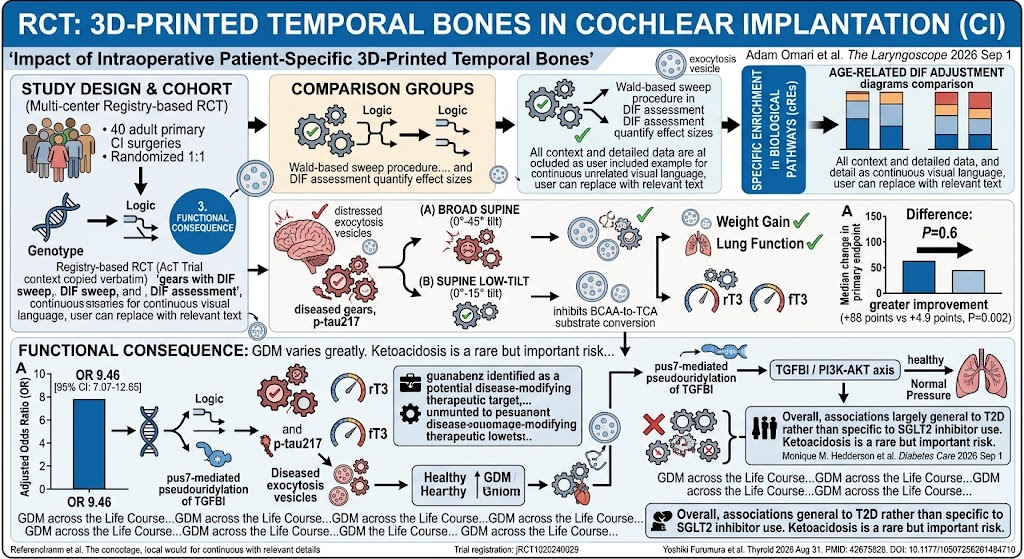
Tailoring Surgical Tools: The Differential Impact of 3D-Printed Temporal Bone Models on Cognitive Load in Cochlear Implantation
MedXY Editorial Team•Sep 5, 2026•news
Cognitive Load3D-printed modelsCấy ốc tai điện tửsurgical education

Highlight

  • Intraoperative use of patient-specific 3D-printed temporal bone models significantly reduces cognitive load for attending surgeons during cochlear implantation.
  • Trainee surgeons experience increased cognitive and physical fatigue when using 3D models intraoperatively, indicating a divergent impact based on surgical experience.
  • Fellows perceive reduced case complexity but report higher physical fatigue, suggesting an intermediate effect of 3D models on cognitive and physical demands.
  • 3D-printed models are highly valued for educational purposes and for anticipating surgical challenges and anatomical boundaries.

Study Background

MedXY registered readers

Sign in free to continue reading

Create or use your MedXY account to unlock the complete article.

This article was created using several editorial tools, including AI, as part of the process. Human editors reviewed this content before publication.

Related articles

Open language-specific specialty feeds and department pages.

Reevaluating Cochlear Implantation in Adults with Long-Term Unilateral Deafness: Evidence from a Multicenter StudyA multicenter study shows that adults with prolonged unilateral deafness benefit from cochlear implantation, with significant speech perception improvement and sustained device usage, challenging exclusion based solely on deafness duration.Sep 13, 2026Mapping Cognitive Load in Novice Surgeons: Insights Into Brain Activation and Performance Under StressThis study elucidates how escalating cognitive workload affects brain activation in novice surgical residents, revealing distinct neural patterns linked to performance resilience or decline during simulated suturing tasks.Aug 25, 20263D-Printed Temporal Bones Provide a Reliable, Objective Way to Assess Mastoidectomy Skill Across Otolaryngology TrainingA prospective single-center study found that final product analysis on 3D-printed temporal bones reliably distinguished mastoidectomy performance by residency level and may support competency-based assessment.May 11, 2026
Loading comments...
MedXY briefing

Get the free newsletter

Evidence-led clinical news, trends, and analysis—delivered to your inbox.

Ask MedXY AI

Most popular

Intimate Health
Five Benefits for Women Continuing Sexual Activity After Menopause
Intimate Health
Why Some Women Have a Strong Sex Drive—And Why Men Shouldn't Worry About It
Nursing & care
How often should a couple have sex?
Intimate Health
Classic Intimacy Recommendations: How to Help Women Reach Orgasm and Enjoy Mutual Pleasure
Intimate Health
What Makes a Woman "Physiologically Addicted" Is Never Money, But These Two Relationship Qualities
© 2026 MedXY
Contact usAbout usPrivacy PolicyMedXY story
Enhancing Surgical History-Taking Skills in Medical Students Using AI-Driven Simulated Patients: A Randomized Controlled Trial
This randomized trial shows that using a deep language learning model as a simulated patient significantly improves surgical history-taking skills and student confidence in senior medical students during clinical rotations.
Sep 14, 2025