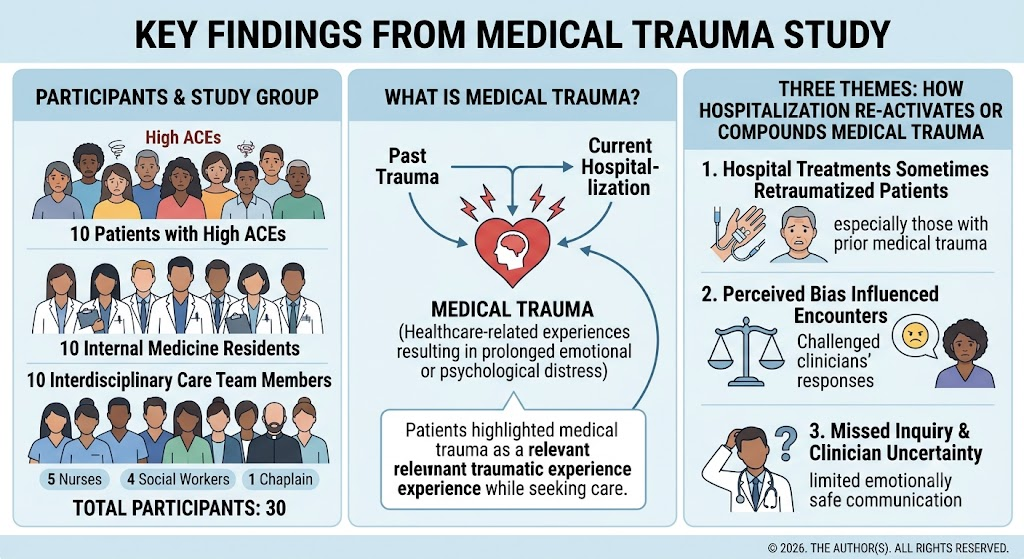
Inpatient Care Can Retraumatize Patients with Medical Trauma
Recently hospitalized adults with high ACEs describe how routine inpatient care can reactivate medical trauma. Residents and care teams identify barriers to trauma-informed communication.

Our website uses essential cookies and, with your consent, additional cookies to measure performance and improve our services. Cookie Policy.
You can change your choice at any time.
Tag

Recently hospitalized adults with high ACEs describe how routine inpatient care can reactivate medical trauma. Residents and care teams identify barriers to trauma-informed communication.


A test recall study demonstrated that the Dutch Breast Implant Registry significantly outperforms electronic patient records alone in tracing breast implants, underlining the critical role of comprehensive registries in patient safety.

Telemedicine is no longer an emergency workaround. New policy guidance shows how virtual care can improve access, but only if payment, safety, equity, and prescribing rules evolve carefully.

A large-scale retrospective study involving over 170,000 patients demonstrates that prolonged emergency department boarding significantly increases the odds of early clinical deterioration and 28-day mortality, emphasizing the urgent need f

A systematic review and meta-analysis of over 400,000 patients reveals that while older adults face higher relative risks for nerve injury and hematoma following thyroidectomy, the absolute risk remains low, confirming the procedure’s

A large-scale study of Swiss surgical patients reveals that nearly 20% of those experiencing major complications die in-hospital. Critical variations between institutions suggest that over 1,000 deaths could be avoided through improved orga

A national Swiss study reveals that 1 in 5 surgical patients experiencing major complications die, with nearly 15% of these deaths linked to institutional performance gaps rather than patient risk factors.

A cross-sectional study reveals that while 85% of Americans support licensing internationally trained surgeons to address workforce shortages, nearly 80% are reluctant to personally undergo surgery by them, highlighting a significant gap be

The EMPOWER-ED randomized clinical trial demonstrates that an electronic, patient-centered intervention significantly increases the odds of complete benzodiazepine cessation among long-term users, providing a scalable, low-cost solution for

A large-scale cross-sectional study of 51,202 admissions reveals that 35.6% of patients aged 70 and older experience cognitive morbidity, predominantly delirium. The findings underscore the urgent necessity for hospital-wide screening and m

The MANIFEST-US study of over 40,000 patients confirms that pulsed field ablation (PFA) for atrial fibrillation maintains a high safety profile in real-world U.S. clinical practice, with a major complication rate of just 0.63% and a complet

A systematic review and meta-analysis finds that real‑time automated clinical deterioration alert systems reduce in‑hospital cardiac arrests and may shorten ICU stay, but mortality benefits are uncertain and higher‑quality trials are needed

The SIPS surgical handover system significantly improves handover quality, patient vital signs, and staff safety perceptions without prolonging meeting times, enhancing safety in emergency general surgery.

A systematic review and meta-analysis of eight RCTs finds no significant safety differences between fasting and nonfasting strategies before cardiac catheterization with minimal to moderate sedation, challenging traditional practices.

A study comparing large language model-generated versus physician-generated discharge summaries found comparable quality and safety, suggesting AI-assisted documentation could reduce clinical burden without compromising patient care.