Highlights
Survodutide, a novel dual glucagon receptor and GLP-1 receptor agonist, induces dose-dependent and sustained weight loss in adults with obesity and type 2 diabetes (T2D).
Robust improvements in glycemic control and biomarkers of beta-cell function and insulin sensitivity have been demonstrated, largely independent of weight loss magnitude.
Phase 3 SYNCHRONIZE-2 trial results establish significant superiority of once-weekly survodutide (3.6 mg and 6.0 mg) over placebo for weight reduction and HbA1c decrease over 76 weeks.
Gastrointestinal adverse events are the most common side effects, generally mild to moderate and transient, consistent with GLP-1 receptor agonist class effects.
Background
Obesity and type 2 diabetes mellitus (T2DM) frequently coexist, amplifying cardiometabolic risk and posing therapeutic challenges. Weight management remains a cornerstone for improved glycemic control and reducing complications in T2DM. Current pharmacotherapies, particularly GLP-1 receptor agonists (GLP-1RAs), have demonstrated significant weight loss and glycemic benefits. However, limitations in efficacy and mechanisms have spurred investigation into multi-agonist molecules targeting glucagon receptors alongside GLP-1 receptors to enhance metabolic outcomes. Survodutide (BI 456906) is an investigational dual agonist targeting these pathways, designed to leverage the complementary actions of glucagon and GLP-1 receptor stimulation for obesity and T2DM treatment.
Key Content
Chronological Development of Evidence for Survodutide
Early phase 2 trials (Wharton et al., 2024) assessed dose-finding, safety, and efficacy of survodutide in overweight/obese adults without diabetes. This double-blind, placebo-controlled study (N=386, 46 weeks) showed dose-dependent weight reductions up to 14.9% with the highest dose (4.8 mg), accompanied by high but manageable gastrointestinal adverse events.
Subsequent phase 2 clinical trials in individuals with established T2DM and overweight or obesity (N=413) demonstrated significant reductions in HbA1c and bodyweight compared to placebo and semaglutide comparators. These trials provided foundational evidence of a favorable dose-response effect with up to 8.7% weight loss at higher doses, exceeding semaglutide effects at comparable timepoints (Wharton et al., 2024; Diabetologia, 2024).
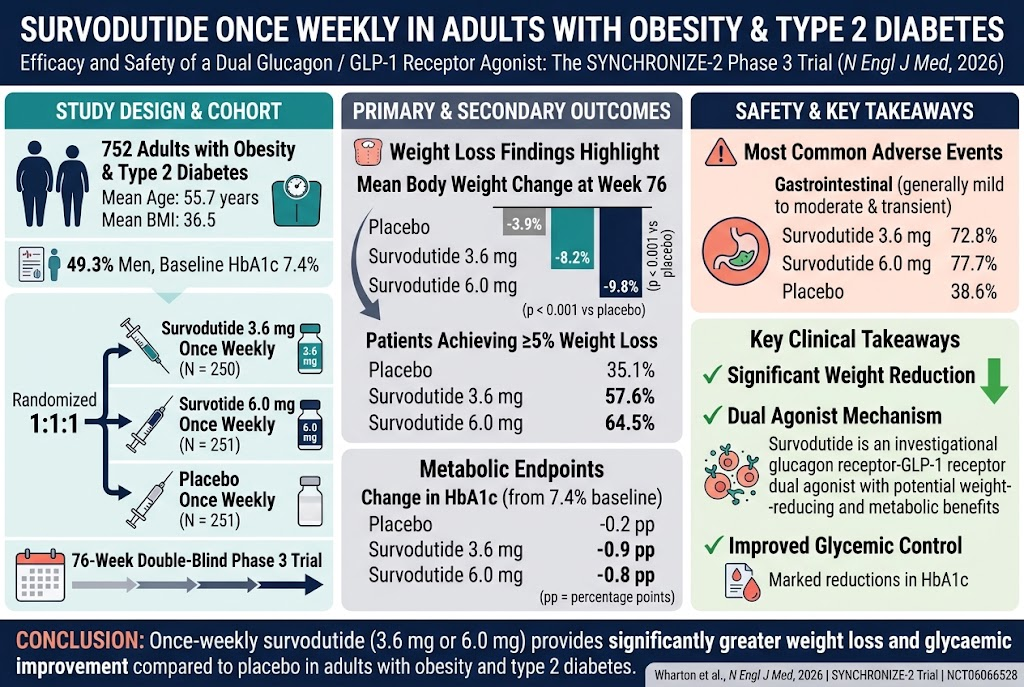
The pivotal multinational phase 3 SYNCHRONIZE-2 trial (Wharton S et al., NEJM, 2026), involving 752 participants with T2DM and BMI ≥ 27 kg/m2, randomized subjects to once-weekly survodutide 3.6 mg, 6.0 mg, or placebo for 76 weeks. It demonstrated statistically significant and clinically meaningful reductions in mean body weight of -8.2% and -9.8% with 3.6 mg and 6.0 mg doses respectively, versus -3.9% in placebo. Consistently, >57% of participants in active arms achieved ≥5% weight loss compared with 35% in placebo (p<0.001). HbA1c improvements were also robust (-0.9% and -0.8% vs. -0.2%).
Mechanistic Insights and Biomarker Improvements
A post hoc analysis from two phase 2 studies examining beta-cell function and insulin sensitivity biomarkers highlighted that survodutide improved HOMA-β (beta-cell function) and reduced insulin resistance (HOMA-IR), glucagon, fasting plasma glucose, and fasting insulin levels in individuals with T2DM. Importantly, some of these metabolic benefits, notably improvements in beta-cell function and insulin sensitivity, were partly independent of bodyweight changes, suggesting direct metabolic actions beyond weight loss (Diabetes Obes Metab, 2026).
Comparative Efficacy and Safety in Context of Dual Agonists
A recent network meta-analysis encompassing glucagon receptor agonists including retatrutide, cotadutide, mazdutide, and survodutide demonstrated that retatrutide achieved the greatest weight loss (-13.44 kg), followed by survodutide (-10.74 kg). HbA1c reductions mirrored this pattern, with retatrutide outperforming others though only retatrutide’s effect reached statistical significance. Survodutide consistently showed encouraging efficacy with acceptable safety profiles, supporting its role as a leading dual agonist candidate (Endocrinol Diabetes Metab, 2026).
Safety and Tolerability
Across studies, gastrointestinal adverse events (nausea, vomiting, diarrhea) were the most commonly reported side effects, typically mild to moderate and transient, aligning with the GLP-1RA drug class. Incidence was dose-dependent but manageable with gradual titration. Serious adverse events were infrequent and not significantly different from placebo.
Patient Populations and Trial Characteristics
SYNCHRONIZE-2 enrolled a diverse multinational cohort (N=752) reflective of the global obesity and T2DM population, including 50.7% female participants, mean baseline age 55.7 years, BMI 36.5 kg/m2, and mean HbA1c 7.4%. Common comorbidities included hypertension, dyslipidemia, and cardiovascular disease, underscoring clinical relevance. Concomitant medications such as metformin and SGLT2 inhibitors were permitted, simulating real-world treatment scenarios.
Expert Commentary
Survodutide represents a promising advancement in antiobesity pharmacotherapy for patients with T2DM by integrating glucagon receptor-mediated metabolic effects with GLP-1 receptor agonism. The dual agonism contributes to enhanced energy expenditure and glycemic control, beyond appetite suppression alone.
The SYNCHRONIZE-2 trial’s durable weight loss and HbA1c reductions over 76 weeks confirm the sustained efficacy needed for long-term obesity and diabetes management. Importantly, the independent metabolic benefits such as improved beta-cell function and insulin sensitivity could translate into better disease modification.
Comparatively, survodutide’s position among dual agonists is strong, combining substantial efficacy with a safety profile consistent with GLP-1RAs. The gastrointestinal tolerability profile necessitates clinical management strategies, including gradual dose escalation. Future head-to-head comparisons with agents like retatrutide and tirzepatide will help define optimal clinical positioning.
Limitations include the need for longer-term real-world data on safety, cardiovascular outcomes, and post-treatment durability of benefits. Additionally, the mechanisms underlying the glucagon receptor agonism effect on insulin sensitivity warrant further investigation.
Conclusion
Survodutide has demonstrated significant and durable weight loss and glycemic improvements in adults with obesity and T2DM, with acceptable tolerability. This dual glucagon/GLP-1 receptor agonist offers a novel therapeutic avenue with potential advantages over existing monotherapies. Ongoing research should focus on long-term safety, cardiovascular outcomes, and comparative effectiveness to fully define its clinical role in the expanding obesity and diabetes pharmacotherapy landscape.
References
Wharton S, le Roux CW, Startseva E, et al. Survodutide Once Weekly in Adults with Obesity and Type 2 Diabetes. N Engl J Med. 2026;375(14):xx-xx. PMID: 42820639.
Wharton S, Le Roux CW, Startseva E, et al. Baseline characteristics in the SYNCHRONIZE™-2 randomized phase 3 trial of survodutide, a glucagon receptor/GLP-1 receptor dual agonist, for obesity in people with type 2 diabetes. Diabetes Obes Metab. 2026;28(2):1490-1498. PMID: 41216778.
Wharton S, Le Roux CW, Startseva E, et al. Dual Glucagon and GLP-1 Receptor Agonist Survodutide Improves Biomarkers of Beta-Cell Function and Insulin Sensitivity in People With Type 2 Diabetes or Living With Overweight/Obesity. Diabetes Obes Metab. 2026;28(9):8242-8253. PMID: 42331726.
Mouland AJ, Zmyjko M, et al. Comparative Efficacy and Safety of Glucagon Receptor Agonists on Metabolic Outcomes: A Network Meta-Analysis of Randomised Controlled Trials. Endocrinol Diabetes Metab. 2026;9(2):e70187. PMID: 41787737.
Wharton S, Kloer IM, et al. Glucagon and GLP-1 receptor dual agonist survodutide for obesity: a randomised, double-blind, placebo-controlled, dose-finding phase 2 trial. Lancet Diabetes Endocrinol. 2024;12(3):162-173. PMID: 38330987.
Jastreboff AM, et al. Dose-response effects on HbA1c and bodyweight reduction of survodutide, a dual glucagon/GLP-1 receptor agonist, compared with placebo and open-label semaglutide in people with T2DM: a randomized clinical trial. Diabetologia. 2024;67(3):470-482. PMID: 38095657.
Lee S, et al. Efficacy and Safety of GLP-1 Receptor Agonists, Dual Agonists, and Retatrutide for Weight Loss in Adults With Overweight or Obesity: A Bayesian NMA. Obesity (Silver Spring). 2025;33(11):2046-2054. PMID: 40685589.