We use cookies

Our website uses essential cookies and, with your consent, additional cookies to measure performance and improve our services. Cookie Policy.

You can change your choice at any time.

MMedXYNews
HomeVideos
MedXY AI/MedXY News/Section: news

Silicone Axillary Lymphadenopathy Linked to Fourth-Generation Cohesive Breast Implant Rupture: Clinical Insights and Surgical Correlation
MedXY Editorial Team•Sep 3, 2026•news
Breast AugmentationSilicone Axillary LymphadenopathyBreast Implant RuptureFourth-Generation Cohesive Implants

Highlight

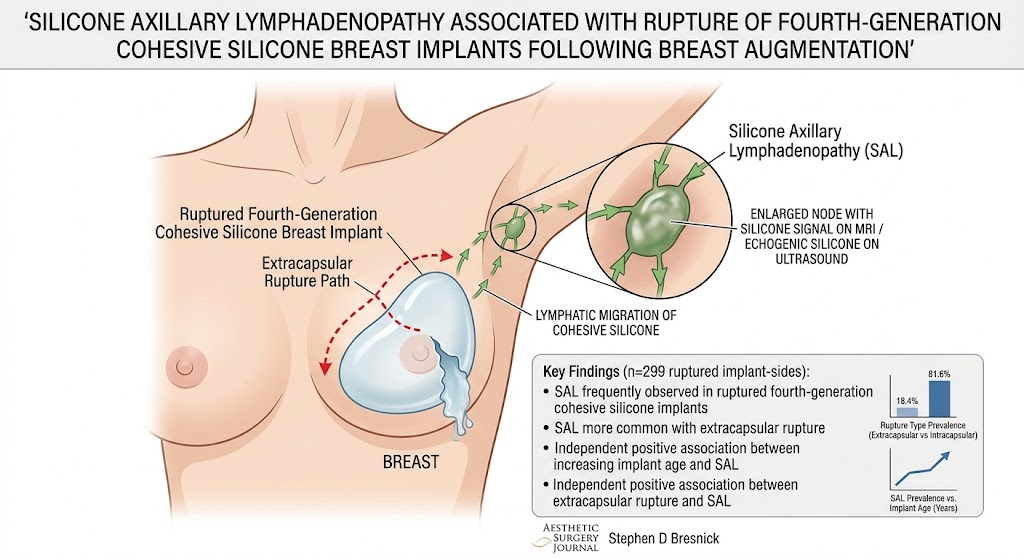
Silicone axillary lymphadenopathy (SAL) is frequently encountered in patients with ruptured fourth-generation cohesive silicone breast implants. This retrospective study involving 260 patients correlates imaging findings from MRI and ultrasound with surgical confirmations, establishing that SAL is more commonly associated with extracapsular ruptures and significantly linked to increased implant age at explantation. The study underscores the importance of incorporating implant age and rupture type into patient counseling and surgical planning.

Study Background

MedXY registered readers

Sign in free to continue reading

Create or use your MedXY account to unlock the complete article.

This article was created using several editorial tools, including AI, as part of the process. Human editors reviewed this content before publication.

Related articles

Open language-specific specialty feeds and department pages.

Tissue-Preserving Inframammary Fold Breast Augmentation: Enhancing Aesthetic Outcomes with Minimal Complications Over Three YearsThis article examines a novel tissue-preserving breast augmentation technique using inframammary fold access, reporting low complication rates and improved implant stability over a 3-year follow-up in 330 patients.Sep 3, 2026Mid- to Long-term Clinical Outcomes of B-Lite Lightweight Breast Implants in Primary Augmentation: A Prospective Multicenter StudyThis prospective multicenter study demonstrates that B-Lite lightweight breast implants offer high efficacy, exceptional patient and surgeon satisfaction, and a favorable safety profile up to five years post-implantation in primary breast aAug 20, 2026Optimizing Breast Augmentation Through Tissue Preservation and 3D Geometric Analysis: Clinical Insights and OutcomesA retrospective study validates tissue-preserving breast augmentation using 3D imaging and ultrasound, demonstrating enhanced stability, natural aesthetics, and low complication rates.Aug 12, 2026
Loading comments...
MedXY briefing

Get the free newsletter

Evidence-led clinical news, trends, and analysis—delivered to your inbox.

Ask MedXY AI

Most popular

Intimate Health
Five Benefits for Women Continuing Sexual Activity After Menopause
Intimate Health
Why Some Women Have a Strong Sex Drive—And Why Men Shouldn't Worry About It
Nursing & care
How often should a couple have sex?
Intimate Health
Classic Intimacy Recommendations: How to Help Women Reach Orgasm and Enjoy Mutual Pleasure
Intimate Health
What Makes a Woman "Physiologically Addicted" Is Never Money, But These Two Relationship Qualities
© 2026 MedXY
Contact usAbout usPrivacy PolicyMedXY story
Comparative Outcomes of Periareolar versus Inframammary Breast Augmentation in Transgender Women: A Prospective Study
This prospective study compares periareolar and inframammary breast augmentation techniques in transgender women, revealing similar complication rates and high patient satisfaction across approaches.
Aug 10, 2026