We use cookies

Our website uses essential cookies and, with your consent, additional cookies to measure performance and improve our services. Cookie Policy.

You can change your choice at any time.

MMedXYNews
HomeVideos
MedXY AI/MedXY News/Section: Cardiology

Sex-Specific Skeletal Muscle Inflammation and Dysfunction in Heart Failure with Reduced Ejection Fraction
MedXY Editorial Team•Aug 28, 2026•Cardiology
Macrophagesskeletal muscle inflammationlymphocytesmuscle dysfunctionSex Differencesheart failure

Highlight

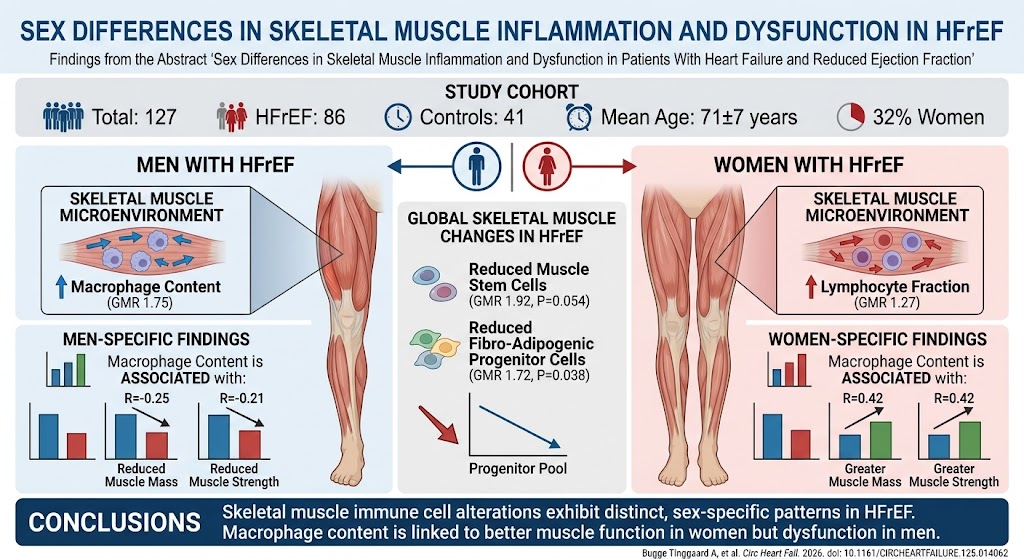
This study identifies sex-specific differences in skeletal muscle immune cell profiles in patients with heart failure with reduced ejection fraction (HFrEF). Women with HFrEF exhibit increased lymphocyte fractions, while men show elevated macrophage content in skeletal muscle. Notably, macrophage content correlates positively with muscle mass and strength in women but negatively in men, implicating distinct pathophysiological roles of immune cells contributing to muscle dysfunction in HFrEF.

Background

MedXY registered readers

Sign in free to continue reading

Create or use your MedXY account to unlock the complete article.

This article was created using several editorial tools, including AI, as part of the process. Human editors reviewed this content before publication.

Related articles

Open language-specific specialty feeds and department pages.

Bridging Evidence-Based and Personalized Medicine in Heart Failure and Cardiomyopathies: Balancing Standardization with IndividualizationThis article explores the integration of evidence-based medicine and personalized approaches in managing heart failure and inherited cardiomyopathies, proposing a framework to optimize patient care by harmonizing standardized guidelines witSep 17, 2026Cardiac Resynchronization Therapy: Metabolomic Insights into Heart Failure ImprovementThis study reveals how cardiac resynchronization therapy (CRT) improves left ventricular function in heart failure patients and modulates systemic metabolomic profiles, highlighting differences between ischemic and nonischemic cardiomyopathSep 15, 2026Heart Failure in Portuguese Adults Aged 50 and Above: Insights from the PORTHOS Study on Prevalence and Predominant PhenotypesThe PORTHOS study reveals a 16.5% prevalence of heart failure among Portuguese adults aged 50+, with HFpEF constituting over 90% of cases, mostly undiagnosed, highlighting the need for enhanced screening strategies in aging populations.Sep 15, 2026
Loading comments...
MedXY briefing

Get the free newsletter

Evidence-led clinical news, trends, and analysis—delivered to your inbox.

Ask MedXY AI

Most popular

Intimate Health
Five Benefits for Women Continuing Sexual Activity After Menopause
Intimate Health
Why Some Women Have a Strong Sex Drive—And Why Men Shouldn't Worry About It
Nursing & care
How often should a couple have sex?
Intimate Health
Classic Intimacy Recommendations: How to Help Women Reach Orgasm and Enjoy Mutual Pleasure
Intimate Health
What Makes a Woman "Physiologically Addicted" Is Never Money, But These Two Relationship Qualities
© 2026 MedXY
Contact usAbout usPrivacy PolicyMedXY story
Genetic Insights into Early Heart Failure Risk in Hypoplastic Left Heart Syndrome: Findings from the NC-DEFINE Study
A prospective study reveals that ultra-rare cardiomyopathy gene variants significantly increase risk for early heart failure in infants with hypoplastic left heart syndrome, highlighting potential for genetic risk stratification and precisi
Sep 12, 2026
Advancing Prognostic Precision in HFpEF: The LIFE-Preserved Risk Prediction ModelThe LIFE-Preserved model accurately predicts short-term and lifetime risks of heart failure hospitalization or cardiovascular death in HFpEF patients, enabling tailored clinical risk stratification and improved management.Sep 11, 2026
Sex-Specific Associations Between Adiposity and Dry Eye Disease: Insights from a Large UK Biobank StudyCentral obesity in women and high overall body fat in men are linked to increased odds of dry eye disease, with distinct metabolic pathways implicated, based on a retrospective analysis of over 480,000 UK Biobank participants.Sep 9, 2026