Response Kinetics Following CAR T-Cell Therapy for Large B-Cell Lymphoma: Insights from the LYSA DESCAR-T Registry
Highlights
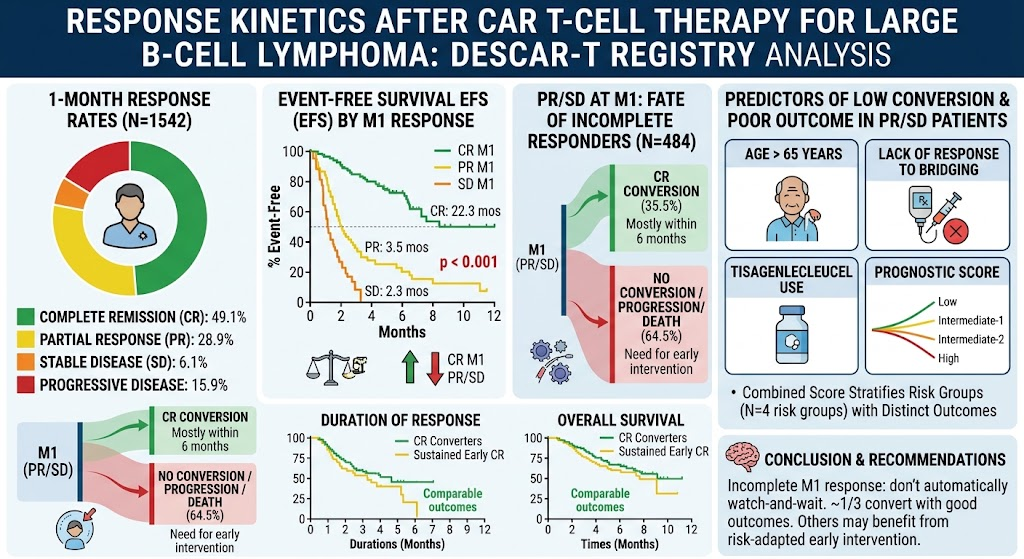
- Real-world evidence from 1542 patients confirms that nearly half achieve complete remission at one month post CAR T-cell therapy.
- About one-third of patients with initial partial or stable disease responses convert to complete remission within six months, achieving survival outcomes comparable to early responders.
- Age over 65, poor response to bridging therapy, and tisagenlecleucel use independently predict reduced conversion to complete remission, shorter event-free and overall survival.
- A novel prognostic scoring system stratifies patients with incomplete initial responses, guiding risk-adapted post-infusion management and early intervention strategies.
Background
Large B-cell lymphoma (LBCL) represents the most common aggressive non-Hodgkin lymphoma subtype, with significant unmet needs in the relapsed/refractory setting. Chimeric antigen receptor (CAR) T-cell therapy targeting CD19 epitopes has revolutionized treatment paradigms, producing durable remissions in patients who have failed multiple lines of therapy. However, the kinetics of response—specifically the timing and likelihood of transitioning from partial to complete remission—remain incompletely characterized outside controlled clinical trial settings. Understanding these dynamics is critical for optimizing post-infusion monitoring and timely intervention.
Key Content
Chronological Development and Real-World Evidence of CAR T-Cell Therapy in LBCL
The introduction of CAR T-cell therapy for LBCL has progressed from pivotal trials (e.g., ZUMA-1, JULIET) demonstrating high complete remission (CR) rates and durable responses, to broader real-world application. Initial studies reported CR rates between 40%-54% at approximately one month post-infusion, establishing early response as a crucial predictor of long-term outcomes. Subsequent registries such as DESCAR-T have expanded this understanding across unselected populations, incorporating diverse centers and bridging strategies.
Response Kinetics and Survival Outcomes from the DESCAR-T Registry
The DESCAR-T study analyzed 1542 adults with relapsed/refractory LBCL after at least two prior therapies. At one month (M1), response distribution was 49.1% CR, 28.9% partial response (PR), 6.1% stable disease (SD), and 15.9% progressive disease (PD). Median event-free survival (EFS) differed markedly based on early response: 22.3 months for CR, 3.5 months for PR, and 2.3 months for SD (p < 0.001).
Significantly, among 484 patients with incomplete responses (PR/SD) at M1, 35.5% eventually converted to CR, predominantly within six months post-treatment. These late converters achieved response durations and overall survival (OS) comparable to patients with sustained early CR, indicating the clinical importance of ongoing therapeutic benefit beyond initial assessment.
Predictors of Conversion and Outcomes
Multivariate modeling identified key factors independently associated with lower likelihood of CR conversion and worse survival outcomes:
- Age >65 years
- Lack of response to bridging therapy
- Use of tisagenlecleucel as the CAR T-cell product
Integrating these variables, the authors developed a prognostic score stratifying patients with PR/SD into four risk groups with distinct EFS and OS trajectories, enabling tailored clinical decision-making.
Translational and Clinical Implications
These findings challenge simplistic watch-and-wait approaches for patients with incomplete responses at one month, advocating instead for risk-adapted surveillance and consideration of early salvage interventions in high-risk subsets. Biologically, the delayed conversions from PR/SD to CR suggest ongoing CAR T-cell activity and tumor-immune dynamics that may be augmented by modulating the tumor microenvironment or addressing CAR T-cell persistence.
Expert Commentary
While pivotal trials have established CAR T-cell therapy as standard of care for relapsed/refractory LBCL, real-world evidence like the DESCAR-T study fills critical gaps by reflecting diverse practices and patient heterogeneity. This study’s large cohort and rigorous analysis offer valuable prognostic insights distinct from controlled trial populations.
The identification of age, bridging therapy responsiveness, and CAR product type as predictors of conversion underscores the multifactorial determinants of response kinetics. Notably, the differential impact of tisagenlecleucel vs. axicabtagene ciloleucel on outcomes aligns with prior analyses suggesting variable efficacy and toxicity profiles among CAR constructs, necessitating choice tailored to patient and disease characteristics.
Limitations include observational design and potential confounding variables inherent to registry data. Moreover, mechanistic studies delineating cellular and microenvironmental factors underlying delayed CR conversion remain warranted to inform adjunctive strategies.
Current guidelines (e.g., NCCN, ESMO) recognize the importance of post-CAR T monitoring but lack granular recommendations for managing incomplete early responses. The prognostic score developed by the DESCAR-T investigators represents a milestone toward personalized post-infusion management paradigms.
Conclusion
The DESCAR-T registry’s comprehensive assessment of response kinetics after CAR T-cell therapy in large B-cell lymphoma elucidates critical temporal patterns and prognostic markers that refine clinical management. Early incomplete response is not an absolute indicator of treatment failure; a substantial subset achieves delayed complete remission with favorable survival. Integrating patient age, bridging therapy efficacy, and CAR product into a validated prognostic tool facilitates risk-adapted strategies balancing watchful waiting and aggressive intervention.
Future directions include prospective validation of risk scores, mechanistic exploration of response dynamics, and trials testing interventions to enhance conversion rates and long-term control. These advances herald a more nuanced, tailored approach optimizing outcomes for patients receiving CAR T-cell therapy in LBCL.
References
- Manson G, Di Blasi R, Houot R, et al. Response kinetics following CAR T-cell therapy for large B-cell lymphoma: a LYSA study from the DESCAR-T registry. Bone Marrow Transplant. 2026 Aug 21. PMID: 42629429.
- Neelapu SS, Locke FL, Bartlett NL, et al. Axicabtagene ciloleucel CAR T-Cell therapy in refractory large B-Cell lymphoma. N Engl J Med. 2017;377(26):2531-2544. PMID: 29091560.
- Savage KJ, Johnson NA, Ben-Neriah S. The molecular biology of large B-cell lymphoma. J Natl Compr Canc Netw. 2020;18(9):1145-1160. PMID: 32831399.
- Wang M, Munoz J, Goy A, et al. KTE-X19 CAR T-cell therapy in relapsed or refractory mantle-cell lymphoma. N Engl J Med. 2020;382(14):1331-1342. PMID: 32196542.
- Schuster SJ, Bishop MR, Tam CS, et al. Tisagenlecleucel in adult relapsed or refractory diffuse large B-cell lymphoma. N Engl J Med. 2019;380(1):45-56. PMID: 30236336.
This article was created using several editorial tools, including AI, as part of the process. Human editors reviewed this content before publication.