Resection Margin Status in Distal Cholangiocarcinoma: Implications for Recurrence and Adjuvant Radiotherapy Selection
Highlight
Margin status after curative resection for distal cholangiocarcinoma (dCC) correlates strongly with the risk of recurrence, especially in node-negative patients.
Patients with non-clear margins—especially those with high-grade dysplasia or tumor presence—exhibit higher recurrence rates compared to those with clear margins.
Adjuvant radiotherapy significantly reduces recurrence risk in node-negative patients with involved margins, suggesting a targeted role for postoperative radiotherapy.
In node-positive patients, the resection margin status appears less prognostic, highlighting the importance of systemic chemotherapy rather than local therapies.
Study Background
Distal cholangiocarcinoma (dCC), a malignancy arising from the distal portion of the extrahepatic bile duct, presents unique challenges in surgical management and postoperative care. Although curative resection is the cornerstone of treatment, recurrence rates remain substantial. Prognostication typically involves evaluation of nodal involvement and margin status; however, the latter has been inconsistently defined and reported in Western populations. Given the rarity of dCC, robust data on the prognostic impact of resection margin status and its potential implication for adjuvant treatment decisions remain sparse. The present study aims to clarify these issues by stratifying margin status into clear margins, low-grade dysplasia (LGD), high-grade dysplasia (HGD), and tumor presence at the margin, and evaluating their impact on recurrence patterns and benefit from adjuvant radiotherapy.
Study Design
This retrospective cohort study included consecutive patients diagnosed with distal cholangiocarcinoma who underwent curative intent surgery between 2000 and 2022. Margin status was categorized into four groups based on histopathological evaluation of the bile duct resection margin: clear margin (no dysplasia or tumor), LGD, HGD, and presence of tumor at the margin. Patients were stratified also by lymph node status (node-negative versus node-positive). The primary endpoint was cumulative overall recurrence rate at 5 years postoperatively. Secondary analyses assessed the impact of adjuvant radiotherapy on recurrence rates among patients with non-clear margins.
Key Findings
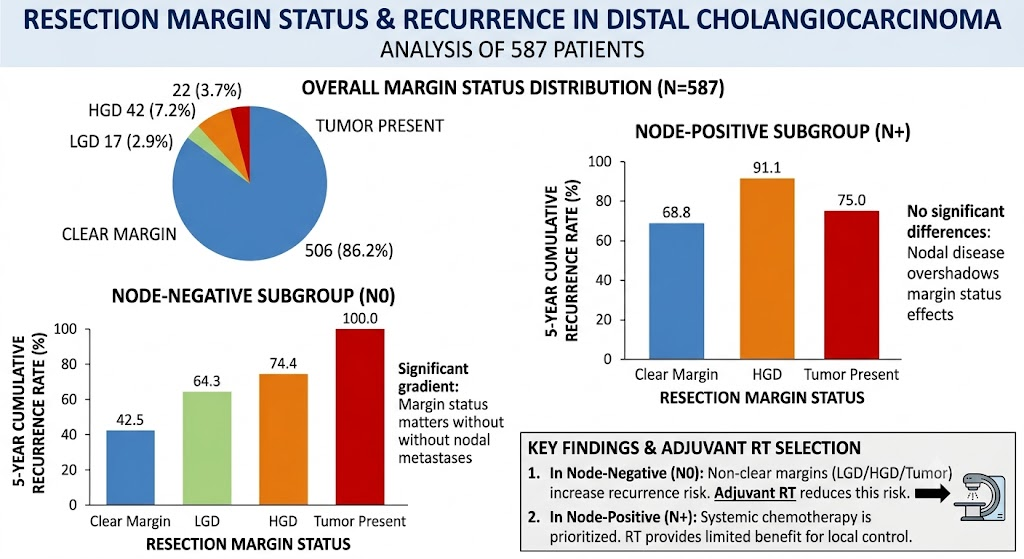
A total of 587 patients met inclusion criteria. Distribution of margin status was: clear margin in 506 patients (86.2%), LGD in 17 (2.9%), HGD in 42 (7.2%), and tumor present in 22 (3.7%).
In the node-negative subgroup, the 5-year cumulative overall recurrence rates significantly differed by margin status: clear margin patients had the lowest recurrence (42.5%), while rates increased progressively in patients with LGD (64.3%), HGD (74.4%), and tumor present at the margin (100%). This gradient underscores the prognostic importance of margin status in patients without nodal metastases.
Conversely, in the node-positive subgroup, no statistically significant differences were observed in recurrence rates across margin status groups—clear margin (68.8%), HGD (91.1%), and tumor present (75.0%)—suggesting that nodal disease may overshadow margin effects.
Importantly, among node-negative patients with involved margins (non-clear margin), those receiving adjuvant radiotherapy experienced significantly lower 5-year recurrence rates compared to those who did not (69.5% vs. 87.5%, P=0.037), indicating a potential therapeutic benefit of postoperative radiotherapy in this subgroup. No such clear benefit was described for node-positive patients.
Expert Commentary
The data address a clinically relevant question regarding the management of distal cholangiocarcinoma after resection. Surgical margin status traditionally guides adjuvant treatment decisions; however, this study refines this approach by integrating dysplasia grading at margins and nodal involvement. The finding that margin positivity markedly increases recurrence in node-negative patients validates margin status as a key stratification metric for postoperative management.
The observed benefit of adjuvant radiotherapy in node-negative patients with non-clear margins aligns with the concept of local control importance where systemic disease burden is limited. By contrast, in node-positive disease, the dominant driver of recurrence appears systemic dissemination, rendering margin-directed local therapies less impactful. This supports contemporary guidelines advocating adjuvant chemotherapy for node-positive patients and suggests a more nuanced application of radiotherapy.
Limitations inherent to retrospective design and single-institution data warrant cautious interpretation. Prospective trials or multi-institutional registries could validate these findings and refine adjuvant therapy criteria further. Mechanistically, the stepwise increase in recurrence correlating with dysplasia grade at margins provides biological plausibility, as dysplasia may represent a field defect or residual premalignant tissue capable of progression.
Conclusion
This comprehensive analysis reaffirms the prognostic value of bile duct resection margin status in distal cholangiocarcinoma, particularly in node-negative patients. Clear margins confer lower recurrence risk, while involvement by dysplasia or tumor heralds elevated relapse rates. Adjuvant radiotherapy emerges as a promising modality to reduce recurrence in node-negative patients with involved margins. Conversely, in node-positive patients, systemic chemotherapy remains crucial, with local treatments playing a limited role.
These insights inform tailored postoperative strategies to optimize outcomes in this challenging malignancy. Future studies should focus on prospective validation, refinement of margin assessment techniques, and integration of molecular markers to enhance personalized therapy selection.
Funding and ClinicalTrials.gov
The study was supported by institutional funding. No clinical trials registration was indicated for this retrospective cohort study.
References
1. Yun WG, Chae YS, Han Y, et al. Impact of Resection Margin Status on Recurrence and Possible Candidates for Adjuvant Radiotherapy in Resected Distal Cholangiocarcinoma. Ann Surg. 2025;284(2):363-370. doi:10.1097/SLA.0000000000005324
2. Bridgewater JA, Galle PR, Khan SA, et al. Guidelines for the diagnosis and management of intrahepatic cholangiocarcinoma. J Hepatol. 2014;60(6):1268-1289.
3. Valle JW, Kelley RK, Nervi B, Oh DY, Zhu AX. Biliary tract cancer. Lancet. 2021;397(10272):428-444.
This article was created using several editorial tools, including AI, as part of the process. Human editors reviewed this content before publication.