Highlight
This article summarizes results from two large-scale, phase 3 clinical trials, REMODEL-1 and REMODEL-2, that compared remibrutinib, a potent oral Bruton’s tyrosine kinase (BTK) inhibitor, to teriflunomide in adult patients with relapsing multiple sclerosis (MS). Both trials demonstrated that remibrutinib significantly reduced annual relapse rates compared to teriflunomide, while maintaining a favorable safety profile and fewer adverse events leading to treatment discontinuation.
Study Background
Multiple sclerosis is a chronic, immune-mediated disease of the central nervous system characterized by inflammation, demyelination, and neurodegeneration. Relapsing multiple sclerosis, defined by episodic neurological dysfunction, represents a significant burden with high morbidity and impact on quality of life. Current oral therapies, including teriflunomide, modulate immune responses but present limitations related to efficacy and tolerability. Advances in understanding B cell involvement in MS pathophysiology have highlighted BTK as a promising therapeutic target. Remibrutinib is a highly selective, covalent BTK inhibitor with the capacity to penetrate the CNS, potentially addressing both peripheral and central inflammatory pathways.
Study Design
REMODEL-1 and REMODEL-2 are two identically designed phase 3 clinical trials conducted in parallel across 407 sites in 46 countries. Both were randomized, double-blind, double-dummy, active-comparator controlled, parallel-group, and event-driven. Eligible patients were adults aged 18–55 years with relapsing MS (Expanded Disability Status Scale [EDSS] 0–5.5) and recent disease activity. Participants were randomized 1:1 to receive oral remibrutinib 100 mg twice daily or teriflunomide 14 mg once daily. Randomization was stratified by geographic region, MRI cohort participation, and MS subtype. The primary endpoint was the annualized relapse rate (ARR), assessed over a maximum of 30 months. The trials are registered at ClinicalTrials.gov under identifiers NCT05147220 and NCT05156281 and remain ongoing but are no longer recruiting.
Key Findings
Between December 2021 and December 2025, 2632 patients were screened and 2007 enrolled, with comparable demographics in both trials (mean age approx. 38.5 years, roughly two-thirds female). REMODEL-1 enrolled 1000 patients (502 remibrutinib, 498 teriflunomide) and REMODEL-2 enrolled 1007 patients (504 remibrutinib, 503 teriflunomide).
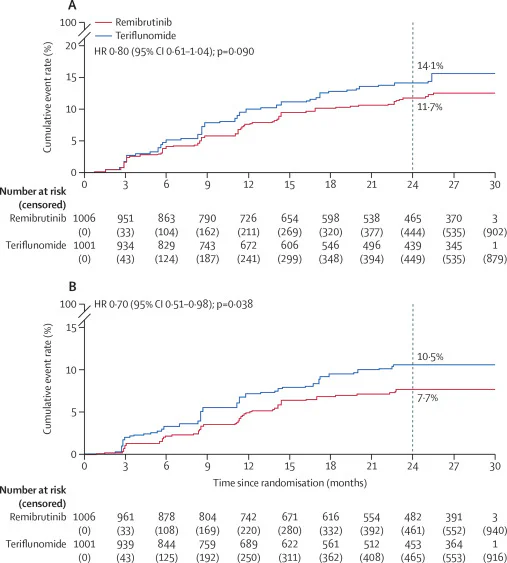
In REMODEL-1, remibrutinib reduced ARR to 0.073 relapses/year compared to 0.112 with teriflunomide, representing a statistically significant 35.2% relative reduction (rate ratio [RR] 0.648; 95% CI 0.453–0.927; p=0.018). REMODEL-2 showed similar results, with an ARR of 0.080 for remibrutinib versus 0.116 for teriflunomide, a 31.2% reduction (RR 0.688; 95% CI 0.487–0.972; p=0.034).
Safety analyses revealed the most common adverse events for remibrutinib included upper respiratory tract infection (13.1%), nasopharyngitis (9.1%), diarrhea (8.3%), and alopecia (5.8%), with lower incidences across these categories compared to teriflunomide (13.7%, 12.3%, 10.9%, and 13.5%, respectively). Importantly, adverse events leading to discontinuation were significantly lower with remibrutinib (3.1%) compared to teriflunomide (5.8%). No new or unexpected safety signals emerged for remibrutinib, including no liver safety concerns, aligning with its safety profile observed in other indications.
Expert Commentary
The findings from REMODEL-1 and REMODEL-2 reinforce BTK inhibition as a viable strategy in relapsing MS, addressing B cell and myeloid cell-mediated inflammation both systemically and within the CNS. The oral administration and CNS penetrance of remibrutinib may provide distinct advantages over current immunomodulatory therapies. The magnitude of relapse reduction, along with a lower adverse event burden, suggests improved patient tolerability and adherence potential. However, longer-term data including disability progression and MRI outcomes will be essential to fully characterize the drug’s impact on neurodegeneration and long-term disease evolution. Additionally, heterogeneity in patient populations and treatment histories requires consideration when extrapolating results.
Conclusion
Remibrutinib demonstrated superior efficacy in reducing relapse rates compared to teriflunomide in adults with relapsing multiple sclerosis, supported by a favorable safety and tolerability profile. These phase 3 data advance remibrutinib as a promising, novel oral therapeutic option targeting BTK, with potential to enrich the armamentarium for relapsing MS management. Ongoing follow-up and further studies will clarify its role in altering disease course and improving patient outcomes over longer time horizons.
Funding and Trial Registration
The trials were funded by Novartis. REMODEL-1 and REMODEL-2 are registered on ClinicalTrials.gov under NCT05147220 and NCT05156281, respectively.
References
Wiendl H, Bermel R, Airas L, et al. Remibrutinib versus teriflunomide in relapsing multiple sclerosis (REMODEL-1 and REMODEL-2): two randomised, phase 3 trials. Lancet. 2026 Oct 23. PMID: 42915009. https://pubmed.ncbi.nlm.nih.gov/42915009/