Highlight
The Re-entry Continuum for Brain Injury (RCBI) intervention significantly lowers recidivism rates among incarcerated men with traumatic brain injury (TBI) up to 3 years postrelease.
RCBI participants demonstrated improved brain injury coping skills and executive functioning compared to treatment as usual (TAU) controls.
The intervention reduced behavioral infractions during incarceration, reflecting better behavioral control and adjustment.
No significant changes were found in aggression or hostility measures, indicating targeted benefits specifically on cognitive and coping domains.
Study Background
Traumatic brain injury (TBI) is highly prevalent among incarcerated populations, contributing to cognitive, emotional, and behavioral impairments that can increase the risk of recidivism. These impairments often include deficits in executive functioning, self-regulation, and coping abilities, which hinder successful community reintegration postrelease. Traditional correctional treatment programs rarely address the unique needs of individuals with TBI, perpetuating high rates of reincarceration and poor outcomes. There is a critical need for tailored interventions that provide specialized support both before and after release to reduce recidivism and improve quality of life for this vulnerable population.
Study Design
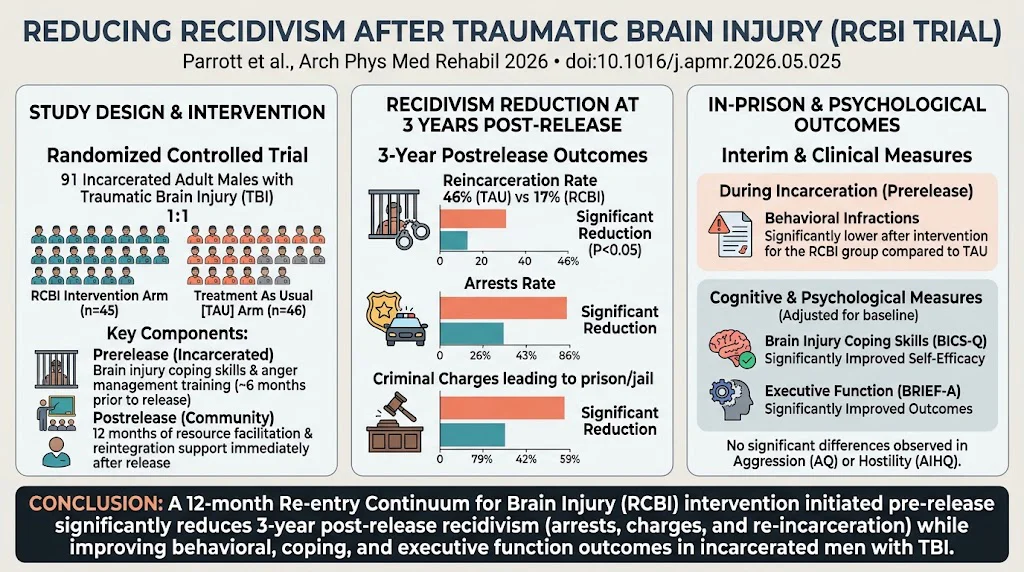
This was a randomized controlled trial assessing the efficacy of the Re-entry Continuum for Brain Injury (RCBI) intervention compared with treatment as usual (TAU) in incarcerated men with documented TBI. The study enrolled 91 participants who were 5 to 8 months from their anticipated release date, randomly assigned to RCBI (n=45) or TAU (n=46).
The RCBI intervention began approximately 6 months before release and consisted of two components: an in-prison program teaching brain injury coping skills and anger management, followed by 12 months of resource facilitation in the community postrelease. Resource facilitation included linkage to healthcare and social services to support community reintegration.
Assessments occurred at multiple time points: approximately 6 months pre-release (baseline), near release, 2 weeks postrelease, and 1, 2, and 3 years postrelease. Outcomes evaluated included recidivism (reincarceration, arrests, criminal charges), behavioral infractions during incarceration, self-efficacy for brain injury coping, aggression, hostility, and executive functioning.
Key Findings
At 3 years postrelease, RCBI participants showed profoundly reduced rates of recidivism compared to TAU:
Return to prison: 17% in RCBI vs 46% in TAU
Arrests: 43% vs 86%
Criminal charges resulting in jail/prison: 42% vs 79%
These outcome differences are both statistically and clinically significant, demonstrating durable long-term benefits of the intervention.
Behavioral infractions while incarcerated decreased over time in both groups but were significantly lower following the intervention in the RCBI group. These positive behavioral changes during incarceration suggest that the coping skills and anger management training had immediate benefits.
On psychological assessments, after adjusting for baseline differences, RCBI participants scored significantly better on the Brain Injury Coping Skills Questionnaire (BICS-Q), reflecting improved self-efficacy in managing TBI-related challenges. They also exhibited superior executive functioning as measured by the Behavior Rating Inventory of Executive Function-Adult version (BRIEF-A), highlighting enhanced cognitive control and regulation capacities.
No significant differences were observed between groups on the Aggression Questionnaire (AQ) or the Ambiguous Intentions Hostility Questionnaire (AIHQ), indicating that the intervention’s effects were domain-specific rather than global reductions in aggression or hostility.
Expert Commentary
The RCBI trial addresses a critical, often overlooked intersection between neuroscience, correctional health, and public safety. The high burden of TBI in justice-involved individuals complicates rehabilitation efforts due to cognitive impairments that conventional programs do not sufficiently accommodate. By implementing a structured, TBI-focused intervention starting pre-release and extending into community reentry, this study provides a compelling model for reducing recidivism through cognitive-behavioral skill acquisition and sustained resource support.
Limitations include a relatively small sample size and male-only participants, which may affect generalizability. Future research should explore adaptation for female populations, diverse correctional settings, and potentially integrate neurorehabilitation techniques to further optimize outcomes.
Conclusion
Individuals with TBI represent a vulnerable subgroup within the justice system at elevated risk for recidivism due to cognitive and behavioral sequelae of brain injury. The RCBI intervention, encompassing pre-release brain injury coping and anger management training plus postrelease resource facilitation, effectively reduces reincarceration rates and enhances coping self-efficacy and executive functioning. These findings underscore the importance of tailored neurorehabilitation-informed programming within correctional and community contexts to promote successful reintegration and reduce the societal and personal costs of recidivism in this population.
Funding and Clinical Trials Registration
Information on funding sources was not provided in the original publication. The trial details and registration status should be verified via corresponding clinical trial registries.
References
Parrott D, Neumann D, Laffoon A. Reducing Recidivism After Traumatic Brain Injury: Results From the Re-entry Continuum for Brain Injury (RCBI) Trial. Arch Phys Med Rehabil. 2026;107(10):2879-2887. PMID: 42270028.
Marsh NV, Keogh J. The Neurorehabilitation of Offenders With Traumatic Brain Injury: A Systematic Review. Brain Inj. 2020;34(1):3-13.
Kreutzer JS, Seel RT, Gourley EJ. The Prevalence and Impact of Traumatic Brain Injury in the Criminal Justice System. J Head Trauma Rehabil. 2023;38(3):171-181.