We use cookies

Our website uses essential cookies and, with your consent, additional cookies to measure performance and improve our services. Cookie Policy.

You can change your choice at any time.

MMedXYNews
HomeVideos
MedXY AI/MedXY News/Section: Hematology-Oncology

Recent Mechanical Venous Thrombosis Risk Factors and Their Role in Young-Onset Cryptogenic Ischemic Stroke

MedXY Editorial Team•Aug 29, 2026•Hematology-Oncology
cryptogenic ischemic strokemechanical risk factorsPatent Foramen Ovalevenous thrombosis risk factorsYoung Adults
Highlight

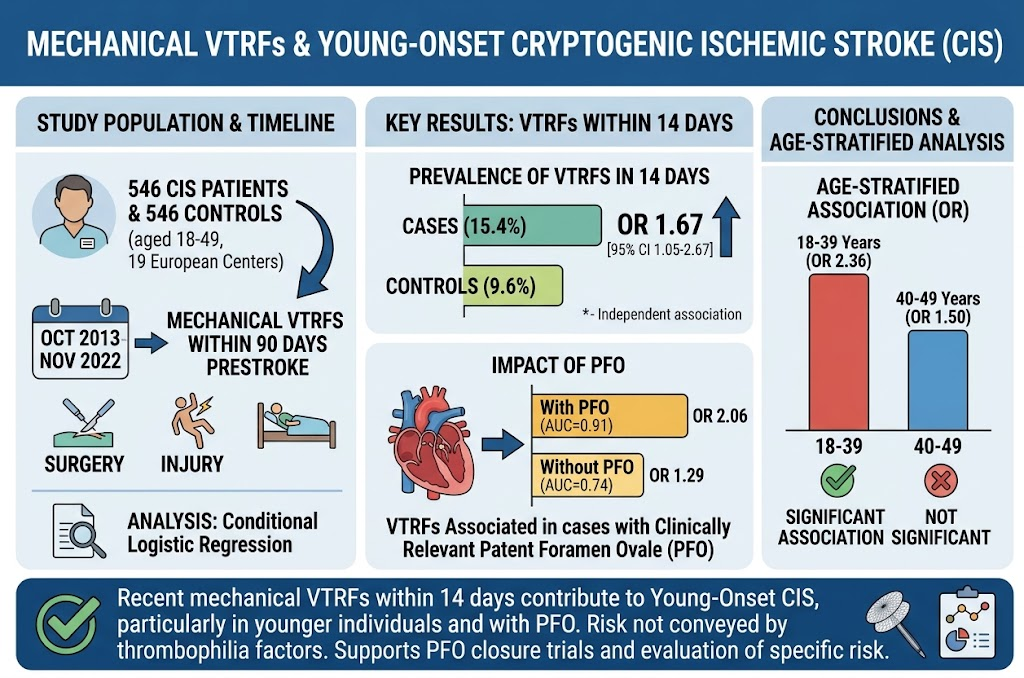
  • Mechanical venous thrombosis risk factors (VTRFs) occurring within 14 days prior to stroke significantly increase the risk of cryptogenic ischemic stroke (CIS) in young adults aged 18–49.
  • The association is particularly strong in younger adults (18–39 years) and in patients with clinically relevant patent foramen ovale (PFO).
  • No significant association was found for VTRFs occurring more than 14 days before stroke or for thrombophilic blood markers.
  • These findings suggest recent mechanical VTRFs may trigger stroke via venous thromboembolism and paradoxical embolism, highlighting opportunities for targeted prevention.

Study Background

MedXY registered readers

Sign in free to continue reading

Create or use your MedXY account to unlock the complete article.

This article was created using several editorial tools, including AI, as part of the process. Human editors reviewed this content before publication.

Related articles

Open language-specific specialty feeds and department pages.

Immunogenicity and Safety of Pentavalent Meningococcal MenABCWY Vaccine in Adolescents and Young Adults: Integrated Evidence from Late-Phase Clinical TrialsThis review synthesizes phase 2 and 3 trial data demonstrating that the pentavalent MenABCWY vaccine is immunologically non-inferior and well tolerated compared with MenB-fHbp and MenACWY-CRM vaccines, offering a simplified, effective vacciSep 4, 2026Recent Mechanical Venous Thrombosis Risk Factors and Their Role in Young-Onset Cryptogenic Ischemic Stroke: New Insights from the SECRETO StudyThis multicenter study reveals that recent mechanical venous thrombosis risk factors markedly increase the risk of cryptogenic ischemic stroke in young adults, especially in those under 40 and with patent foramen ovale, independent of thromAug 31, 2026Medicaid Expansion and Reduced 1-Year Mortality in Young Adults Initiating Dialysis: A Comprehensive ReviewThis review synthesizes evidence showing that Medicaid expansion under the Affordable Care Act significantly reduced 1-year mortality among young adults starting dialysis by improving insurance coverage and access to nephrology care.Aug 17, 2026
Loading comments...
MedXY briefing

Get the free newsletter

Evidence-led clinical news, trends, and analysis—delivered to your inbox.

Ask MedXY AI

Most popular

Intimate Health
Five Benefits for Women Continuing Sexual Activity After Menopause
Intimate Health
Why Some Women Have a Strong Sex Drive—And Why Men Shouldn't Worry About It
Nursing & care
How often should a couple have sex?
Intimate Health
Classic Intimacy Recommendations: How to Help Women Reach Orgasm and Enjoy Mutual Pleasure
Intimate Health
What Makes a Woman "Physiologically Addicted" Is Never Money, But These Two Relationship Qualities
© 2026 MedXY
Contact usAbout usPrivacy PolicyMedXY story
Younger adults with intracerebral hemorrhage have better outcomes but distinct risk profile: INTERACT3 sub-analysisA secondary analysis of the INTERACT3 trial shows that younger adults (≤50 years) with intracerebral hemorrhage have lower mortality and disability but differ in risk factors and may benefit more from bundled care.Jul 26, 2026
Recent Infections Act as a Transient Trigger for Cryptogenic Stroke in Young Adults via Thromboinflammatory PathwaysThe SECRETO study demonstrates that infections within the preceding week increase the odds of cryptogenic ischemic stroke by 2.6-fold in young adults, primarily driven by transient increases in von Willebrand Factor and Factor VIII levels.Mar 18, 2026
Long-Term Efficacy and Safety of Transcatheter Patent Foramen Ovale Closure: A 20-Year Follow-Up StudyA 20-year follow-up study of 130 patients demonstrates that transcatheter PFO closure is highly effective in preventing recurrent strokes, though long-term antithrombotic therapy increases bleeding risks, particularly in women.Mar 9, 2026