Racial, Ethnic, and Socioeconomic Disparities in Islet Autoantibody Patterns Among Individuals at Risk for Type 1 Diabetes
Highlight
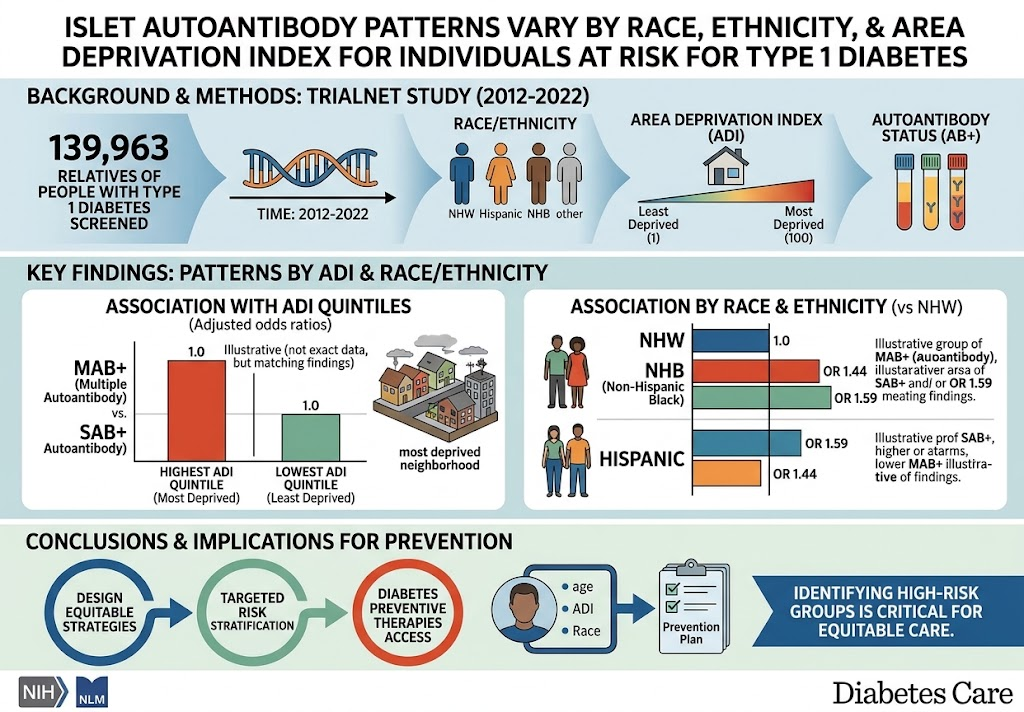
- Islet autoantibody positivity (AB+) shows significant variation across racial and ethnic groups among individuals at risk for type 1 diabetes.
- Non-Hispanic Black individuals demonstrate higher odds of AB+ including both single and multiple autoantibodies compared to non-Hispanic Whites.
- Hispanic individuals show increased odds of single autoantibody positivity but lower odds of multiple autoantibodies than non-Hispanic Whites.
- Socioeconomic deprivation influences autoantibody patterns, with lower deprivation associated with increased multiple autoantibody positivity.
Study Background
Type 1 diabetes (T1D) is an autoimmune condition characterized by destruction of pancreatic beta cells, resulting in insulin deficiency. Detection of islet autoantibodies (ABs) is a cornerstone in evaluating individuals at risk before clinical onset. While large-scale screening programs, such as TrialNet, have advanced understanding of autoantibody prevalence and progression risk, disparities related to race, ethnicity, and socioeconomic status have been understudied. Understanding these disparities is crucial to ensuring equitable risk assessment, preventive strategies, and clinical trial recruitment, especially considering growing recognition of racial and socioeconomic disparities in diabetes outcomes.
Study Design
This analysis utilized data from the TrialNet Pathway to Prevention study, spanning January 2012 to December 2022, encompassing 139,963 relatives of individuals with T1D who underwent screening for islet autoantibodies. Participants’ race and ethnicity were self-reported and categorized as non-Hispanic White, Hispanic, non-Hispanic Black, and non-Hispanic other. Socioeconomic status was quantified by the area deprivation index (ADI), derived from participants’ home addresses, stratified into quintiles reflecting levels from least to most deprived.
Islet autoantibody positivity was classified into single AB positive (SAB+) and multiple AB positive (MAB+) categories. Multivariate logistic regression models adjusted for age and the period of protocol enrollment were employed to examine associations between race, ethnicity, ADI quintiles, and AB+ status.
Key Findings
The study revealed several important patterns:
1. Age-related trends: Younger participants had higher odds of MAB+ and lower odds of SAB+, consistent with earlier development of more extensive autoimmune response in youth.
2. Racial and ethnic disparities:
– Non-Hispanic Black individuals had significantly elevated odds of AB+ overall (adjusted odds ratio [aOR] 1.44, 95% CI 1.29–1.62), SAB+ (aOR 1.59, 95% CI 1.38–1.85), and MAB+ (aOR 1.26, 95% CI 1.06–1.51) compared to non-Hispanic Whites.
– Hispanic participants had increased odds of SAB+ (aOR 1.26, 95% CI 1.15–1.39) but decreased odds of MAB+ (aOR 0.81, 95% CI 0.72–0.91) relative to non-Hispanic Whites.
3. Socioeconomic deprivation influence: Individuals residing in areas with the lowest deprivation demonstrated higher odds of MAB+ (aOR 1.21, 95% CI 1.06–1.37) but no significant association was found between deprivation level and SAB+.
These findings underscore differential autoantibody emergence patterns tied to race, ethnicity, and socioeconomic context, which carry implications for disease pathogenesis understanding and risk-based screening approaches.
Expert Commentary
This comprehensive analysis by Addala et al. advances our epidemiologic understanding that islet autoantibody positivity — a predictor of T1D onset — is not uniformly distributed across racial, ethnic, and socioeconomic strata. The higher odds of both single and multiple autoantibody positivity in non-Hispanic Black individuals emphasize the need for targeted research in these populations, historically underrepresented in T1D studies. The contrasting patterns in Hispanic populations, with prevalent single autoantibody but less commonly multiple autoantibodies, may suggest different autoimmune trajectories or genetic-environmental interactions warranting mechanistic exploration.
The association of lower socioeconomic deprivation with increased multiple autoantibody positivity contrasts with common paradigms linking disadvantage to worse disease burden, indicating that environmental and lifestyle factors related to affluence might influence immunological phenomena in T1D risk.
Limitations include reliance on relatives of people with T1D, possibly limiting generalizability, and residual confounding from unmeasured variables such as detailed genetic ancestry or environmental exposures. Nonetheless, the large sample size and longitudinal design enhance confidence in these associations.
Conclusion
The patterns of islet autoantibody positivity vary significantly by race, ethnicity, and socioeconomic deprivation among individuals at risk for type 1 diabetes. These disparities highlight the necessity for inclusive screening protocols that incorporate sociodemographic factors to refine risk stratification. Moreover, preventive strategies and clinical trial designs should proactively address these differences to bridge gaps in access and outcomes. Future studies should investigate the underlying biological and environmental drivers contributing to these disparities, facilitating equitable and effective diabetes prevention efforts.
Funding and Clinical Trials Registration
The reported analysis was supported by TrialNet, a multicenter clinical trials network funded by the National Institute of Diabetes and Digestive and Kidney Diseases (NIDDK) and other NIH institutes. The TrialNet Pathway to Prevention Study is registered at clinicaltrials.gov.
References
1. Addala A, Cabrera S, Cuthbertson D, Libman I, Tosur M, Siller AF, DiMeglio LA, Herold KC, Redondo MJ, Ismail HM. Islet Autoantibody Patterns Vary by Race and Ethnicity and Area Deprivation Index for Individuals at Risk for Type 1 Diabetes. Diabetes Care. 2026 Aug 7; PMID: 42566303.
2. Steck AK, Vehik K. Natural history of type 1 diabetes. Curr Opin Endocrinol Diabetes Obes. 2015;22(4):267-74.
3. Redondo MJ, Rewers M, Yu L, Garg S, Pilcher C, Elliott RB. Genetic determination of islet autoantibody positivity and progression to type 1 diabetes in relatives: The TrialNet Pathway to Prevention Study. Diabetes Care. 2020;43(6):e109-e110.
4. American Diabetes Association. 2. Classification and Diagnosis of Diabetes: Standards of Medical Care in Diabetes—2024. Diabetes Care. 2024 Jan;47(Suppl 1):S17–S29.
5. Mayer-Davis EJ, Lawrence JM, Dabelea D, et al. Incidence trends of type 1 and type 2 diabetes among youths, 2002–2012. N Engl J Med. 2017;376(15):1419–1429.
6. Mayer-Davis EJ, Kahkoska AR, Jefferies C, et al. ISPAD Clinical Practice Consensus Guidelines 2018: Type 2 diabetes in youth. Pediatric Diabetes. 2018;19(Suppl 27):28-46.
This article was created using several editorial tools, including AI, as part of the process. Human editors reviewed this content before publication.