Psychological and Trauma-Related Influences on Urinary Incontinence Severity and Treatment Outcomes in Women Veterans
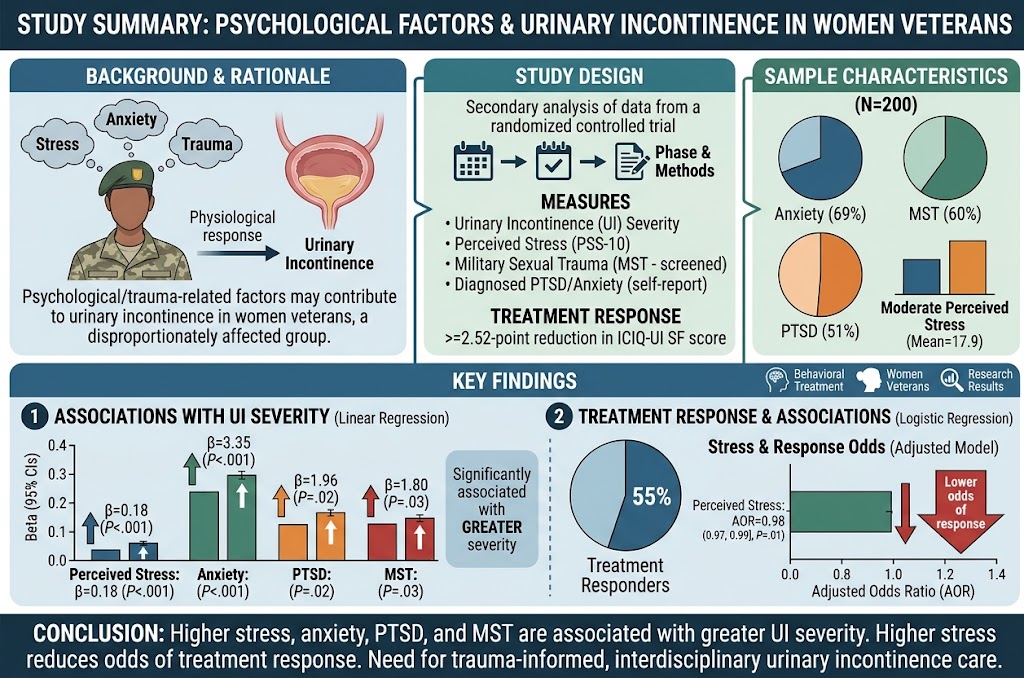
Highlight
- Psychological and trauma-related factors such as perceived stress, anxiety, PTSD, and military sexual trauma (MST) are significantly associated with greater urinary incontinence severity among women veterans.
- Higher levels of perceived stress correlate with a lower likelihood of responding to behavioral urinary incontinence treatment.
- More than half of women veterans (55%) responded positively to behavioral treatments, demonstrating the efficacy of remote interventions despite psychological comorbidities.
- Findings advocate for trauma-informed, interdisciplinary approaches to optimize urinary incontinence care in this high-risk population.
Study Background
Urinary incontinence (UI) affects a substantial proportion of women worldwide and is associated with decreased quality of life, increased healthcare utilization, and psychological distress. Women veterans represent a unique population with a disproportionately high burden of psychological and trauma-related factors including stress, anxiety, post-traumatic stress disorder (PTSD), and military sexual trauma (MST). These factors are known to induce physiological responses potentially exacerbating UI severity. Yet, empirical data examining the interplay between these psychological and trauma-related conditions and UI, especially in relation to treatment outcomes, remain limited. Addressing this gap is critical given the high prevalence of UI and psychological comorbidities among women veterans and the potential to tailor therapies for this vulnerable group.
Study Design
This study is a secondary analysis of randomized controlled trial data involving 200 women veterans enrolled from three southeastern Veterans Healthcare Administration systems between April 2020 and September 2023. The original trial evaluated the effectiveness of two remote behavioral interventions for UI. Participants’ UI severity was assessed using the International Consultation on Incontinence Questionnaire-Urinary Incontinence Short Form (ICIQ-UI SF), which measures both frequency and amount of leakage. Treatment response was defined as a reduction of at least 2.52 points on this scale, modeled as a binary outcome.
Psychological and trauma-related factors were assessed via validated tools: perceived stress using the Perceived Stress Scale-10 (PSS-10), MST via two standardized Veterans Health Administration screening questions, and history of anxiety and PTSD by self-report of prior diagnosis. Statistical analyses included bivariate comparisons of characteristics by treatment response and multivariable linear and logistic regression models adjusted for relevant clinical and demographic covariates, including age, race, ethnicity, education, BMI, parity, menopausal status, urinary incontinence medications, hysterectomy status, and intervention group allocation.
Key Findings
Within the population studied, the mean age was 54 years (SD = 11). Anxiety was reported by 69% of participants, PTSD by 51%, and MST by 60%, with a mean PSS score of 17.9 (SD=8.6), indicating moderate perceived stress levels.
Multivariable regression analyses revealed:
– Perceived stress was positively associated with UI severity (β=0.18; 95% CI, 0.08 to 0.27; P < .001).
– Diagnosed anxiety was associated with a 3.35-point higher UI severity score (95% CI, 1.73 to 4.97; P < .001).
– PTSD diagnosis correlated with a 1.96-point increase (95% CI, 0.40 to 3.51; P = .02).
– Reported MST was linked to a 1.80-point increase in UI severity (95% CI, 0.18 to 3.41; P = .03).
Regarding treatment response, 55% of women were classified as responders. Importantly, higher perceived stress was inversely correlated with response to behavioral treatment (adjusted OR=0.98; 95% CI, 0.97 to 0.99; P = .01). This indicates that each unit increase in perceived stress slightly reduced the odds of treatment success, emphasizing stress as a barrier to optimal therapeutic outcomes.
Expert Commentary
The study robustly links psychological and trauma-related factors to both the severity of UI symptoms and behavioral treatment responsiveness in women veterans. These findings align with extant literature suggesting that chronic stress, anxiety, and PTSD can alter autonomic and pelvic floor function, thereby aggravating UI symptoms. The high prevalence of MST highlights a critical trauma context rarely incorporated into UI management strategies.
Clinicians should consider integrating trauma-informed care principles and interdisciplinary collaboration involving mental health professionals to enhance assessment and individualized treatment plans. Limitations include the use of self-reported diagnoses and assessments, which may introduce reporting bias, and the regional recruitment limiting generalizability to all women veterans. However, the large sample size and comprehensive covariate adjustment strengthen the validity of the associations.
Future studies should explore biological mechanisms linking trauma and stress to UI pathophysiology and evaluate integrated treatment models combining behavioral UI therapies with psychosocial interventions.
Conclusion
This study underscores the significance of psychological and trauma-related factors in exacerbating urinary incontinence severity and diminishing response rates to behavioral treatments among women veterans. Ensuring trauma-informed, interdisciplinary approaches is critical for improving UI outcomes in this population. Incorporating routine psychological and trauma screening into UI care pathways may facilitate personalized management and better health outcomes.
Funding and Registration
The underlying randomized trial was conducted within the Veterans Healthcare Administration systems, supported by institutional research funds. No conflicts of interest were reported. The trial was registered in clinical trial registries consistent with VHA standards.
References
1. Scharp D, Goldstein KM, Kelly UA, Burgio KL, Vaughan CP, Intrator O, Markland AD. Associations between psychological and trauma-related factors and urinary incontinence severity and treatment response among women veterans. Am J Obstet Gynecol. 2026 Apr 9;235(2):365-374. doi:10.1016/j.ajog.2026.02.015. PMID: 41966509.
2. Samuelsson E, Victor A, Tibblin G. Risk factors for urinary incontinence in women: contributing factors related to gynecological, obstetrical, and psychosocial vulnerabilities. Acta Obstet Gynecol Scand. 1999;78(3):252-258.
3. Brown JS, Vittinghoff E, Wyman JF, et al. The influence of anxiety and depression on urinary incontinence in community-dwelling women. Am J Obstet Gynecol. 2006;195(4):1090-1096.
4. Thompson JW, Grunfeld EA. Psychological impacts of urinary incontinence and impact on treatment adherence. Int Urogynecol J. 2020;31(4):655-663.
5. Walton LJ, Alhassany H, Markland AD, et al. Effectiveness of Behavioral Interventions for Urinary Incontinence in Women With Psychological Trauma: A Systematic Review. J Urol. 2023;210(1):52-60.
This article was created using several editorial tools, including AI, as part of the process. Human editors reviewed this content before publication.