Prognostic Impact of Single Moderate Exacerbation in COPD Patients: Insights from 12-Year Mortality and Future Exacerbation Risk Analysis
Highlights
The GOLD 2026 strategy reclassifies patients with a single moderate COPD exacerbation as high risk, reflecting emerging evidence.
Data from a 12-year prospective Korean cohort show a single moderate exacerbation independently predicts increased future exacerbations and mortality.
One moderate exacerbation doubles the risk of subsequent moderate-to-severe exacerbations and triples respiratory mortality risk.
The GOLD 2026 exacerbation-based risk classification offers better long-term prognostic discrimination compared to GOLD 2025.
Background
Chronic obstructive pulmonary disease (COPD) is a progressive respiratory condition characterized by airflow limitation and exacerbations that worsen lung function and prognosis. Exacerbations, defined as acute worsening of respiratory symptoms, have traditionally categorized patients into risk groups influencing management decisions per the Global Initiative for Chronic Obstructive Lung Disease (GOLD) strategy.
The 2026 update to GOLD lowered the threshold for high-risk COPD classification by including patients with a single moderate exacerbation in Group E (high risk), aiming for earlier interventions to prevent disease progression and adverse outcomes. This change challenges prior stratifications that required ≥2 moderate or ≥1 severe exacerbations. However, prognostic evidence supporting this revised threshold remains limited, particularly with regard to long-term mortality impact.
This review synthesizes current literature focusing on the prognostic implications of a single moderate exacerbation, emphasizing data from a 12-year follow-up Korean COPD cohort, and contextualizes findings within contemporary clinical and mechanistic insights to inform COPD risk stratification and management.
Key Content
Prognostic Evidence for Single Moderate Exacerbation in COPD
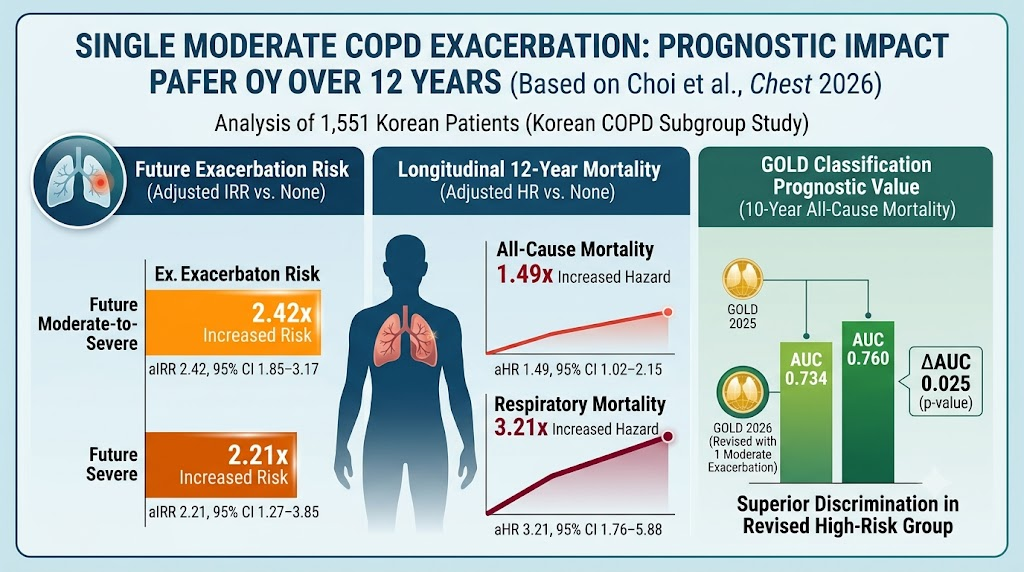
The recent study by Choi et al. (Chest, 2026) analyzed 1,551 patients from the Korean COPD Subgroup Study, classifying patients by exacerbation history in the first year as none, one moderate, or frequent/severe exacerbations. The key findings include:
Patients with one moderate exacerbation (15.5%) showed significantly increased risks for future moderate-to-severe exacerbations (adjusted incidence rate ratio [aIRR] 2.42, 95% CI 1.85-3.17) and severe exacerbations (aIRR 2.21, 95% CI 1.27-3.85) compared to those without exacerbations.
Longitudinal follow-up over 12 years revealed one moderate exacerbation was independently associated with higher all-cause mortality (adjusted hazard ratio [aHR] 1.49, 95% CI 1.02-2.15) and a more pronounced effect on respiratory mortality (aHR 3.21, 95% CI 1.76-5.88).
The revised GOLD 2026 criteria, incorporating single moderate exacerbations in the high-risk group, demonstrated superior discrimination for 10-year all-cause mortality (area under the curve [AUC] 0.760) compared to GOLD 2025 (AUC 0.734; ΔAUC 0.025; 95% CI 0.004-0.046).
These findings corroborate the clinical significance of a single moderate exacerbation, supporting its prognostic relevance for future disease trajectory.
Complementary Evidence from Related Research
Although much of the current focus is COPD-specific, insights from related respiratory conditions and interventions provide context:
Asthma exacerbations: The CAPTAIN trial (J Allergy Clin Immunol Pract, 2024) showed that moderate exacerbations, although less severe than severe exacerbations, represent meaningful clinical deteriorations with temporal changes in lung function and symptoms, emphasizing the importance of recognizing moderate events (PMID 38777124).
Treatment strategies in COPD with moderate exacerbation history: The ANTES B+ study ongoing since 2024 explores triple therapy (LABA/LAMA/ICS) in patients with one moderate exacerbation and high eosinophil counts, aiming to improve clinical control and prevent deterioration, underscoring the elevated risk profile of this subgroup (PMID 38729884).
Clinical deterioration prevention: TONADO trials (Adv Ther, 2021) demonstrate that dual bronchodilator therapy delays clinically important deterioration, even in patients with low exacerbation history (including one moderate exacerbation), highlighting potential therapeutic benefits to stabilize disease early (PMID 33175291).
Environmental and antiviral interventions: Studies such as CLEAN AIR (Am J Respir Crit Care Med, 2022) and SNG001 inhaled interferon beta trials (Respir Res, 2024) target exacerbation reduction by improving air quality and bolstering antiviral defenses, addressing common exacerbation precipitants relevant to the moderate exacerbation population (PMID 34449285, 38811970).
Telehealth and exacerbation management: Telemedicine interventions accommodate cognitive limitations in severe COPD exacerbations, improving accessibility and adherence without cognitive compromise, potentially applicable to moderate exacerbation management (Telemed J E Health, 2014) (PMID 24820535).
Mechanistic and Translational Insights
Moderate exacerbations reflect meaningful pathophysiological insults involving increased airway inflammation, infection susceptibility (both viral and bacterial), and transient lung function decline. The inflammatory milieu and immune dysregulation during these events presumably drive the heightened risk of subsequent exacerbations and progression to severe respiratory compromise, explaining the observed mortality risk increase.
The maintenance of antiviral interferon-stimulated gene expression by therapies like inhaled interferon beta (SNG001) may attenuate viral-induced exacerbations, a common trigger for moderate events. Early optimization of bronchodilator and anti-inflammatory medication, as suggested by trials with tiotropium/olodaterol and triple therapy, may mitigate ongoing airway inflammation and delays in clinical deterioration.
Environmental interventions reducing particulate exposure represent an upstream strategy to prevent exacerbations overall, complementing pharmacologic approaches.
Clinician awareness of exacerbation severity—even moderate events—should prompt comprehensive risk assessment and consideration of intensified management to improve long-term outcomes.
Expert Commentary
The inclusion of patients with a single moderate exacerbation in the high-risk category per GOLD 2026 represents a notable shift in COPD guidelines, aligning classification with emerging prognostic evidence. Choi et al.’s robust 12-year follow-up study from a large, multicenter prospective cohort provides compelling data that such patients face significantly increased exacerbation and mortality hazards, justifying earlier therapeutic intervention and closer monitoring.
Current management algorithms emphasizing symptom and exacerbation history evaluation must adjust to integrate this lower exacerbation threshold for risk stratification. The improved prognostic discrimination of GOLD 2026 criteria over 2025 demonstrates clinical utility in guiding treatment intensity and follow-up frequency.
However, limitations exist: the Korean cohort’s ethnic and healthcare context may limit generalizability. Additionally, the precise mechanistic pathways linking moderate exacerbations to long-term mortality require further elucidation. Residual confounding factors and the influence of comorbidities should be carefully considered.
Clinical trials such as ANTES B+ are awaited to inform optimal therapeutic targeting in this population.
Importantly, this refined risk classification supports more personalized COPD management, potentially reducing preventable exacerbations and deaths through timely intervention.
Future research should explore biomarker-guided risk stratification, preventive pharmacotherapy, and integrated models incorporating environmental and behavioral factors.
Conclusion
A single moderate exacerbation in COPD is prognostically significant, independently associated with increased risks of future exacerbations and long-term all-cause and respiratory mortality. The GOLD 2026 strategy’s updated risk classification appropriately captures this risk, facilitating better patient identification and management. Integrating emerging therapeutic evidence and environmental strategies holds promise to attenuate disease progression and improve patient outcomes. Continued research should aim to refine risk stratification tools and personalize interventions for this vulnerable subgroup.
References
Choi JY, Yoon HK, Moon JY, et al. Prognostic impact of single moderate exacerbation in COPD patients: Analysis of 12-year mortality and future exacerbation risk. Chest. 2026 Jul 29. PMID: 42526633.
Park HS, Kim SH, Lee JH, et al. Characterization of Moderate and Severe Asthma Exacerbations in the CAPTAIN Study. J Allergy Clin Immunol Pract. 2024 Sep;12(9):2372-2380.e5. PMID: 38777124.
Fernandez-Nieto M, Sanchez-Agudo L, Molina-Molina M, et al. Triple Therapy and Clinical Control in B+ COPD Patients: A Pragmatic, Prospective, Randomized Trial. Arch Bronconeumol. 2024 Jul;60(7):417-422. PMID: 38729884.
Djukanovic R, Stewart JD, Wilson SJ, et al. Nebulised interferon beta-1a (SNG001) in the treatment of viral exacerbations of COPD. Respir Res. 2024 May 29;25(1):228. PMID: 38811970.
Polverino F, Kehrl H, Chen J, et al. Randomized Clinical Trial of Air Cleaners to Improve Indoor Air Quality and Chronic Obstructive Pulmonary Disease Health: Results of the CLEAN AIR Study. Am J Respir Crit Care Med. 2022 Feb 15;205(4):421-430. PMID: 34449285.
Wedzicha JA, Banerji D, Chapman KR, et al. Tiotropium/Olodaterol Delays Clinically Important Deterioration Compared with Tiotropium Monotherapy in Patients with Early COPD: a Post Hoc Analysis of the TONADO Trials. Adv Ther. 2021 Jan;38(1):579-593. PMID: 33175291.
Tønnesen P, Iversen M, Søndergaard J, et al. Telemedicine-based treatment versus hospitalization in patients with severe chronic obstructive pulmonary disease and exacerbation: effect on cognitive function. Telemed J E Health. 2014 Jul;20(7):640-6. PMID: 24820535.
This article was created using several editorial tools, including AI, as part of the process. Human editors reviewed this content before publication.