We use cookies

Our website uses essential cookies and, with your consent, additional cookies to measure performance and improve our services. Cookie Policy.

You can change your choice at any time.

MMedXYNews
HomeVideos
MedXY AI/MedXY News/Section: news

Prepectoral Direct-to-Implant Breast Reconstruction: A Viable Single-Stage Alternative?
MedXY Editorial Team•Aug 18, 2026•news
surgical outcomesBreast Reconstructionprepectoral implantdirect-to-implant

Highlight

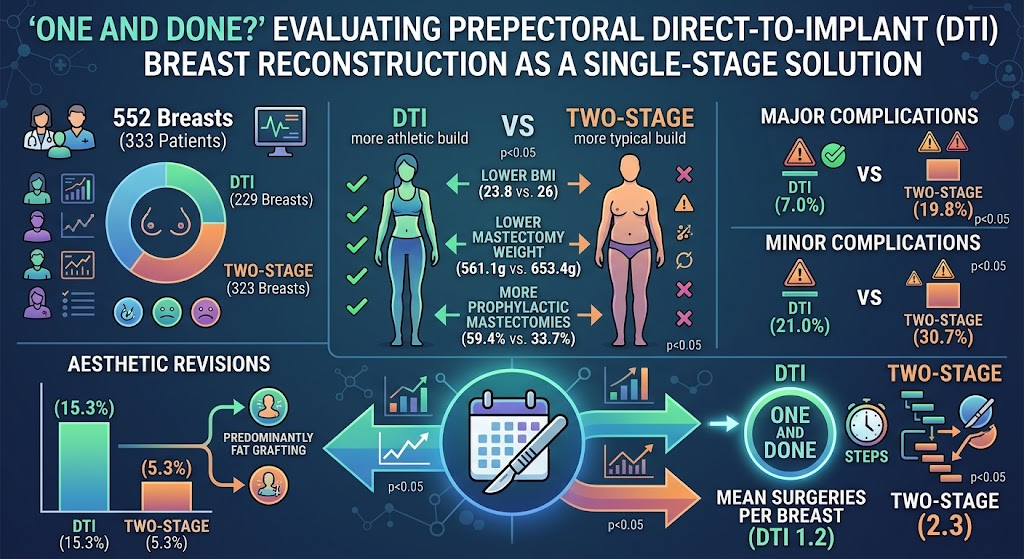
1. Prepectoral direct-to-implant (DTI) breast reconstruction demonstrated significantly lower major and minor complication rates than traditional two-stage implant-based breast reconstruction (IBBR).
2. Patients undergoing DTI required fewer overall surgeries, averaging 1.2 per breast, compared to 2.3 in two-stage approaches.
3. Although aesthetic revisions were more frequent with DTI, these were primarily minor, elective procedures such as fat grafting.
4. This study provides the largest dataset focused exclusively on prepectoral reconstruction, offering plane-specific insights for surgical planning and patient counseling.

Study Background

MedXY registered readers

Sign in free to continue reading

Create or use your MedXY account to unlock the complete article.

This article was created using several editorial tools, including AI, as part of the process. Human editors reviewed this content before publication.

Related articles

Open language-specific specialty feeds and department pages.

Prophylactic Mesh Placement Significantly Reduces Incisional Hernia Risk After Hepatobiliopancreatic SurgeryA randomized clinical trial demonstrates that synthetic mesh reinforcement during subcostal abdominal closure notably decreases incisional hernia incidence without increasing postoperative complications, improving patient recovery after hepSep 15, 2026Evaluating Early Outcomes of Robotic versus Laparoscopic and Open Cholecystectomy in the US: A Nationwide AnalysisA national multipayer analysis demonstrates robotic cholecystectomy offers comparable safety to laparoscopic methods while improving key outcomes versus open surgery, signaling maturation of robotic biliary surgery.Sep 12, 2026Hidden Costs of Healing: Financial Burdens After Distal Upper Extremity Nerve InjuriesDespite nearly universal insurance coverage, nearly half of patients with distal upper extremity nerve injuries face significant financial hardship, influenced by injury location, surgical complexity, and preexisting debt. Targeted financiaSep 2, 2026
Loading comments...
MedXY briefing

Get the free newsletter

Evidence-led clinical news, trends, and analysis—delivered to your inbox.

Ask MedXY AI

Most popular

Intimate Health
Five Benefits for Women Continuing Sexual Activity After Menopause
Intimate Health
Why Some Women Have a Strong Sex Drive—And Why Men Shouldn't Worry About It
Nursing & care
How often should a couple have sex?
Intimate Health
Classic Intimacy Recommendations: How to Help Women Reach Orgasm and Enjoy Mutual Pleasure
Intimate Health
What Makes a Woman "Physiologically Addicted" Is Never Money, But These Two Relationship Qualities
© 2026 MedXY
Contact usAbout usPrivacy PolicyMedXY story
A Split-Muscle Support Technique for Direct-To-Implant Breast Reconstruction: A Case Series
This report details the first application of the split-muscle support technique in direct-to-implant breast reconstruction, highlighting its approach to reduce animation deformity and enhance implant support with less ADM use.
Sep 2, 2026
Defining a Quantitative Perfusion Threshold with SPY-PHI QP to Predict Mastectomy Skin Necrosis in Breast Reconstruction: Insights and Clinical ImplicationsThis prospective study identifies a 30% SPY-PHI QP perfusion threshold predictive of mastectomy skin flap necrosis in staged breast reconstruction, highlighting the confounding effect of nitroglycerin ointment and underscoring the need forAug 27, 2026
Long-Term Outcomes of Strabismus Surgery in Children with Perinatal Brain Injury: Insights and Clinical ImplicationsChildren with perinatal brain injury exhibit lower long-term success rates following strabismus surgery, mainly due to undercorrection despite comparable surgical dosing. Larger preoperative deviations predict poorer outcomes, underscoringAug 24, 2026