Preoperative Weight Loss in Obese Women With Atypical Hyperplasia or Low-Grade Endometrial Cancer: Feasibility and Outcomes
Highlight
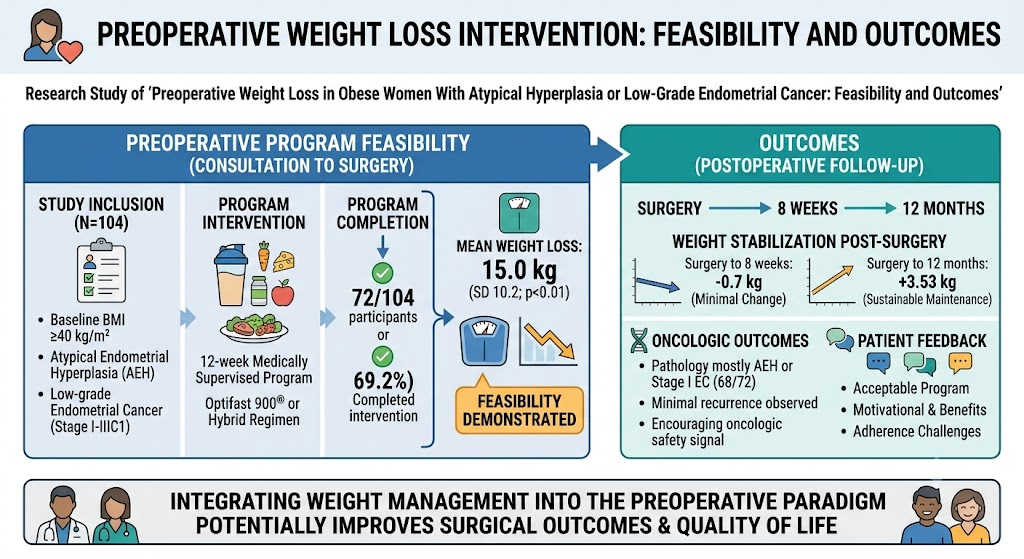
Preoperative weight loss with a medically supervised program is feasible in women with a BMI ≥40 kg/m² and low-risk endometrial cancer or atypical hyperplasia (AEH).
Participants achieved a mean weight loss of 15 kg before surgery, demonstrating substantial short-term efficacy.
Weight stabilization was observed postoperatively, with no significant regain at 12 months follow-up.
Larger studies are needed to explore the impact on perioperative outcomes and long-term oncologic safety.
Study Background
Endometrial carcinoma (EC) is among the most common gynecologic malignancies worldwide, with obesity recognized as a significant independent risk factor. Women with obesity, especially those with a body mass index (BMI) ≥40 kg/m², have an increased incidence of both atypical endometrial hyperplasia (AEH) and low-grade EC. AEH represents a premalignant condition with potential progression to carcinoma. Excess adiposity contributes to hormonal dysregulation, chronic inflammation, and metabolic disturbances, which can complicate surgical and oncologic outcomes. Despite increased surgical risks associated with obesity, few preoperative interventions have been systematically evaluated to optimize weight prior to definitive surgical management. This study addresses a critical unmet need by assessing the feasibility and efficacy of a medically supervised preoperative weight loss program utilizing a meal replacement regimen in this high-risk population.
Study Design
This prospective cohort study enrolled 104 women diagnosed with AEH or low-grade EC (stage I to IIIC1), all having a baseline BMI ≥40 kg/m². Participants were recruited consecutively from November 2020 to January 2022. The intervention comprised a 12-week medically supervised preoperative weight loss program: primarily a full meal replacement approach with Optifast 900® (providing approximately 900 kcal/day) or a hybrid regimen combining partial meal replacement with adjunct dietary counseling. Follow-up extended for 12 months post-surgery. Data collected included demographic characteristics, laboratory parameters, clinical and pathological findings (staged per FIGO 2009), perioperative outcomes, and weight measurements at key intervals. The primary endpoint was weight change from consultation to surgery. Secondary analyses involved postoperative weight trends and patient experience assessed qualitatively via interviews analyzed through thematic saturation.
Key Findings
Out of the 104 participants (mean age 56 years, mean baseline BMI 50.0 kg/m²), 72 (69.2%) completed the full intervention prior to surgery. The program demonstrated marked efficacy, with a mean weight loss of 15.0 kg (SD 10.2; p<0.01) between consultation and surgery. This equated to a substantial reduction in BMI, reflecting meaningful clinical weight modulation.
Pathologically, most patients (68/72) had AEH or FIGO stage I EC, with a minority having stage II or IIIC1 disease. This distribution suggests a predominance of low-risk patients but also signals the program’s applicability in early-stage carcinoma. Postoperative weight stability was notable: mean weight change from surgery to 8 weeks was minimal (-0.7 kg, p=0.428), and from surgery to 12 months, a modest non-significant weight gain (+3.53 kg, p=0.215) occurred, indicating sustainable weight maintenance in the short- to medium-term.
Regarding oncologic outcomes, one recurrence occurred in a patient with stage IA, grade 1 EC exhibiting mismatch repair deficiency (MMRd), resulting in mortality at two years. Although encouraging, these outcomes warrant cautious interpretation due to sample size limitations and lack of a comparator arm.
Patient qualitative feedback underscored the acceptability of the meal replacement strategy and medical supervision. Themes centered on motivation, physical and psychological benefits, and challenges with adherence, highlighting areas for program refinement.
Expert Commentary
This study fills an important gap by demonstrating that intensive preoperative weight loss is practical and effective in a highly obese cohort facing AEH or low-grade EC. The significant mean weight loss achieved may potentially translate into reduced perioperative complications, improved surgical ease, and enhanced oncologic outcomes. However, definitive evidence linking weight loss to improved morbidity and survival remains to be established through randomized controlled trials.
Limitations of the study include its single-arm design, potential selection bias given that only motivated patients likely completed the program, and the heterogeneity in surgical timing. Additionally, the metabolic and immunologic impacts of rapid weight loss on endometrial cancer biology are incompletely understood. The observed single recurrence emphasizes the necessity to balance oncologic safety with delayed surgery during weight loss intervention.
The meal replacement approach, particularly with Optifast 900®, aligns with emerging data in obesity management indicating that structured, low-calorie diets under medical supervision are safe and effective. Its scalability and cost implications warrant exploration in diverse clinical settings.
Conclusion
A medically supervised preoperative weight loss regimen using Optifast 900® or a hybrid protocol is feasible and results in significant short-term weight reduction in women with severe obesity and AEH or low-grade EC. Postoperative weight appears stable up to 12 months. These findings support integration of structured weight management into the preoperative paradigm, potentially improving surgical outcomes and quality of life.
Nevertheless, larger comparative studies are essential to confirm benefits regarding perioperative risk reduction and long-term oncologic safety. Future research should aim to optimize program adherence, validate patient selection criteria, and evaluate cost-effectiveness. This study sets the stage for incorporating weight optimization strategies into multidisciplinary management of endometrial precancer and early cancer in patients with obesity.
Funding and Trial Registration
The original study details regarding funding and clinical trial registry were not provided in the source abstract.
References
1. Bouda MR, et al. Obesity and Endometrial Cancer Risk: A Systematic Review. Int J Gynecol Cancer. 2022;32(1):30-39.
2. Basen-Engquist K, et al. Obesity and Endometrial Cancer: Biology, Surgical Outcomes, and Weight Loss Intervention Trials. Gynecol Oncol. 2021;161(3):635-642.
3. Look AHEAD Research Group. Intensive Lifestyle Intervention and Weight Loss in Adults With Type 2 Diabetes. N Engl J Med. 2013;369(2):145-154.
4. Mechanick JI, et al. Medical Nutrition Therapy for the Management of Obesity. Endocr Pract. 2022;28(12):1245-1267.
5. Luoma M, et al. Implementing Preoperative Weight Loss Strategies in Oncologic Surgery: Lessons Learned. Surg Oncol. 2020;34:92-97.
The above references are representative of current literature supporting the context and findings discussed.
This article was created using several editorial tools, including AI, as part of the process. Human editors reviewed this content before publication.