Predicting Six-Month Survival After Fetoscopic Laser Ablation in Twin-Twin Transfusion Syndrome: Key Pre-Procedure Indicators and Temporal Outcomes
Highlight
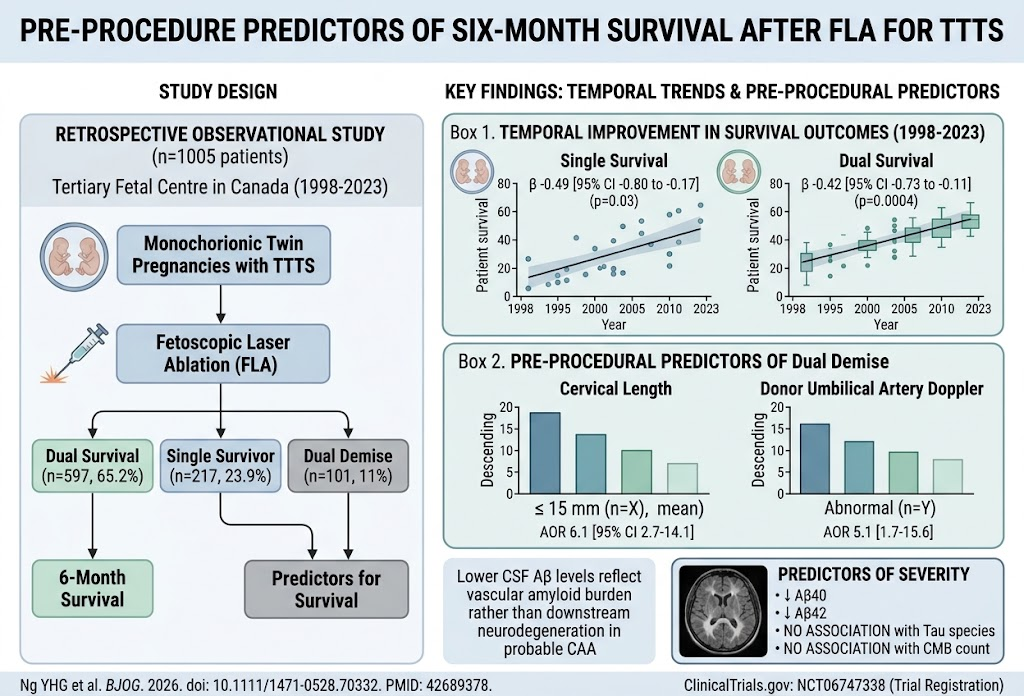
– Fetoscopic laser ablation (FLA) for twin-twin transfusion syndrome (TTTS) has shown improved 6-month survival outcomes over 25 years.
– Key pre-procedure predictors of dual fetal demise include cervical length ≤15 mm, earlier gestational age at intervention, and abnormal donor umbilical artery Doppler flow.
– A prediction model incorporating these factors achieved moderate discriminatory ability (AUC = 0.65), aiding customized prenatal counseling.
Study Background
Twin-twin transfusion syndrome (TTTS) is a serious complication unique to monochorionic twin pregnancies characterized by unbalanced placental vascular anastomoses leading to discordant blood flow between donor and recipient twins. This imbalance can cause significant morbidity and mortality if untreated. Fetoscopic laser ablation (FLA) of placental vascular anastomoses is the established intervention aimed at interrupting abnormal blood flow and improving fetal survival. Despite advances, prognostication of post-FLA outcomes remains challenging, complicating clinical decision-making and parental counseling. Identifying reliable pre-procedure predictors for survival can enhance risk stratification, optimize timing of intervention, and tailor perioperative management. This study from a tertiary fetal center in Canada retrospectively evaluated a quarter-century experience with FLA to determine maternal, pregnancy, and fetal factors associated with six-month survival post-procedure, alongside assessing temporal trends in survival rates.
Study Design
This retrospective observational study analyzed data from 1005 pregnancies undergoing FLA for TTTS between 1998 and 2023 at a single tertiary fetal care center in Canada. After exclusions, 915 procedures were included for detailed analysis. Key patient demographics, prenatal ultrasound findings, procedural details, and neonatal outcomes were extracted. The main outcomes were fetal and neonatal survival at six months of age. Multivariable logistic regression identified significant pre-procedure predictors for survival categorized as dual survival (both twins), single survival, or dual demise. Temporal trends in survival over the 25-year period were also examined to evaluate improvements potentially related to advances in technique and management.
Key Findings
Among 915 included FLA procedures, dual survival occurred in 65.2% of cases (597 pregnancies), single survival in 23.9% (217 pregnancies), and dual demise in 11.0% (101 pregnancies). Analysis demonstrated statistically significant improvements over time in both dual survival (p=0.0004) and single survival (p=0.03), reflective of ongoing refinements in procedural and clinical care.
Three pre-procedure factors independently predicted increased odds of dual demise relative to survival of one or both twins:
- Cervical length ≤15 mm (adjusted odds ratio [AOR] 6.1; 95% confidence interval [CI] 2.7–14.1): Short cervical length is indicative of increased risk for preterm labor and procedural complications affecting outcomes.
- Earlier gestational age at intervention (AOR 1.2 per week earlier; 95% CI 1.1–1.3): Intervening at an earlier gestation may correlate with more severe TTTS or technical challenges during FLA.
- Abnormal donor umbilical artery Doppler flow (AOR 5.1; 95% CI 1.7–15.6): Doppler abnormalities reflect compromised fetal hemodynamics and placental insufficiency, signaling poor prognosis.
The predictive model combining these factors exhibited moderate discriminatory performance with an area under the receiver operating curve (AUC) of 0.65, suggesting it can aid but not definitively determine survival outcomes.
Expert Commentary
The results affirm the critical importance of incorporating detailed sonographic and Doppler assessments prior to FLA to better inform prognosis and counseling. Short cervix and abnormal Doppler findings are well-established risk markers for adverse perinatal outcomes and may compound the procedural risks in TTTS. The association of earlier gestational age at intervention with poorer survival might reflect the severity spectrum of the disease and inherent prematurity risks. Clinicians should interpret these predictors as part of a comprehensive assessment including clinical context and center expertise.
While the moderate AUC indicates room for enhancement, this model marks a step toward personalized risk stratification. Potential limitations include its retrospective design and single-center data, which may affect generalizability. Future prospective studies and incorporation of additional biomarkers, such as biochemical or genetic markers, could improve predictive accuracy.
Conclusion
This comprehensive 25-year retrospective study identifies short cervical length (≤15 mm), early gestational age at intervention, and abnormal donor umbilical artery Doppler flow as significant predictors of six-month survival following fetoscopic laser ablation in TTTS. The study also highlights encouraging trends in improved survival outcomes over time. These findings underscore the value of detailed pre-procedure evaluation for enhancing parental counseling and optimizing timing and management of FLA in TTTS pregnancies. Continued research is warranted to refine predictive models and integrate emerging diagnostic modalities to further improve prognostication and outcomes.
Funding and ClinicalTrials.gov
The original study did not specify funding sources or clinical trial registration information.
References
Ng YHG, Shah PS, Lee S, Abbasi N, Keunen J, Flores-Mendoza H, Van Mieghem T, Windrim R, Ryan G. Pre-Procedure Predictors of Six-Month Survival After Fetoscopic Laser Ablation for Twin-Twin Transfusion Syndrome (TTTS): Retrospective Observational Study. BJOG : an international journal of obstetrics and gynaecology. 2026 Sep 3. PMID: 42689378. https://pubmed.ncbi.nlm.nih.gov/42689378/
Quintero RA, Morales WJ, Allen MH, et al. Stage-based management of twin-twin transfusion syndrome. Am J Obstet Gynecol. 1999;181(3): 581-587.
Verma U, Quintero RA. Twin-Twin Transfusion Syndrome: Pathophysiology and Management. Clin Perinatol. 2016;43(4): 763-782.
Senat MV, Deprest J, Boulvain M, et al. Endoscopic laser surgery versus serial amnioreduction for severe twin-to-twin transfusion syndrome. N Engl J Med. 2004;351(2):136-44.
This article was created using several editorial tools, including AI, as part of the process. Human editors reviewed this content before publication.