We use cookies

Our website uses essential cookies and, with your consent, additional cookies to measure performance and improve our services. Cookie Policy.

You can change your choice at any time.

MMedXYNews
HomeVideos
MedXY AI/MedXY News/Section: Emergency Medicine

Predicting PTSD in Gunshot Wound Survivors: The Role of Shock Index, Hypotension, and Blood Transfusion
MedXY Editorial Team•Sep 12, 2026•Emergency Medicine
Gunshot woundsHypotensionshock indexpost-traumatic stress disorderblood transfusion

Highlight

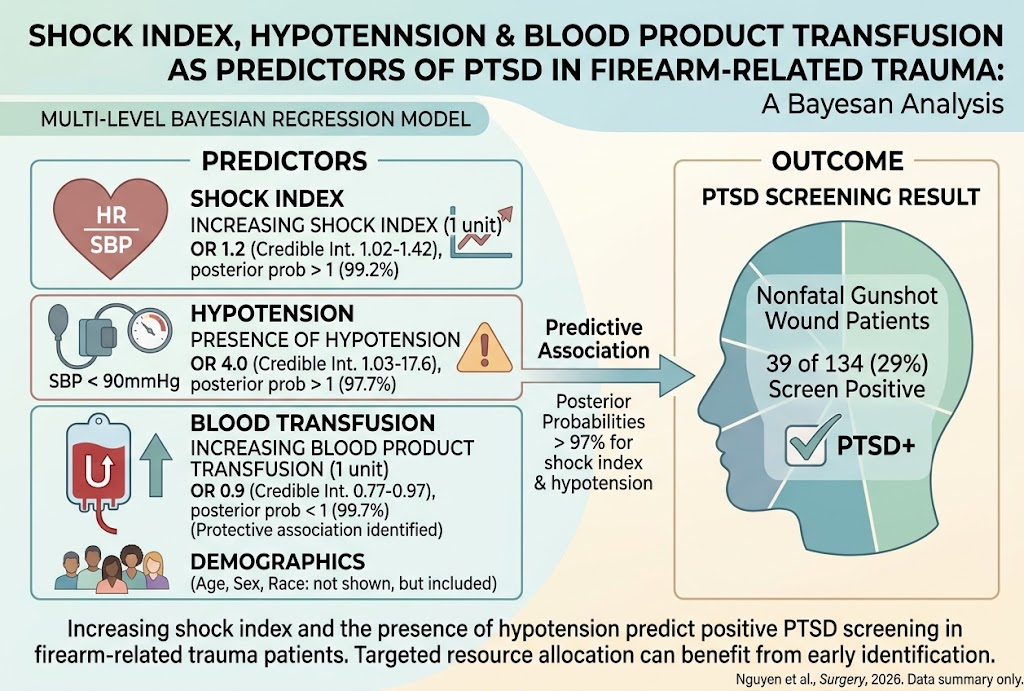
  • Post-traumatic stress disorder (PTSD) affects nearly 30% of gunshot wound survivors in this urban trauma cohort.
  • Increased shock index and hypotension during initial resuscitation significantly predict positive PTSD screens.
  • Contrarily, higher units of blood product transfusion correlate with a decreased likelihood of PTSD diagnosis.
  • Early physiologic markers may enable targeted mental health interventions in firearm trauma patients.

Study Background

MedXY registered readers

Sign in free to continue reading

Create or use your MedXY account to unlock the complete article.

This article was created using several editorial tools, including AI, as part of the process. Human editors reviewed this content before publication.

Related articles

Open language-specific specialty feeds and department pages.

Elevated Risk of Premature Ovarian Failure Following Severe Postpartum Hemorrhage Requiring Blood Transfusion: Insights from a Nationwide Korean CohortA large Korean cohort study reveals that women experiencing severe postpartum hemorrhage requiring red blood cell transfusion have significantly increased risk of premature ovarian failure, underscoring the need for long-term reproductive mAug 9, 2026Bridging the Mental Health Care Gap for Trauma Patients at Risk of PTSD: Insights from Social WorkersThis article examines the current gaps and strengths in mental health services for trauma surgery patients at risk of PTSD, highlighting underutilization of guidelines, barriers to care, and opportunities for improving psychosocial support.Aug 4, 2026Finerenone and Hypotension Risk in Heart Failure: Evidence from the FINEARTS-HF TrialThis analysis of the FINEARTS-HF trial identifies that while finerenone increases hypotension risk in HFmrEF and HFpEF patients, its clinical benefits persist. The study highlights key predictors of hypotension, such as low baseline blood pDec 26, 2025
Loading comments...
MedXY briefing

Get the free newsletter

Evidence-led clinical news, trends, and analysis—delivered to your inbox.

Ask MedXY AI

Most popular

Intimate Health
Five Benefits for Women Continuing Sexual Activity After Menopause
Intimate Health
Why Some Women Have a Strong Sex Drive—And Why Men Shouldn't Worry About It
Nursing & care
How often should a couple have sex?
Intimate Health
Classic Intimacy Recommendations: How to Help Women Reach Orgasm and Enjoy Mutual Pleasure
Intimate Health
What Makes a Woman "Physiologically Addicted" Is Never Money, But These Two Relationship Qualities
© 2026 MedXY
Contact usAbout usPrivacy PolicyMedXY story
Enhancing Early Detection of Postpartum Hemorrhage: Insights from a WHO Meta-Analysis on Clinical Prognostic Markers
A WHO meta-analysis reveals that combining lower blood loss thresholds with abnormal vital signs improves prediction of severe postpartum hemorrhage outcomes, supporting earlier diagnosis and intervention.
Oct 10, 2025
Optimizing Blood Transfusion Strategies in Acute Myocardial Infarction with Anemia and Heart Failure: Insights from the MINT TrialThe MINT trial reveals that liberal transfusion strategies in MI patients with anemia, including those with heart failure, reduce adverse outcomes compared to restrictive transfusion, supporting a tailored approach to transfusion managementOct 3, 2025
Acute Normovolemic Hemodilution in Cardiac Surgery: No Reduction in Allogeneic Transfusion—Insights from a Multinational Randomized TrialA large multinational trial found that acute normovolemic hemodilution (ANH) did not significantly reduce allogeneic red-cell transfusion in adult cardiac surgery patients, with similar safety outcomes compared to usual care.Sep 30, 2025