Persistence of Blood Inflammatory Biomarkers as Predictors of Long-Term Recurrent Stroke Risk: Insights From the Oxford Vascular Study
Highlights
Inflammatory biomarkers (IL-6, CRP, TNFR-1, NGAL) showed persistent association with recurrent stroke risk over a 10-year follow-up in a large, population-based cohort.
The predictive value of inflammation markers was independent of age, sex, and baseline vascular risk factors, highlighting inflammation as a distinct modifiable risk pathway.
Biomarker burden (number of elevated inflammatory markers) correlated with increased recurrence risk, with consistent effect sizes across early and late post-stroke periods.
Neuronal cell damage and thrombotic biomarkers were less predictive, suggesting inflammation plays a central mechanistic role in long-term stroke recurrence.
Background
Stroke remains a leading cause of morbidity and mortality worldwide, with recurrent events contributing substantially to disability and healthcare burden. While acute management and secondary prevention have improved, the long-term risk of recurrent stroke continues to challenge clinicians. Short-term studies have established that raised inflammatory biomarkers after stroke or transient ischemic attack (TIA) predict early recurrent vascular events. However, it was unclear whether these associations persisted over extended durations under contemporary intensive treatment. Identifying stable predictors of long-term recurrence can refine risk stratification and guide novel preventive interventions.
Key Content
Population-Based Evidence from the Oxford Vascular Study (OXVASC)
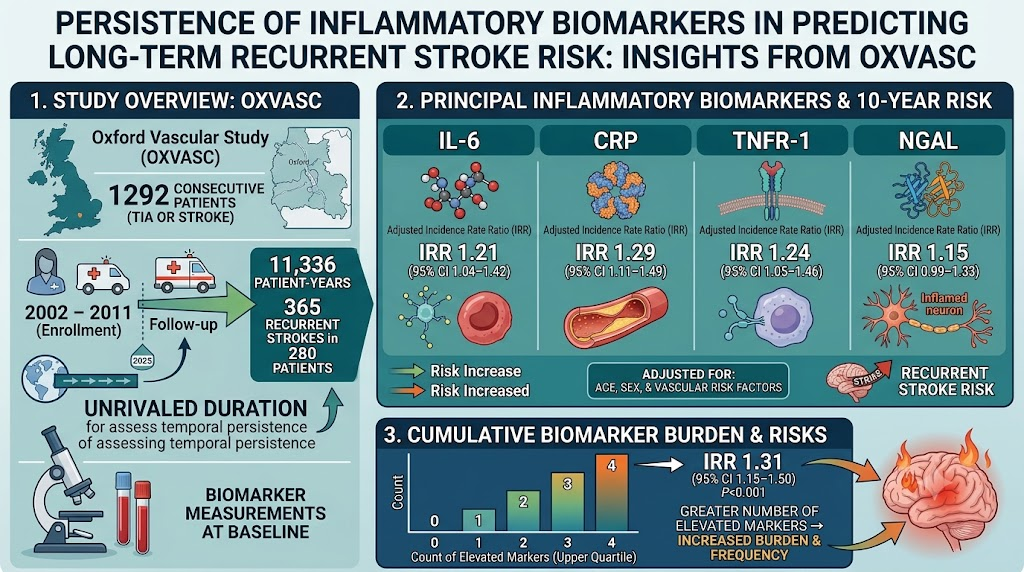
The OXVASC, a rigorously conducted population study, enrolled 1292 consecutive patients with TIA or stroke between 2002 and 2011, with biomarker measurements taken soon after the index event. Follow-up extended through 2025, encompassing 11,336 patient-years and 365 recurrent strokes in 280 patients. This unrivaled duration allowed investigation of the temporal persistence of biomarker associations.
Inflammatory Biomarkers and Recurrent Stroke Risk
Four principal inflammatory markers measured were interleukin-6 (IL-6), C-reactive protein (CRP), tumor necrosis factor receptor-1 (TNFR-1), and neutrophil gelatinase-associated lipocalin (NGAL). Each exhibited significant, independent associations with 10-year recurrent stroke risk after adjustment for age, sex, and established vascular risk factors.
IL-6: Adjusted incidence rate ratio (IRR) 1.21 (95% CI, 1.04–1.42)
CRP: IRR 1.29 (95% CI, 1.11–1.49)
TNFR-1: IRR 1.24 (95% CI, 1.05–1.46)
NGAL: IRR 1.15 (95% CI, 0.99–1.33)
Importantly, a greater number of elevated inflammatory markers (upper quartile) was associated with increased burden and frequency of recurrent strokes (IRR 1.31, 95% CI 1.15–1.50; P<0.001).
Temporal Stability of Predictive Associations
Hazard ratios for elevated inflammatory markers remained stable throughout follow-up periods:
Within 90 days: HR 1.24 (95% CI, 0.98–1.57)
90 days to 1 year: HR 1.24 (95% CI, 0.95–1.62)
1 to 5 years: HR 1.22 (95% CI, 1.01–1.47)
5 to 10 years: HR 1.34 (95% CI, 1.06–1.68)
This consistency underscores a chronic inflammatory milieu contributing to long-term stroke risk beyond the acute phase.
Neuronal and Thrombotic Biomarkers
Markers indicative of neuronal cell damage or thrombosis generally demonstrated weaker and less consistent associations with recurrent stroke risk, suggesting they play a lesser role in predicting long-term recurrence compared to inflammatory markers.
Comparative Evidence and Mechanistic Insights
Previous meta-analyses and cohort studies have variably linked elevated inflammatory markers (particularly CRP and IL-6) with cardiovascular events and stroke risk. However, most were limited by shorter follow-up or hospital-based cohorts. The extensive population-based design of OXVASC, coupled with adjustment for confounders and longer follow-up, strengthens the evidence for inflammation as a durable pathogenic factor.
Inflammation contributes to atherosclerosis progression, plaque instability, and thrombosis, providing a plausible mechanistic basis for these associations. Elevated pro-inflammatory cytokines may reflect ongoing vascular injury and systemic immune activation.
Expert Commentary
The findings from OXVASC address a critical gap regarding the longevity of inflammation-associated stroke risk. The sustained predictive value over a decade is clinically relevant, as current guidelines largely focus on established vascular risk factors such as hypertension, diabetes, and hyperlipidemia.
This evidence supports intensifying inflammatory biomarker measurement in risk stratification models to identify high-risk patients. Moreover, it bolsters the rationale for clinical trials targeting inflammatory pathways for secondary stroke prevention. Recent trials (e.g., CANTOS targeting IL-1β) have demonstrated cardiovascular benefit from anti-inflammatory therapies, suggesting a translational potential.
Limitations include the observational design which precludes causal inference and the single-time biomarker measurement which may not capture longitudinal inflammatory dynamics. The elderly mean cohort age (73 years) means generalizability to younger stroke populations requires caution.
Conclusion
This large population-based study confirms that inflammatory biomarkers remain robust predictors of recurrent stroke risk up to 10 years post-event, independent of traditional vascular risk factors. The persistence and magnitude of these associations highlight inflammation as a chronic contributor to stroke pathogenesis and recurrence.
Incorporating inflammatory markers into clinical risk models may enhance secondary prevention strategies. Furthermore, the results justify further randomized controlled trials evaluating anti-inflammatory interventions for long-term stroke recurrence reduction. Future research should explore longitudinal biomarker trajectories and evaluate targeted therapeutics in diverse patient populations.
References
Li L, Burgess AI, Duerden J, Onions K, Segal HC, Rothwell PM; Oxford Vascular Study. Persistence of Association of Blood Biomarkers With Risk of Recurrent Stroke on Long-Term Follow-Up: Population-Based Study. Stroke. 2026 Aug 3; PMID: 42544483. https://pubmed.ncbi.nlm.nih.gov/42544483/
Ridker PM, Everett BM, Thuren T, et al. Antiinflammatory Therapy with Canakinumab for Atherosclerotic Disease. N Engl J Med. 2017;377(12):1119-1131. PMID: 28845751
Emerging Risk Factors Collaboration. C-Reactive Protein, Fibrinogen, and Cardiovascular Disease Prediction. N Engl J Med. 2012;367(14):1310-1320. PMID: 22955805
Smolina K, et al. Inflammatory biomarkers and recurrent stroke: systematic review and meta-analysis. Neurology. 2018;90(5):e482-e491. PMID: 29353865
This article was created using several editorial tools, including AI, as part of the process. Human editors reviewed this content before publication.