Patient Characteristics Influencing Treatment Choices in Bilateral Vocal Fold Atrophy: Insights from a Decade of Clinical Data
Introduction
Bilateral vocal fold atrophy (BVFA) is a progressive condition characterized by thinning and wasting of the vocal fold muscular and mucosal tissues. This atrophy impairs glottic closure, resulting in dysphonia—commonly perceived as a weak, breathy voice—and posing risks for aspiration and airway compromise in severe cases. As populations age globally, BVFA prevalence is expected to rise, given age-related neuromuscular degeneration and comorbid conditions that adversely affect laryngeal function. Despite its clinical significance, there remains limited understanding regarding the patient-level factors influencing the choice of therapeutic approach for BVFA when presented in routine clinical settings.
Prior research has focused primarily on treatment decision-making in vocal fold paralysis or employed objective vocal assessments to guide therapy. However, such studies do not reflect the multifactorial nature of treatment choice in BVFA, which often involves weighing symptom burden, patient lifestyle (such as professional voice use), comorbidities, and prior treatment history. This knowledge gap presents challenges for clinicians aiming to tailor interventions that balance voice outcomes and airway safety effectively.
Study Design and Methods
A retrospective chart review was conducted at a tertiary academic hospital, encompassing patients diagnosed with BVFA via videostroboscopy over a 10-year period (2015–2024). Inclusion required documented bilateral vocal fold atrophy on endoscopic examination. Data extracted included demographic details, Voice Handicap Index-10 (VHI-10) scores reflecting patient-reported voice impairment, professional voice use status, prior medical and surgical history—including intubations and laryngeal trauma—symptom profiles such as dysphagia, and comorbid conditions including cardiac disease and alcohol use.
Treatment decisions at initial intake were categorized into three groups: observation (no active intervention), voice therapy, or procedural/surgical intervention. Univariable logistic regression analysis was employed to explore associations between baseline characteristics and treatment choices, analyzed separately for voice therapy versus observation and surgical versus nonsurgical interventions.
Key Findings
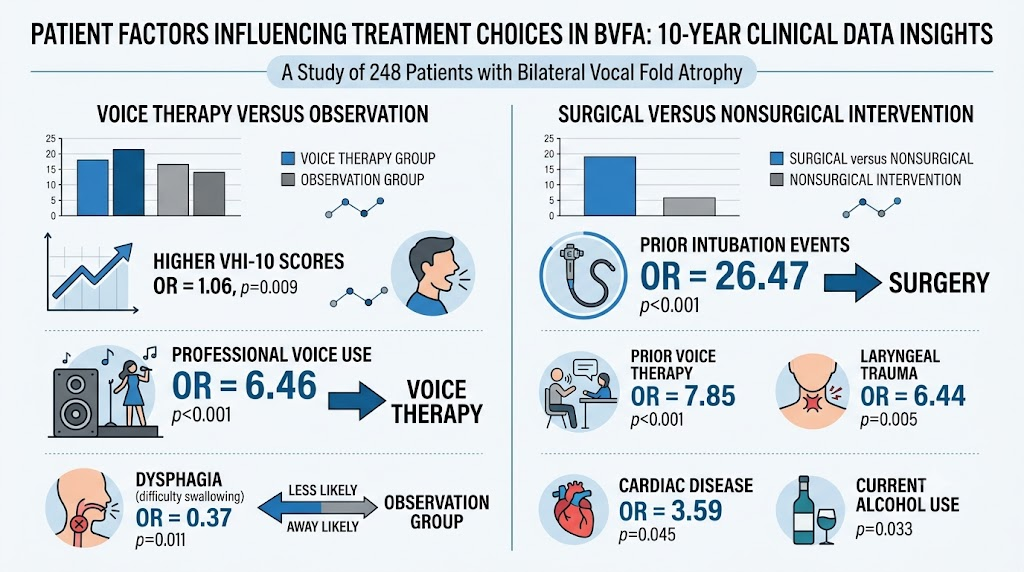
The study cohort comprised 248 patients with BVFA. Analysis revealed distinct patient factors influencing treatment path selection:
Voice Therapy Versus Observation: Higher VHI-10 scores correlated with increased likelihood of electing voice therapy (Odds Ratio [OR] = 1.06 per unit increase, p = 0.009), reflecting that greater perceived voice handicap motivates active therapy. Notably, patients engaged in professional voice use were markedly more likely to choose voice therapy over simple observation (OR = 6.46, p < 0.001). Conversely, patients presenting with dysphagia were less likely to opt for voice therapy (OR = 0.37, p = 0.011), possibly reflecting concerns that such symptoms require more definitive airway management rather than rehabilitative voice-focused care.
Surgical Versus Nonsurgical Intervention: Prior intubation events showed the strongest association with choosing surgery (OR = 26.47, p < 0.001), indicating that prior airway instrumentation and potentially severe glottic injury influence a more interventional approach. Prior voice therapy also raised the odds of surgery (OR = 7.85, p < 0.001), suggesting that insufficient response or persistence of symptoms after conservative management prompts escalation of care. Laryngeal trauma history was another significant factor (OR = 6.44, p = 0.005). Cardiac disease presence (OR = 3.59, p = 0.045) and current alcohol use (p = 0.033) were also independently associated with surgical decision-making, possibly reflecting underlying systemic vulnerability or impact on healing trajectories.
These findings underscore the multifaceted nature of clinical decision-making in BVFA. The clinical severity as reported by patients, occupational voice demands, and comorbid conditions all play integral roles in guiding treatment direction.
Expert Commentary
This study importantly highlights the complexity of choosing the optimal treatment for BVFA beyond pure objective measures or diagnosis. The strong association between professional voice use and selection of voice therapy aligns with clinical intuition—patients reliant on vocal function for career reasons intuitively pursue rehabilitative interventions first.
Equally, the pronounced inclination toward surgery in those with prior intubation or trauma reflects a subgroup with structural compromise and potentially irreversible anatomical changes necessitating more aggressive management. The associations with cardiac disease and alcohol use inform clinicians to consider systemic health status that may influence surgical candidacy or recovery.
However, as a retrospective study, causality cannot be affirmed, and unmeasured confounders may exist. The single-center design may limit broader applicability. Future prospective studies with standardized outcome measures are needed to refine decision-making algorithms and personalize treatment recommendations further.
Conclusion
This comprehensive retrospective analysis delineates key intake-level patient characteristics influencing treatment decisions in bilateral vocal fold atrophy. Higher subjective voice handicap, professional voice dependency, previous therapeutic trial history, and specific comorbidities significantly impact whether patients and clinicians choose observation, therapy, or surgery. Awareness of these factors can enhance shared decision-making, helping to tailor interventions according to individual patient needs and priorities. This groundwork also invites further research exploring longitudinal outcomes and integrative decision-support tools for managing vocal fold atrophy effectively.
Funding and Clinical Trials
No specific funding or clinical trial registry details were reported in the source publication.
References
1. Wu P, Jung H, Hwang J, Chadwick K. Patient Characteristics Associated With Treatment Decisions in Bilateral Vocal Fold Atrophy. The Laryngoscope. 2026 Aug 4. doi:10.1002/lary.42552258. PubMed PMID: 42552258.
2. Koufman JA. Diagnosis and management of vocal fold immobility and paresis. Otolaryngol Clin North Am. 1993;26(3):777-786.
3. Sulica L. Diagnosis and management of vocal fold paresis and paralysis. Curr Opin Otolaryngol Head Neck Surg. 2008;16(3):204-208.
4. Sprecher AJ, Rosen CA, Remacle M. Current trends in treatment of bilateral vocal fold immobility. Curr Opin Otolaryngol Head Neck Surg. 2013;21(6):562-567.
5. Cohen SM, Kim J, Roy N, Asche C, Courey M. The Impact of Dysphagia on Quality of Life Among Patients with Bilateral Vocal Fold Immobility. J Voice. 2020;34(5):767.e1-767.e8.
This article was created using several editorial tools, including AI, as part of the process. Human editors reviewed this content before publication.