We use cookies

Our website uses essential cookies and, with your consent, additional cookies to measure performance and improve our services. Cookie Policy.

You can change your choice at any time.

MMedXYNews
HomeVideos
MedXY AI/MedXY News/Section: Clinical Updates

Paternal Valproate Exposure and Offspring Neurodevelopmental Outcomes: A Comprehensive Review of Current Evidence
MedXY Editorial Team•Aug 24, 2026•Clinical Updates
neurodevelopmental disorderspaternal exposurevalproateantiseizure medications

Highlights

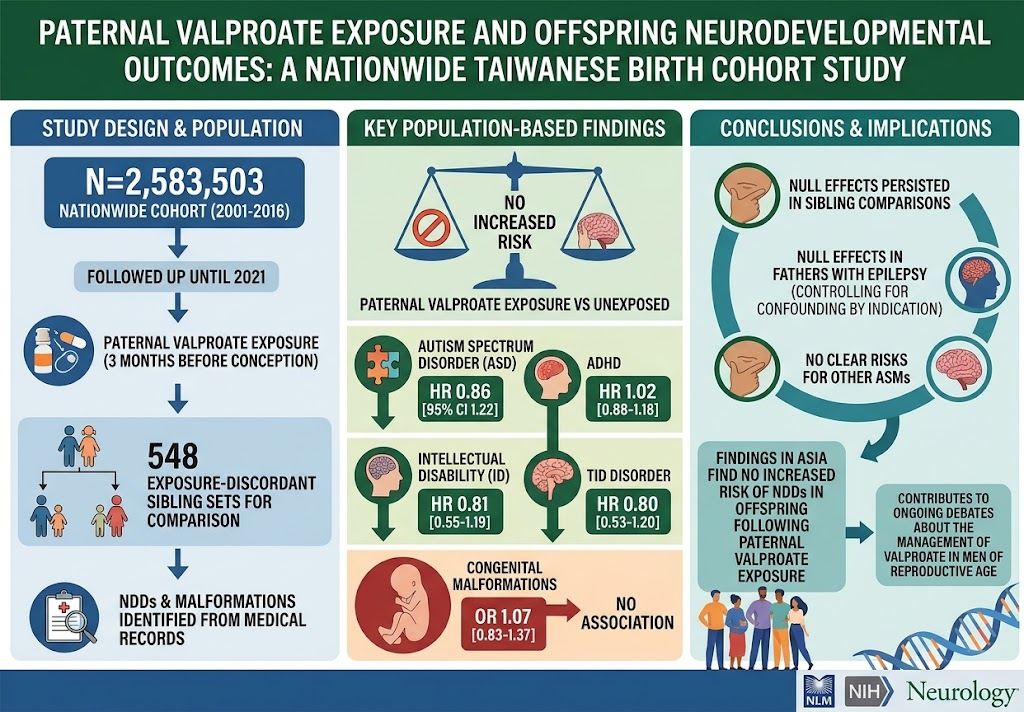
  • Large, population-based data indicate no increased risk of neurodevelopmental disorders or congenital malformations in offspring following paternal valproate exposure during spermatogenesis.
  • Prior studies have established maternal valproate use is associated with significant teratogenic risk, notably congenital malformations and neurodevelopmental impairment, highlighting a gender-specific exposure risk.
  • Sibling-comparison analyses help control for genetic and environmental confounders, strengthening the validity of findings that paternal valproate exposure lacks detectable offspring risk.
  • Comprehensive care for reproductive-age men with epilepsy should consider these findings, although continued vigilance and additional research remain warranted.

Background

MedXY registered readers

Sign in free to continue reading

Create or use your MedXY account to unlock the complete article.

This article was created using several editorial tools, including AI, as part of the process. Human editors reviewed this content before publication.

Related articles

Open language-specific specialty feeds and department pages.

Decoding Persistent Tachypnea of Infancy: Genetic Insights Expand Diagnostic ParadigmsComprehensive exome sequencing reveals genetic heterogeneity in persistent tachypnea of infancy (PTI/NEHI), highlighting its phenotype nature and association with neurodevelopmental disorders, advocating early genetic testing to enhance diaSep 17, 2026Balancing Risks: Safety Profiles of Antiseizure Medications in Epilepsy Patients on Direct Oral AnticoagulantsThis study reveals distinct thromboembolic, bleeding, and mortality risks based on antiseizure medication selection in epilepsy patients receiving direct oral anticoagulants, highlighting the critical role of ASM choice on patient safety anAug 18, 2026Fetal Reduction in Triplet Pregnancies Significantly Reduces Neurodevelopmental Risks, Study FindsA nationwide cohort study reveals that fetal reduction from triplets to twins lowers the long-term risk of neurodevelopmental disorders in surviving children compared to non-reduced pregnancies.Apr 23, 2026Distinctive Endocrine Profiles and Hyperphagia in Rare Genetic Neurodevelopmental Disorders: Beyond the Prader-Willi Paradigm
Loading comments...
MedXY briefing

Get the free newsletter

Evidence-led clinical news, trends, and analysis—delivered to your inbox.

Ask MedXY AI

Most popular

Intimate Health
Five Benefits for Women Continuing Sexual Activity After Menopause
Intimate Health
Why Some Women Have a Strong Sex Drive—And Why Men Shouldn't Worry About It
Nursing & care
How often should a couple have sex?
Intimate Health
Classic Intimacy Recommendations: How to Help Women Reach Orgasm and Enjoy Mutual Pleasure
Intimate Health
What Makes a Woman "Physiologically Addicted" Is Never Money, But These Two Relationship Qualities
© 2026 MedXY
Contact usAbout usPrivacy PolicyMedXY story
This review synthesizes findings from a national multicenter study identifying that hyperghrelinemia is a specific biomarker for Prader-Willi Syndrome, whereas other rare neurodevelopmental disorders exhibit normal ghrelin levels despite se
Mar 11, 2026
The Mortality Gap in Neurodevelopmental Care: Why Young Adults with ASD, ID, and CP Face Higher RisksA landmark study using CDC ADDM Network data reveals significantly elevated mortality risks for young adults with autism, intellectual disability, and cerebral palsy, highlighting a critical need for improved transition-of-care strategies aFeb 10, 2026
Cenobamate Outperforms Brivaracetam, Lacosamide, and Perampanel in Real-World Focal Epilepsy ManagementA large multicenter real-world study indicates that cenobamate provides superior effectiveness and seizure freedom rates compared to brivaracetam, lacosamide, and perampanel in adults with drug-resistant focal epilepsy, despite a higher incFeb 10, 2026