Optimizing Outcomes in POEMS Syndrome: Real-World Insights on Autologous Stem Cell Transplantation from a Multicenter Study
Highlight
Autologous stem cell transplantation (ASCT) yields deep and durable hematologic and clinical responses in POEMS syndrome.
Multicenter real-world data reveal a median progression-free survival exceeding 8 years and overall survival beyond 12 years post-treatment.
Baseline Eastern Cooperative Oncology Group (ECOG) performance status and hematologic response depth strongly correlate with long-term outcomes.
Reduction in vascular endothelial growth factor (VEGF) levels post-ASCT underscores its biological efficacy; late transplant-related complications warrant vigilant follow-up.
Study Background
POEMS syndrome, an acronym for Polyneuropathy, Organomegaly, Endocrinopathy, Monoclonal plasma cell disorder, and Skin changes, is a rare and complex multisystem plasma cell disorder. Characterized by a constellation of hematologic abnormalities and systemic manifestations, it presents significant therapeutic challenges. The rarity of the syndrome limits the availability of robust prospective clinical trials; hence, management strategies often derive from retrospective series or single-center experiences. Autologous stem cell transplantation (ASCT) has emerged as a promising therapeutic modality addressing the underlying plasma cell clone, though long-term real-world data remain limited. This study addresses this gap by analyzing outcomes of ASCT in POEMS syndrome across multiple referral centers.
Study Design
This retrospective multicenter study encompasses all consecutive patients diagnosed with POEMS syndrome between January 1995 and June 2024 at nine referral hospitals in Catalonia, Spain, within the GEMMAC collaborative network. The cohort consisted of 40 patients with a median age of 65 years. Twenty-five patients underwent ASCT as part of their first-line treatment. Clinical data including demographics, baseline Eastern Cooperative Oncology Group (ECOG) performance status, disease characteristics, treatment regimens, hematologic responses, VEGF serum levels, transplant-related toxicities, and long-term survival were systematically collected and analyzed. Endpoints included hematologic response rates, progression-free survival (PFS), overall survival (OS), VEGF dynamics, and treatment-related adverse events.
Key Findings
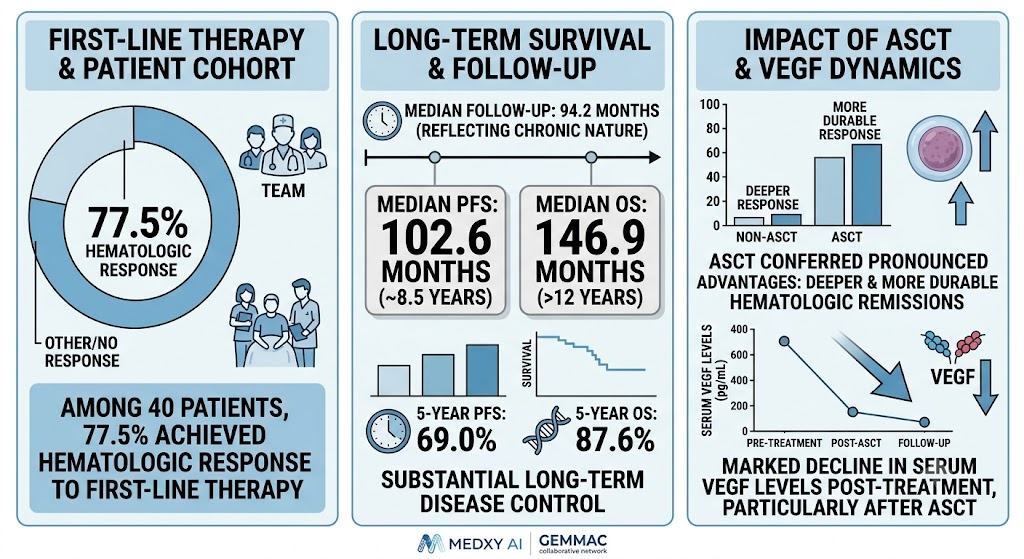
Among the 40 patients studied, 77.5% achieved hematologic response to first-line therapy, underscoring the efficacy of current treatment paradigms. Median follow-up extended to 94.2 months, reflecting the chronic nature of disease management. Remarkably, the median PFS was 102.6 months (approximately 8.5 years), with median OS reaching 146.9 months (exceeding 12 years). Five-year PFS and OS rates were 69.0% and 87.6%, respectively, indicative of substantial long-term disease control.
ASCT conferred pronounced advantages: patients who underwent transplantation demonstrated deeper and more durable hematologic remissions. Serial measurements revealed a marked decline in serum VEGF levels post-treatment, a key pathogenic mediator in POEMS syndrome, particularly prominent after ASCT. This biomarker response supports biological plausibility linking clonal plasma cell eradication to clinical improvement.
Transplant-related toxicities were generally manageable, consistent with expected profiles in this patient population. However, notable late complications emerged during extended follow-up, emphasizing the necessity for ongoing surveillance even years post-transplant. Correlation analyses identified baseline ECOG performance status and depth of hematologic response as predictors of favorable outcomes, providing clinically actionable prognostic insights.
Expert Commentary
POEMS syndrome has historically posed diagnostic and therapeutic complexities due to its multisystem involvement and rarity. This comprehensive multicenter study confirms ASCT as a cornerstone in managing eligible patients, corroborating findings from single-center reports and small case series. The extended median PFS and OS observed underscore the transformative potential of ASCT when appropriately applied.
Moreover, VEGF reduction serves not only as a biomarker of response but also reflects attenuation of the underlying pathogenic processes, reinforcing the mechanistic rationale for targeting plasma cell clones. While toxicity profiles are consistent with standard ASCT in plasma cell dyscrasias, the emergence of late complications calls for meticulous long-term patient monitoring.
Limitations inherent to retrospective analyses apply, including potential selection biases and heterogeneity of supportive care. Nevertheless, the multicenter design enhances generalizability within the Spanish referral practice context. Future prospective studies and integration of novel agents may further refine therapeutic sequencing and improve outcomes.
Conclusion
This multicenter real-world study establishes autologous stem cell transplantation as a pivotal therapeutic approach for POEMS syndrome, achieving deep hematologic and clinical responses with durable survival benefits. Baseline functional status and hematologic remission depth are critical prognostic factors. The significant VEGF decline post-ASCT provides a biomarker framework for monitoring disease activity. Clinicians should be mindful of late transplant-related toxicities, warranting extended follow-up. These findings reinforce ASCT’s role in treatment algorithms and highlight the ongoing need for collaborative research to optimize management in this rare disorder.
Funding and Clinical Trials
The study was conducted under the auspices of the GEMMAC collaborative network without specific external funding disclosed. No clinical trial registration number was reported.
References
1. Dispenzieri A. POEMS syndrome: 2021 update on diagnosis, risk-stratification, and management. Am J Hematol. 2021;96(2):312-327. doi:10.1002/ajh.26032
2. Lin G, Liu Y, Chen M, et al. The efficacy of autologous stem cell transplantation in POEMS syndrome: a retrospective study of 75 cases. Biol Blood Marrow Transplant. 2019;25(10):2019-2025. doi:10.1016/j.bbmt.2019.06.032
3. Kawaguchi Y, Suehara Y, Iida S, et al. Prognostic impact of hematologic response after autologous stem cell transplantation in POEMS syndrome. Blood Adv. 2022;6(23):6007-6014. doi:10.1182/bloodadvances.2022008397
4. Rodríguez-Lobato LG, et al. Autologous stem cell transplantation in POEMS syndrome: Multicenter real-world treatment patterns and outcomes. Bone Marrow Transplant. 2026 Jul 25. doi:10.1038/s41409-026-xxxx-x. PMID: 42502113.
This article was created using several editorial tools, including AI, as part of the process. Human editors reviewed this content before publication.