Highlight
MRONJ poses a significant clinical challenge in patients receiving antiresorptive therapy, with treatment approaches varying by underlying disease etiology.
Surgical management demonstrated superior outcomes compared to conservative treatment in this single-center retrospective cohort.
Patients with osteoporosis-associated MRONJ had higher rates of clinical resolution, correlating with more frequent surgical intervention.
Marginal mandibulectomy and partial maxillectomy were notably effective surgical procedures in achieving complete healing.
Study Background
Medication-related osteonecrosis of the jaw (MRONJ) is a debilitating adverse effect primarily linked to the use of antiresorptive agents such as bisphosphonates and denosumab, prescribed commonly for malignancy-associated bone disease and osteoporosis. The condition manifests as exposed necrotic bone in the maxillofacial region persisting for more than eight weeks, often accompanied by pain, infection, and impaired quality of life. Despite increasing awareness, the optimal management strategy remains contentious, with approaches ranging from conservative systemic antibiotics and local care to aggressive surgical resection. Differing patient populations and etiologies further complicate management, highlighting the need for detailed, evidence-based therapeutic paradigms.
Study Design
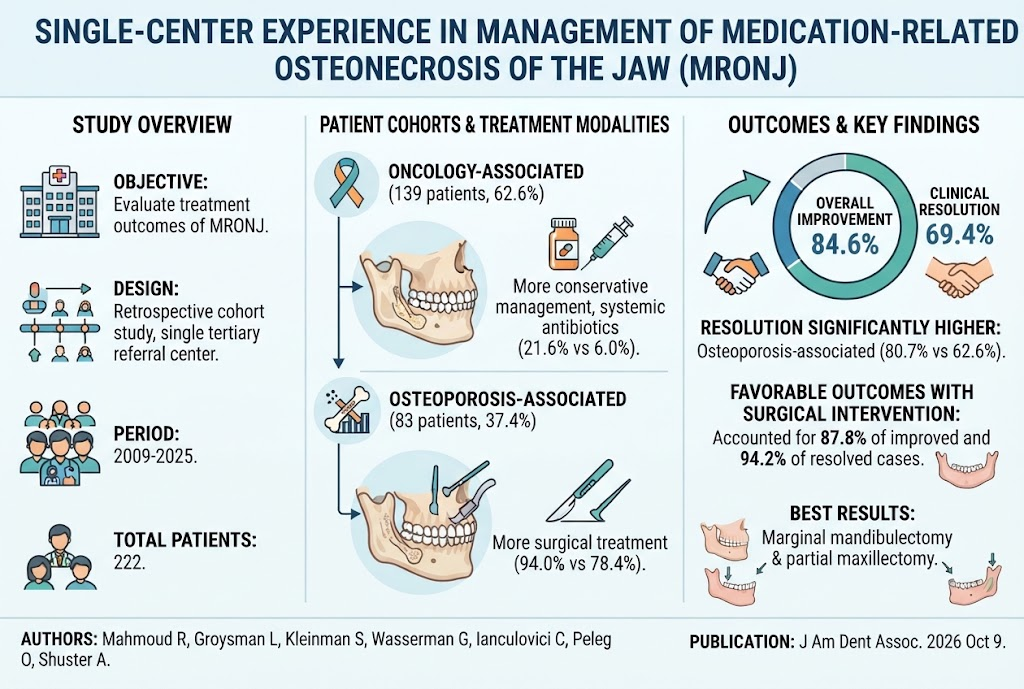
This retrospective cohort study was carried out at a single tertiary referral center analyzing all patients treated for MRONJ between 2009 and 2025. A total of 222 patients were included, comprising two subgroups based on the indication for antiresorptive therapy: oncology-associated MRONJ (62.6%) and osteoporosis-associated MRONJ (37.4%). Treatment modalities included conservative management—primarily systemic antibiotics, oral rinses, and pain control—and surgical interventions, such as marginal mandibulectomy and partial maxillectomy. Clinical endpoints focused on lesion improvement, defined as clinical downstaging, and complete resolution, characterized by full mucosal coverage without infection or exposed bone. Comparative analyses evaluated the distribution and outcomes of treatments between the two groups.
Key Findings
The cohort consisted of 222 patients, predominantly oncology-associated MRONJ cases. Oncology patients were more often treated conservatively (21.6%) compared to only 6% in the osteoporosis subgroup (P = .002). Conversely, surgical treatment was significantly more prevalent in the osteoporosis group (94.0%) than in oncology patients (78.4%; P = .002). Overall, high rates of improvement were achieved—84.6% of patients improved clinically, and 69.4% attained full clinical resolution.
Resolution rates were significantly higher in osteoporosis-associated MRONJ at 80.7%, versus 62.6% for oncology-associated cases (P = .005), suggesting possible differences in disease behavior or response to treatment according to underlying disease context.
Surgical intervention strongly correlated with better clinical outcomes: 87.8% of improvements and 94.2% of complete resolutions occurred in surgically treated patients (P < .001). Among surgical techniques, marginal mandibulectomy and partial maxillectomy were most associated with complete healing (50.0% of resolved cases vs 22.1% in nonhealed cases; P < .001), underlying the importance of tailored surgical resection in appropriate cases.
Expert Commentary
This study contributes valuable real-world evidence indicating that surgical management should be a considered cornerstone for MRONJ treatment, particularly in patients with osteoporosis. The observed differential in resolution rates between oncology and non-oncology patients may reflect distinct pathophysiological mechanisms or the extent of disease at presentation. Limitations include the retrospective design, potential selection bias in treatment modality application, and lack of standardized surgical timing and protocols. Prospective randomized studies will be critical to delineate optimal timing, surgical margins, and adjuvant therapies.
The findings align with recent guidelines emphasizing early surgical consultation for MRONJ and underscore the limited role of conservative therapy in advanced disease stages. Clinicians should weigh patient comorbidities, functional status, and disease burden when choosing between conservative and surgical approaches.
Conclusion
The single-center experience highlights that surgical treatment approaches, particularly marginal mandibulectomy and partial maxillectomy, significantly enhance clinical outcomes in MRONJ patients. Osteoporosis-associated MRONJ responds better to surgical intervention than oncology-associated cases, possibly due to disease characteristics or treatment variables. This study advocates integrating surgical options early in the treatment algorithm for appropriately selected patients and calls for prospective studies to establish evidence-based guidelines on the timing and extent of surgery.
Research and Practice Gaps
Need for prospective, multicenter trials to standardize surgical protocols and evaluate timing of intervention.
Further investigation of pathophysiological differences between MRONJ subtypes to tailor management.
Development of biomarkers to predict treatment response and prognosis.
Funding and ClinicalTrials.gov
The study did not disclose specific funding sources. No clinical trial registration was reported.
References
Mahmoud R, Groysman L, Kleinman S, Wasserman G, Ianculovici C, Peleg O, Shuster A. Single-center experience in the management of medication-related osteonecrosis of the jaw. J Am Dent Assoc. 2026 Oct 9:S0002-8177(26)00432-0. doi: 10.1016/j.adaj.2026.06.015. Epub ahead of print. PMID: 42853155.