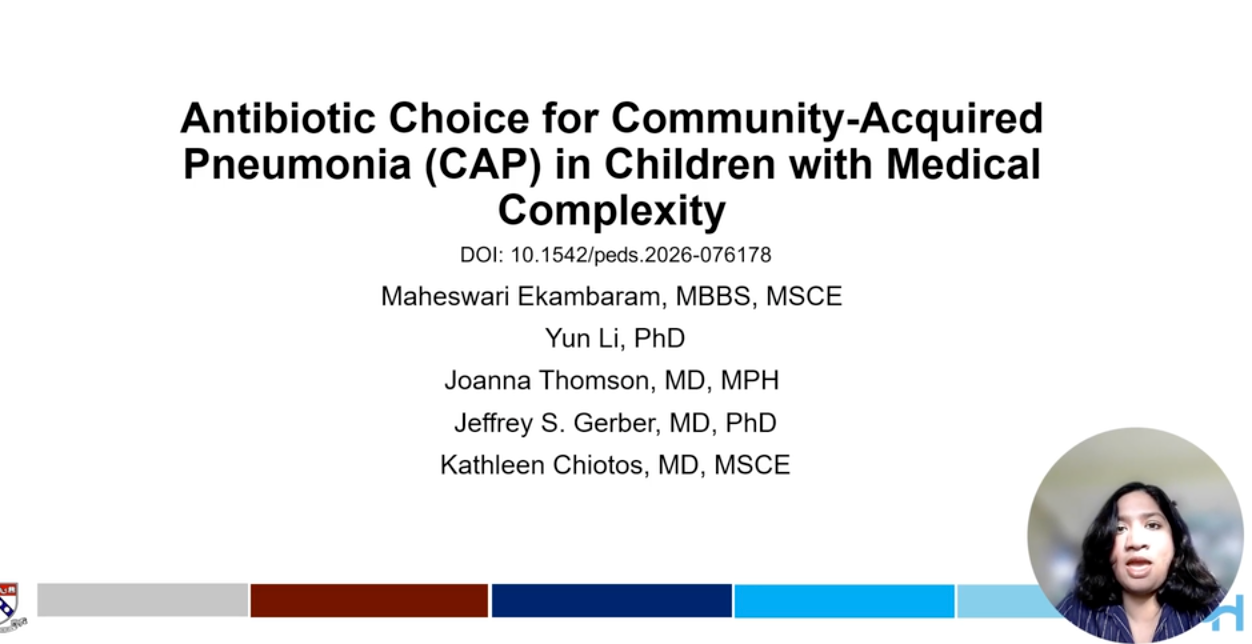
Highlight
This study addresses the evidence gap in antibiotic selection for community-acquired pneumonia (CAP) in children with medical complexity (CMC). Key findings include the lack of clinical advantage of broad-spectrum antibiotics over narrow-spectrum alternatives in hospitalized CMC with nonsevere CAP. The findings support the use of aminopenicillins as initial therapy to optimize outcomes and limit antibiotic overuse.
Study Background
Community-acquired pneumonia (CAP) remains a leading cause of pediatric hospitalization worldwide. Children with medical complexity (CMC)—those with multiple significant chronic conditions and frequent healthcare interactions—are at heightened risk for infections but also vulnerable to adverse effects of broad-spectrum antibiotic overuse. Despite this, current clinical guidelines provide limited guidance specific to this population, particularly regarding antibiotic spectrum choice. The resulting variability in prescribing may impact both clinical outcomes and antimicrobial resistance patterns.
This study by Ekambaram et al. seeks to address this critical knowledge gap by comparing broad-spectrum versus narrow-spectrum antibiotic efficacy in CMC hospitalized with nonsevere CAP, using rigorous target trial emulation methods within an academic health system setting.
Study Design
The investigators performed a retrospective cohort study emulating a target trial, analyzing hospitalizations from January 2016 to April 2024. Eligible patients were aged 3 months to 21 years with ICD-10 codes for CAP and complex chronic conditions who received at least three days of antibiotic therapy. Exclusion criteria were severe or complicated CAP, chronic pulmonary diseases, sickle cell disease, tracheostomies, immunosuppression, concurrent bacterial infections, or recent CAP admission to reduce confounding.
The primary exposure compared was initial broad-spectrum antibiotic administration—defined as CAP antibiotics other than aminopenicillins—initiated within 12 hours of hospital presentation, versus initial narrow-spectrum aminopenicillin therapy. The primary outcome measured was time to hospital discharge, censored at day 10. Secondary outcomes included progression to severe CAP and 30-day CAP-related hospital revisits.
To reduce bias from confounding, the authors employed inverse probability of treatment weighting and applied a Royston-Parmar flexible survival model for time-to-event analysis along with logistic regression for binary outcomes. A total of 847 encounters involving 749 patients were analyzed, with 742 encounters retained post-weighting for balanced covariates.
Key Findings
The core findings showed no statistically significant differences between the broad-spectrum and narrow-spectrum antibiotic groups in:
Time to hospital discharge (hazard ratio [HR], 0.84; 95% confidence interval [CI], 0.68–1.04), indicating slightly longer but non-significant discharge times with broad-spectrum antibiotics.
Progression to severe CAP (odds ratio [OR], 1.29; 95% CI, 0.7–2.4), suggesting no protective benefit of broader coverage against disease escalation.
30-day CAP-related hospital revisits (OR, 0.39; 95% CI, 0.1–1.2), with no significant difference and a wide confidence interval indicating limited precision in this secondary endpoint.
These results collectively suggest that broader-spectrum antibiotics do not confer additional clinical benefit in nonsevere CAP among CMC compared with aminopenicillins, a finding that supports narrow-spectrum use to limit unnecessary antimicrobial exposure.
Expert Commentary
Given the complexity and vulnerability of this patient population, clinicians might instinctively favor broad-spectrum empiric therapy due to concerns of multi-drug resistant organisms and atypical pathogens. Yet, the study’s robust methodology—utilizing target trial emulation and advanced statistical adjustment—strengthens the validity of these findings.
Notably, exclusion of severe cases and immunocompromised hosts allows these results to be most directly applicable to nonsevere CAP management, where antibiotic stewardship is paramount. This aligns with pediatric guidelines favoring aminopenicillins in typical CAP but extends this recommendation to medically complex children, a group often underrepresented in clinical trials.
Limitations include the retrospective design and reliance on administrative data, which may not capture all clinical nuances or microbiologic details. The study’s single academic system setting may affect generalizability, although the cohort size and rigorous adjustment afford reasonable confidence.
Current IDSA and pediatric pneumonia guidelines emphasize tailored therapy balancing efficacy and minimizing collateral resistance. This study provides timely real-world evidence to support such stewardship in a challenging cohort.
Conclusion
For children with medical complexity hospitalized with nonsevere community-acquired pneumonia, initial treatment with broad-spectrum antibiotics does not improve clinical outcomes compared to narrow-spectrum aminopenicillins. This evidence supports guideline-concordant antibiotic selection emphasizing aminopenicillins to optimize patient outcomes while mitigating risks linked to broad-spectrum antibiotic overuse, including resistance development and adverse effects.
Further research could focus on microbial etiology, resistance patterns, and long-term outcomes within this population to refine recommendations. Clinicians should consider this evidence when making empiric antibiotic decisions for CMC with CAP, ensuring stewardship principles are maintained without sacrificing clinical efficacy.
Funding and ClinicalTrials.gov
The study was supported by institutional funding within the academic health system. No clinical trial registration was reported due to retrospective cohort design.
References
Ekambaram M, Li Y, Thomson J, Gerber JS, Chiotos K. Antibiotic Choice for Community-Acquired Pneumonia in Children With Medical Complexity. Pediatrics. 2026 Oct 7. PMID: 42838530.
Bradley JS, Byington CL, Shah SS, et al. The management of community-acquired pneumonia in infants and children older than 3 months of age: clinical practice guidelines by the Pediatric Infectious Diseases Society and the Infectious Diseases Society of America. Clin Infect Dis. 2011;53(7):e25-e76.
World Health Organization. Pocket book of hospital care for children: guidelines for the management of common childhood illnesses. 2nd edition. 2013.
Thomson J, Gerber JS. Antibiotic stewardship in children with medical complexity. Curr Opin Pediatr. 2023;35(1):112-117.