Highlight
This large retrospective study of 569 patients (727 eyes) with intraocular and epibulbar metastases over 40 years provides valuable insight into persistent survival challenges despite advances in systemic cancer treatments. Key highlights include: (1) Median overall survival following ocular metastasis detection remains under nine months; (2) Breast and lung cancers are the predominant primary origins, with lung cancer correlating with significantly worse survival; (3) Treatment offers meaningful vision preservation or improvement and tumor regression in the majority; (4) No significant survival improvement was evident between earlier and later decades studied.
Background: Burden and Clinical Context of Ocular Metastases
Ocular metastases represent the most common intraocular malignant tumors, occurring when systemic cancers disseminate to ocular tissues. The eye’s vascular-rich choroid is the frequent site due to hematogenous spread, although metastases may also affect epibulbar and other intraocular sites. With increasing cancer survival in some populations, recognition and management of ocular metastases have become clinically relevant for preserving vision and quality of life. However, survival following ocular involvement remains poor, and the efficacy of evolving systemic therapies on ocular metastasis prognosis is not fully established.
Study Design and Methods
This retrospective case series and trend study reviewed medical records from 569 patients diagnosed with ocular metastases spanning from 1979 to 2018, encompassing a total of 727 affected eyes. Data were extracted on demographics, primary cancer type and metastatic history, ocular tumor characteristics (laterality, focality, tumor size), diagnostic biopsies, systemic and ophthalmic treatments, and clinical outcomes including symptoms, visual acuity changes, tumor response, and survival. Statistical analyses included descriptive statistics, cross-tabulations, and survival analyses using Kaplan-Meier curves and log-rank testing to compare survival across time intervals and cancer types.
Key Findings and Results
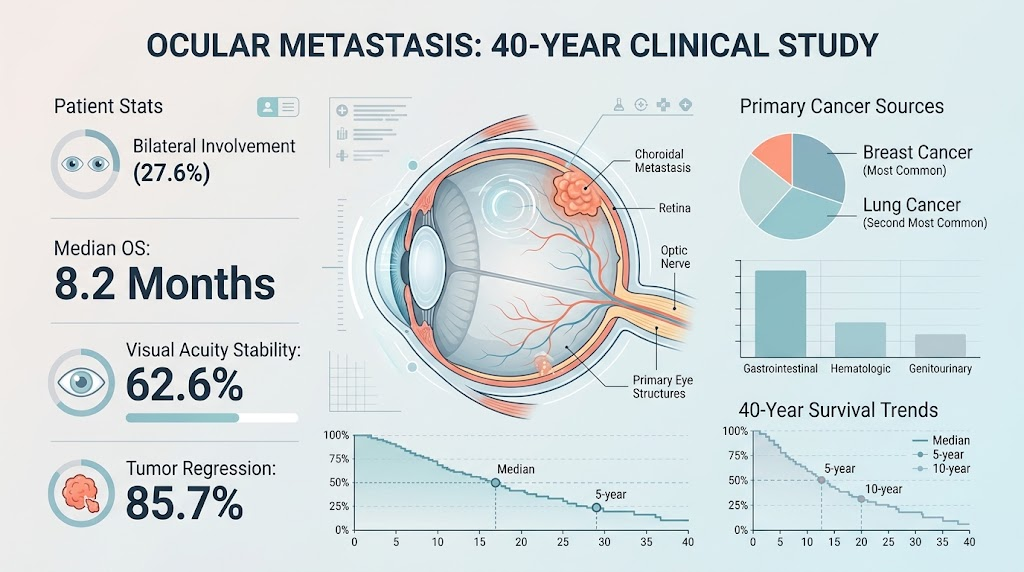
Survival Outcomes: Survival data were robust with known death dates for 98.1% of patients. Median overall survival after ocular metastasis diagnosis was 8.2 months. The 5-year survival rate was 8.2%, and 10-year survival was only 2.8%. Notably, survival did not significantly improve in the latter 20 years compared to the earlier 20 years of this 40-year interval, despite advancements in systemic cancer therapies.
Primary Cancer Distribution: Breast carcinoma was the most frequent primary tumor causing ocular metastases, consistent with literature citing its predilection for choroidal spread. Lung carcinoma was the second most common origin and was associated with significantly worse patient survival compared to breast cancer. Other primaries included gastrointestinal, hematologic, and genitourinary cancers at lower frequencies.
Ocular Involvement Characteristics: Of the 569 patients, 27.6% eventually developed bilateral ocular metastases. Tumors varied in size, with documented largest basal diameters and thicknesses. Both intraocular and epibulbar metastases were represented.
Treatment and Visual Outcomes: Among the 435 treated eyes, follow-up visual acuity data were available for 313 eyes. Visual acuity was stable or improved in 62.6% of these cases. Tumor response, assessed via fundus examination in 286 eyes, showed complete or partial regression in 85.7% initially. Treatment modalities included systemic therapy, local ophthalmic interventions, or combined approaches.
Cause of Death and Prognostic Considerations: Overall mortality remained high and rapid following ocular metastasis detection. Patients with lung cancer primaries had notably poorer prognosis, emphasizing the aggressive nature of pulmonary metastatic disease affecting the eye.
Expert Commentary and Interpretation
This extensive dataset confirms that ocular metastasis heralds advanced systemic disease with dismal survival despite improvements in oncologic care over four decades. The eye serves as a sentinel for systemic metastatic burden, particularly in breast and lung cancers. The absence of significant survival gains over forty years highlights the aggressive biology of cancers that metastasize to the eye and underscores the need for novel systemic therapies targeting metastatic phenotypes.
Despite poor survival, the documented therapeutic success in preserving or improving vision and inducing tumor regression is clinically meaningful. It suggests that ophthalmic interventions, alongside systemic cancer therapies, can maintain visual function and improve quality of life during limited survival. However, incomplete data on systemic regimens and newer targeted or immunotherapies limit the ability to correlate survival improvements with contemporary oncologic advances directly.
Limitations of this study include its retrospective design, potential selection biases inherent in referral patterns to a single center, and incomplete data on systemic treatment regimens and follow-up duration in some cases. Nevertheless, it represents one of the largest cohorts characterized over an extended period, offering a unique perspective on ocular metastatic disease epidemiology and outcomes.
Conclusion
This comprehensive 40-year study elucidates the grim prognosis associated with ocular metastases despite evolving systemic cancer treatments. Breast and lung cancers predominate as primary sites, with lung cancer conferring worse survival. Treatment effectively preserves vision and induces tumor regression in most patients but does not significantly alter overall survival. These findings highlight the clinical importance of early detection and vision-preserving therapy in ocular metastasis, alongside ongoing urgent need for breakthroughs in systemic cancer management to improve survival outcomes.
Funding and Trial Registration
No specific funding sources or clinical trial registrations were reported for this retrospective analysis.
References
Leone AR, Augsburger JJ, Corrêa ZM. Ocular Metastasis: Clinical Course and Survival Analysis of 569 Patients (727 Eyes) Over a 40-Year Interval (1979-2018). American Journal of Ophthalmology. 2026 Oct 9. PMID: 42855109.
Other pertinent literature on ocular metastases and systemic cancer survival can be found in databases such as PubMed for further clinical context and understanding.