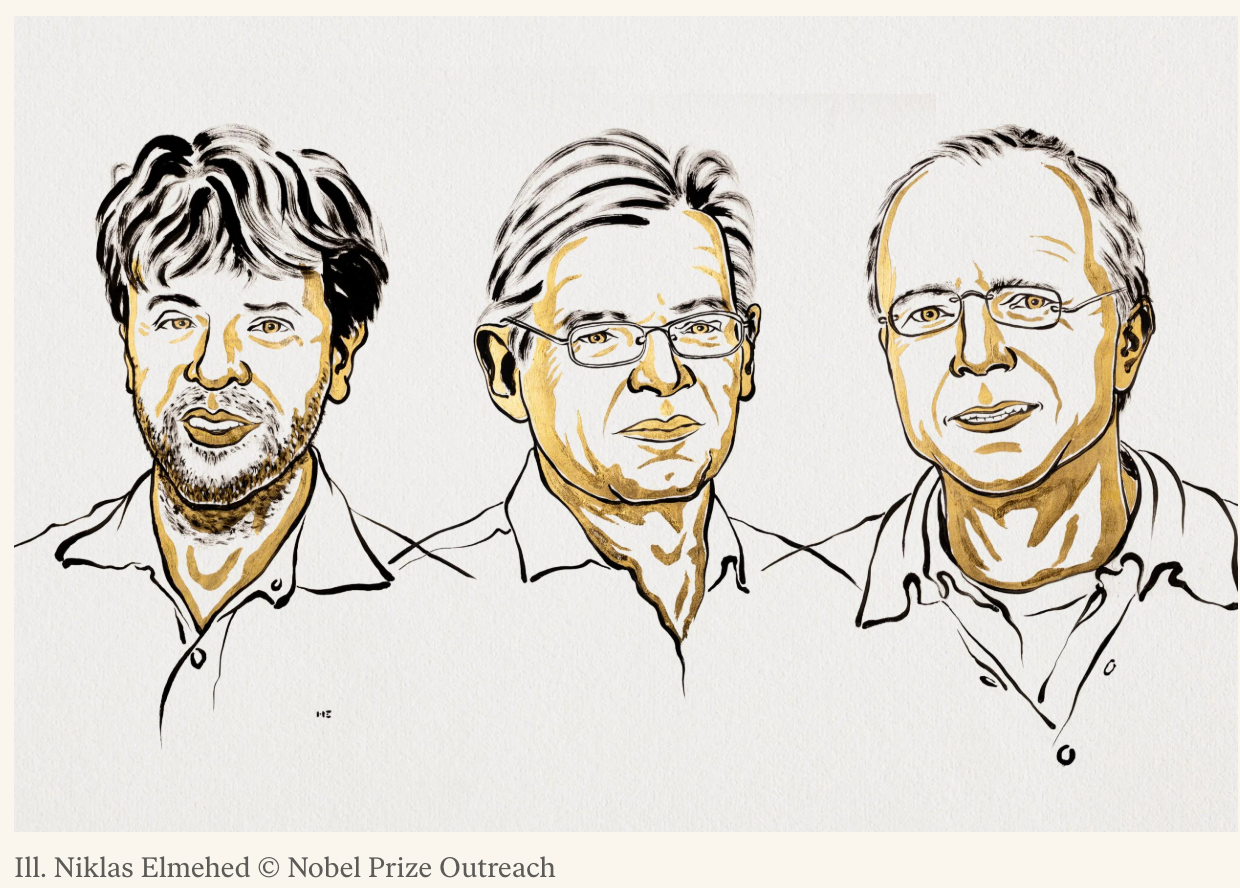
The 2026 Nobel Prize in Physiology or Medicine was awarded to Karl Deisseroth, Peter Hegemann and Georg Nagel for discoveries on light-controlled ion channels and optogenetics, according to the source announcement.
Optogenetics lets researchers switch genetically defined populations of neurons on or off with light, on a millisecond timescale.
The prize is worth 12 million Swedish kronor, about 8 million RMB, an increase of 1 million kronor over the previous level.
This report rests on a single news brief: no primary papers, trial data, effect estimates, safety data or registry entries were supplied.
The source reports no patient outcomes, and no optogenetic therapy is described as an approved clinical treatment.
Award snapshot as reported in the source brief
Award: 2026 Nobel Prize in Physiology or Medicine.
Laureates: Karl Deisseroth, Peter Hegemann and Georg Nagel.
Recognised work: discoveries concerning light-controlled ion channels and optogenetics.
Prize amount: 12 million Swedish kronor, given as approximately 8 million RMB.
Evidence level: news announcement only. No primary publication, dataset, trial registration, confidence interval or independent verification was supplied.
The award recognises a tool that changed how brain circuits are studied
The 2026 Nobel Prize in Physiology or Medicine has been awarded to Karl Deisseroth, Peter Hegemann and Georg Nagel for discoveries concerning light-controlled ion channels and optogenetics, according to the source brief underlying this report. The announcement places the award at the intersection of molecular biophysics and neuroscience: a family of proteins that respond to light by moving ions across cell membranes, and the method that turned those proteins into a general-purpose switch for studying the nervous system.
Unlike prizes in this category that honour a specific disease mechanism or a therapeutic class, this award concerns an enabling technology. That distinction shapes how the result should be read. The prize recognises a research capability that has reshaped experimental neuroscience, not a treatment shown to change patient outcomes. The source brief contains no clinical trial data, no patient numbers, no effect estimates and no regulatory decisions.
What actually is a light-controlled ion channel?
Ion channels are protein pores that sit in the fatty membrane surrounding every cell. When they open, specific ions flow down their electrochemical gradient, and the resulting movement of charge shifts the electrical voltage across the membrane. In neurons, that voltage shift is the currency of signalling: it decides whether a cell fires and how much neurotransmitter it releases.
Ordinary ion channels are gated by voltage, by chemicals such as neurotransmitters, or by mechanical force. The proteins recognised by this prize are gated by light. They are found naturally in microorganisms, where they help single-celled organisms sense and respond to their illuminated environment, and they work as compact, self-contained sensors: a single protein both absorbs a photon and opens a pore, with no need for a separate downstream signalling cascade.
Two structural and functional features made these proteins unusually attractive as laboratory instruments. First, the response is fast. Channel opening and closing occurs on a millisecond timescale, which is the timescale on which neurons actually communicate. Second, the family is functionally diverse.
Different members conduct different ions or move ions in different directions, so the tools can be used in two opposite modes: some depolarise a cell and make it more likely to fire, while others hyperpolarise it and suppress activity. In practical terms, this means a researcher can press an accelerator and a brake on the same circuit, using light of different colours.
How the technique works in practice
Optogenetics is not a single product or drug. It is a method assembled from three components, and the source brief's citation refers to the underlying discoveries rather than to a finished clinical platform.
Genetic targeting. The gene encoding a light-gated channel is introduced so that it is expressed only in a chosen class of cells. Because expression is controlled genetically rather than anatomically, the tool can be restricted to, for example, neurons that use one particular neurotransmitter or that project to one particular target.
Light delivery. An implanted optical fibre, a laser or a light-emitting diode illuminates the target region. Light is the control signal, and it can be switched on and off within milliseconds.
Readout. Electrophysiological recording, calcium imaging or behavioural measurement captures the consequence of switching the cells on or off.
This combination addresses two long-standing limits of older experimental approaches. Electrical stimulation excites everything within reach of an electrode, regardless of cell type. Drugs act on receptor classes distributed throughout the brain rather than on identified circuits. Light-guided control, by contrast, is both cell-type specific and temporally precise.
Why causality, not correlation, is the payoff
Much of neuroscience has depended on observation: recording activity while an animal performs a task, or damaging a structure and watching what goes wrong. Both approaches generate correlations or relatively crude lesions. They struggle to answer the question of whether a given circuit actually causes a given behaviour.
Optogenetics supports true gain-of-function and loss-of-function experiments in intact, behaving animals. Activate the circuit and see what appears. Silence it and see what disappears. That logic has been applied across species, including rodents, fish, insects and non-human primates, and it underpins much of the modern mapping of circuits underlying movement, memory, reward, sleep, feeding and sensory processing.
An important qualification is that methodological influence is not the same as patient benefit. A technique can transform an entire research field while remaining many steps removed from a clinical endpoint, and the source brief offers no evidence that any of that distance has yet been closed.
Clinical translation: plausible directions, unproven benefits
Because the method can restore light sensitivity to cells that do not normally respond to light, its most obvious translational direction is the retina, where inherited degeneration destroys the photoreceptors that normally convert light into electrical signals. In principle, remaining retinal neurons could be re-sensitised. Other research directions that have been explored in the field include direct modulation of seizure-generating tissue in epilepsy, modulation of deep brain targets relevant to movement disorders, and control of pain-signalling pathways.
None of these directions can be evaluated from the source brief. It reports no trials, no endpoints, no follow-up, no adverse events and no regulatory submissions, and it does not state that any optogenetic intervention has been approved for human use. Any clinical programme would have to solve several problems that basic research does not face: delivering the gene reliably and durably to the right cells, avoiding immune rejection, supplying light to deep or delicate tissue without damaging it, and generating long-term safety data in humans.
Readers should therefore treat optogenetics as an established research tool and an investigational clinical idea, not as a therapy.
What the prize is worth, and how the sum has grown
According to the source brief, this year's prize is worth 12 million Swedish kronor, given as approximately 8 million RMB. Each Nobel Prize this year increases by 1 million kronor, or roughly 670,000 RMB, to reach that 12 million kronor figure.
The brief traces the trajectory of the award sum:
1901, the first year of the prizes: 150,000 Swedish kronor.
2020: the prize rose to 10 million kronor.
2023: the prize rose to 11 million kronor.
Now: 12 million kronor.
Currency conversions are the brief's own approximations and fluctuate with exchange rates.
The past five years in physiology or medicine
The brief lists the five preceding laureates in this category, showing how the prize has moved between immunology, gene regulation, vaccine technology, evolutionary genomics and sensory biology.
Year | Laureates | Recognised discovery, as listed in the source brief |
|---|---|---|
2025 | Mary E. Brunkow, Fred Ramsdell, Shimon Sakaguchi | Peripheral immune tolerance |
2024 | Victor Ambros, Gary Ruvkun | microRNA and its role in post-transcriptional gene regulation |
2023 | Katalin Karikó, Drew Weissman | Nucleoside base modifications that enabled effective mRNA vaccines against COVID-19 |
2022 | Svante Pääbo | Genomes of extinct hominins and human evolution |
2021 | David Julius, Ardem Patapoutian | Receptors for temperature and touch |
Placed alongside that sequence, the 2026 award is unusual in one respect: it honours an experimental method rather than a discovered biological mechanism or a therapeutic platform. That is a statement about how central the tool has become to neuroscience, not a statement about its clinical readiness.
116 awards, 232 laureates: the prize in numbers
From 1901 to 2025, the physiology or medicine prize was awarded 116 times.
It was not awarded in nine years: 1915, 1916, 1917, 1918, 1921, 1925, 1940, 1941 and 1942.
Between 1901 and 2025, 232 people received the prize, of whom 14 were women.
Of the 116 awards, 40 went to a single laureate, 36 were shared by two laureates and 40 were shared by three.
The youngest laureate was Frederick G. Banting, honoured in 1923 at age 31 for the discovery of insulin.