We use cookies

Our website uses essential cookies and, with your consent, additional cookies to measure performance and improve our services. Cookie Policy.

You can change your choice at any time.

MMedXYNews
HomeVideos
MedXY AI/MedXY News/Section: Hematology-Oncology

Navigating the Decision-Making Burden in Cancer Care: Oncologists’ Perspectives and Strategies
MedXY Editorial Team•Aug 28, 2026•Hematology-Oncology
cancer carepatient burdenoncology cliniciansShared decision making

Introduction

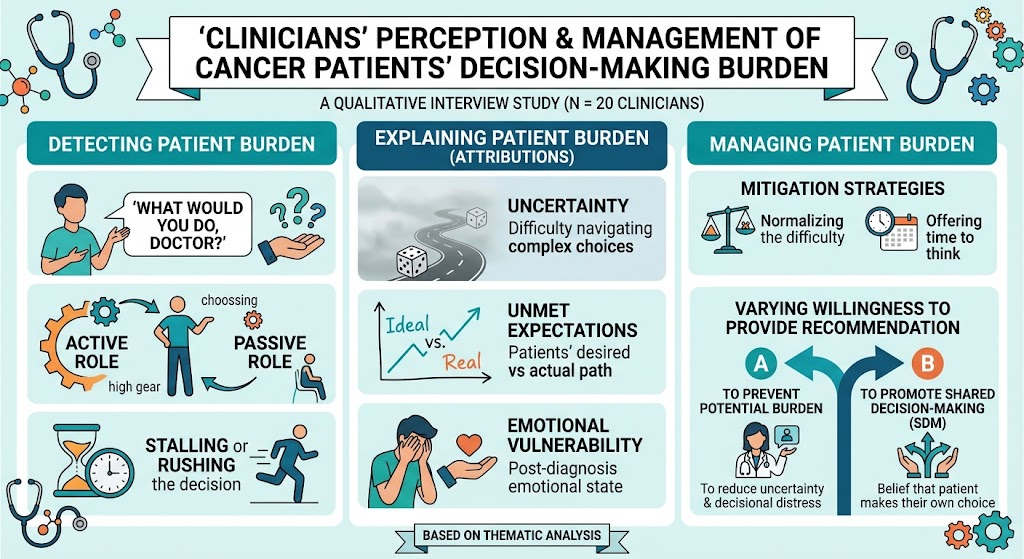
Cancer care has increasingly emphasized patient-centered approaches, with shared decision making (SDM) becoming a cornerstone in treatment planning. Involving patients actively in decisions respects autonomy and can improve satisfaction and adherence. However, the complexity and emotional weight of cancer treatment choices may impose a significant decision-making burden on patients. Understanding how clinicians perceive and manage this burden is crucial to optimizing SDM and ensuring patients receive support without feeling overwhelmed.

Background

MedXY registered readers

Sign in free to continue reading

Create or use your MedXY account to unlock the complete article.

This article was created using several editorial tools, including AI, as part of the process. Human editors reviewed this content before publication.

Related articles

Open language-specific specialty feeds and department pages.

Understanding Physicians’ Mental Models on Goals of Care in Chronic Critical Illness: Implications for Shared Decision MakingThis study explores how intensivists conceptualize appropriate goals of care and the influences of health system factors on decision-making for patients with chronic critical illness, emphasizing predictions about quality of life and functiSep 12, 2026Technology-Guided Diet Counseling Training Enhances Resident Physicians’ Shared Decision-Making Skills in Primary CareTechnology-guided diet counseling training using the Nutri platform improves resident physicians’ attitudes, self-efficacy, and intention to discuss diet, facilitating shared decision making in routine primary care.Aug 27, 2026Personalizing Osteoporosis Treatment: Integrating Pharmacotherapy with Patient-Centered Lifestyle StrategiesThis article explores personalized osteoporosis management, combining evidence-based pharmacologic therapies with individualized lifestyle and nutrition guidance, to improve patient outcomes through shared decision making.Aug 18, 2026
Loading comments...
MedXY briefing

Get the free newsletter

Evidence-led clinical news, trends, and analysis—delivered to your inbox.

Ask MedXY AI

Most popular

Intimate Health
Five Benefits for Women Continuing Sexual Activity After Menopause
Intimate Health
Why Some Women Have a Strong Sex Drive—And Why Men Shouldn't Worry About It
Nursing & care
How often should a couple have sex?
Intimate Health
Classic Intimacy Recommendations: How to Help Women Reach Orgasm and Enjoy Mutual Pleasure
Intimate Health
What Makes a Woman "Physiologically Addicted" Is Never Money, But These Two Relationship Qualities
© 2026 MedXY
Contact usAbout usPrivacy PolicyMedXY story
Embedding Tobacco Treatment Into Cancer Care Achieved Universal Screening but Exposed Persistent Gaps in Cessation Assistance
A cancer program quality improvement initiative reached a 100% smoking-status ask rate through an electronic hard stop, but assistance for identified smokers remained inconsistent, underscoring the implementation gap between screening and e
May 29, 2026
CBT‑I in Cancer Survivors: Small Subjective Gains, Unclear Objective Benefits — What the 2025 Cochrane Review Tells CliniciansA 2025 Cochrane review of 21 RCTs (2431 participants) finds cognitive behavioural therapy for insomnia (CBT‑I) yields modest improvements in self‑reported insomnia and sleep quality in people with cancer versus inactive controls or aerobic Dec 16, 2025
Digital‑Twin Decision Aid for Knee Osteoarthritis Improves Decision Quality and 6‑Month Function: Randomized Trial ResultsAn AI-enabled decision aid that generated patient-specific digital twins improved decision quality, reduced decisional conflict and regret, and produced better 6–9 month knee function versus education alone in patients considering total kneNov 1, 2025