Navigating Conflicting Clinical Trial Evidence: The FDA’s Approval Journey of Gepirone Extended Release for Major Depression
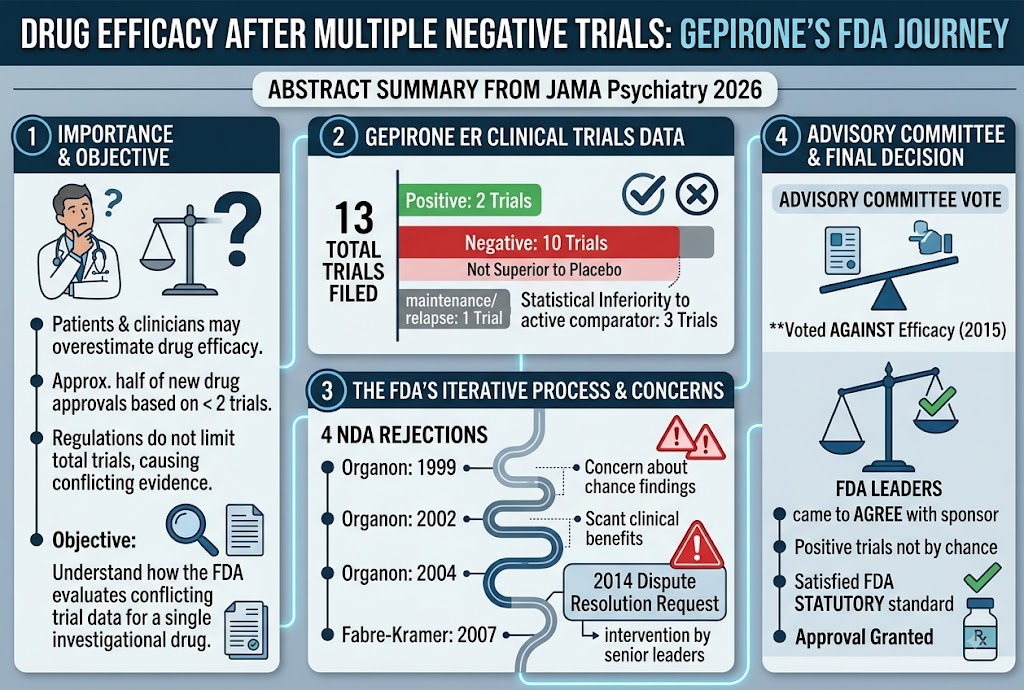
Highlight
- The FDA reviewed 13 clinical trials for gepirone ER, with only two showing statistically significant efficacy over placebo.
- Despite multiple failed trials and some evidence of inferiority to active comparators, regulatory “flexibility” led to FDA approval after prolonged dispute resolution.
- The case illustrates the tension between statistical significance and clinical relevance in drug approval decisions.
- Calls for improved transparency in labeling to include all trial data are essential for informed prescribing.
Study Background
Major depressive disorder (MDD) represents a leading cause of disability worldwide, imposing a significant clinical and societal burden. Although numerous antidepressants have been approved, many patients experience inadequate response or intolerable side effects, underscoring the need for effective and safe new treatments. Gepirone extended release (ER), a selective 5-HT1A receptor partial agonist, was developed as a potential antidepressant option. However, gepirone’s FDA approval journey highlights significant challenges in evaluating drug efficacy amid conflicting trial outcomes.
Study Design
The US Food and Drug Administration (FDA) reviewed a comprehensive set of 13 clinical trials testing gepirone ER for MDD: 12 acute treatment trials and 1 maintenance or relapse prevention trial. These were randomized, controlled studies comparing gepirone ER to placebo, with some including active comparators. The primary endpoint across trials was typically the change in standardized depression rating scales (e.g., Hamilton Depression Rating Scale). Trials varied in size, duration, and methodology but were considered adequate and well controlled according to FDA standards.
Key Findings
Among the 13 trials, only two acute treatment studies demonstrated statistically significant superiority of gepirone ER over placebo on the primary efficacy endpoint. Notably, 3 trials indicated statistical inferiority of gepirone compared to an active comparator. The majority (8 acute treatment trials and the maintenance trial) failed to show any benefit over placebo, raising concerns about the consistency and robustness of the drug’s efficacy profile.
Given the predominance of negative or inconclusive results and the possibility that the positive findings occurred by chance, the FDA initially rejected the new drug application multiple times—in 1999, 2002, 2004 (by Organon), and again in 2007 (by Fabre-Kramer Pharmaceuticals, Inc). The repeated refusals underscored the FDA’s concern about conflicting evidence.
In 2014, after a dispute resolution request by the sponsor, higher-level FDA leadership intervened. Despite an FDA Advisory Committee vote in 2015 that the efficacy was not demonstrated, internal agreement emerged recognizing that the two positive trials were unlikely to be false-positive and that the statutory threshold for efficacy was met. Consequently, gepirone ER received FDA approval.
Expert Commentary
This case exemplifies the FDA’s exercise of regulatory flexibility when faced with heterogeneous trial results. While the FDA traditionally requires at least two adequate and well-controlled trials demonstrating efficacy, the gepirone case reveals that approval may occur on the basis of statistical significance in a limited subset of trials, even when the broader trial portfolio is largely negative.
Critically, this raises questions about the clinical significance of such approvals. Statistical significance denotes a low probability that findings are due to chance but does not equate to meaningful patient benefit. The situation highlights the need for regulatory decision-making to balance statistical outcomes with effect size, clinical relevance, and reproducibility.
The DISCUSS authors (Turner et al.) recommend enhanced transparency in product labeling, advocating that all adequate and well-controlled trials related to the approved indication—including negative studies—be reported in labeling. Such disclosure would empower clinicians to make informed prescribing decisions in the context of a drug’s nuanced evidence landscape.
Conclusion
Gepirone ER’s regulatory pathway underscores the complexities in evaluating drug efficacy amid conflicting clinical data. The FDA’s willingness to apply regulatory flexibility—focusing on statistical significance from limited positive trials—facilitated approval despite multiple failures and some evidence of inferiority. This case calls for improved transparency mechanisms in drug labeling and highlights the importance of rigorous clinical trial design, comprehensive evidence review, and balanced interpretation of statistical and clinical endpoints to optimize patient care.
Funding and clinicaltrials.gov
The reviewed studies were primarily sponsored by pharmaceutical companies Organon and Fabre-Kramer Pharmaceuticals, Inc. The original article by Turner et al. does not disclose additional funding sources. Detailed trial registrations and protocols are accessible via clinical trial registries corresponding to the respective studies.
References
- Turner EH, Powers JH, Ahn-Horst RY, Kesselheim AS. Assessing Drug Efficacy After Multiple Negative Trials-Gepirone’s Journey Through the FDA. JAMA Psychiatry. 2026;83(8):864-869. doi:10.1001/jamapsychiatry.2026.1234
- Food and Drug Administration. Guidance for Industry: General Considerations for Clinical Trials. 2020. Available at: https://www.fda.gov/regulatory-information/search-fda-guidance-documents
- Sinyor M, Schaffer A, Levitt AJ. The Sequenced Treatment Alternatives to Relieve Depression (STAR*D) trial: a review. Can J Psychiatry. 2010;55(3):126-135.
- Carpenter LL, et al. Challenges in antidepressant drug development: clinical trial design and endpoints. Neuropsychopharmacology. 2010;35(10):2233-2242.
This article was created using several editorial tools, including AI, as part of the process. Human editors reviewed this content before publication.