Highlight
– Transphyseal ACL reconstruction performed within two years of skeletal maturity largely preserves coronal and sagittal plane alignment in the majority of patients.
– A meaningful subset (16%-28%) experience clinically significant changes, primarily valgus deformity and decreased posterior tibial slope.
– Routine preoperative and postoperative radiographic assessment is critical to detect and manage growth-related alignment disturbances early.
– There is a need to establish intervention thresholds for guided growth in patients predisposed to progressive deformities.
Study Background
Anterior cruciate ligament reconstruction (ACLR) in skeletally immature patients poses unique challenges due to the presence of open physes and ongoing growth. Transphyseal ACLR, which involves crossing the growth plates (physes) with soft tissue grafts and metaphyseal fixation, is favored for patients near skeletal maturity. This surgical technique aims to restore knee stability while minimizing the risk of iatrogenic growth disturbances such as limb length discrepancy (LLD) or angular deformities.
Although iatrogenic injury to the physes is uncommon, reported cases of postoperative growth abnormalities highlight the importance of understanding potential alignment changes following surgery. Growth disturbances can have long-term implications for joint biomechanics and patient function, especially when deformities involve coronal plane valgus or varus misalignment and alterations in sagittal plane parameters like posterior tibial slope (PTS).
Study Design
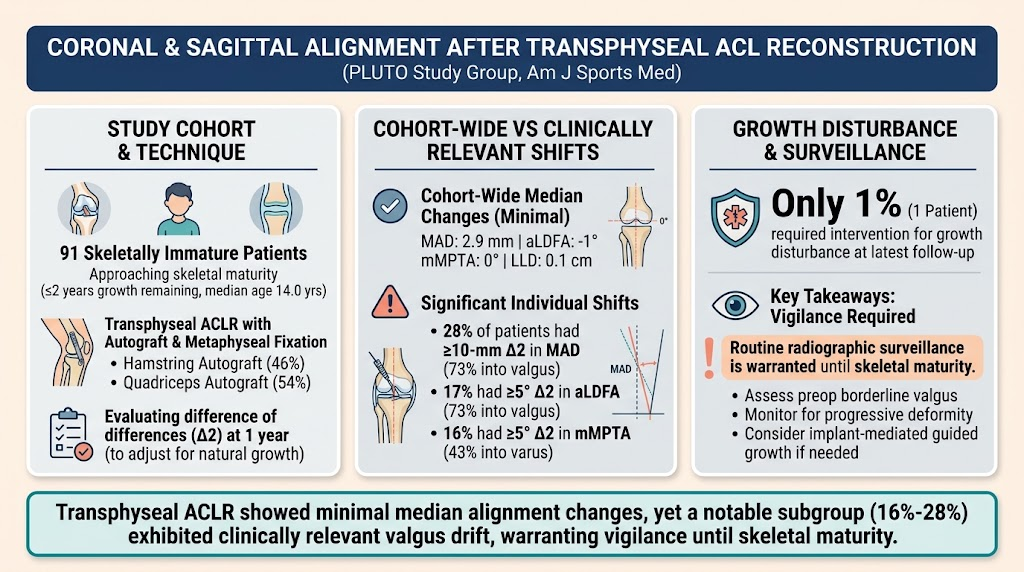
The PLUTO (Pediatric Lower-limb Outcomes) Study Group conducted a prospective, multicenter cohort study to investigate changes in lower extremity alignment after transphyseal ACLR in patients within two years of skeletal maturity. Inclusion criteria demanded skeletally immature patients with up to 2 years of remaining growth who underwent primary ACLR using soft tissue autografts fixed metaphyseally.
Alignment parameters were measured preoperatively and one year postoperatively and included mechanical axis deviation (MAD), anatomic lateral distal femoral angle (aLDFA), mechanical medial proximal tibial angle (mMPTA), posterior tibial slope (PTS), and leg length discrepancy (LLD). The outcome metric used was the change in the difference of alignment between the involved and uninvolved extremities over time (difference of differences = Δ2), accounting for physiological growth changes.
Key Findings
Among the 91 patients studied (median skeletal age 14.0 years, 48 males), the cohort-wide median Δ2 values indicated minimal overall changes: MAD changed by a median of 2.9 mm, aLDFA by -1°, mMPTA by 0°, and LLD by 0.1 cm. Importantly, these median values denote stability in alignment at one year post-surgery for most patients.
However, subgroup analyses revealed that 28% of patients exhibited a change of ≥10 mm in MAD, with 73% of these changes trending towards valgus alignment. Similarly, 17% showed changes ≥5° in aLDFA, predominantly into valgus, and 16% had significant changes in mMPTA, though varus alignment predominated in this group. Posterior tibial slope changes were less emphasized but suggested some decrease postoperatively in affected patients.
Only one patient (approximately 1%) required clinical intervention for growth disturbance at the latest follow-up, highlighting the low but clinically important risk of significant deformity. The type of graft (hamstring vs. quadriceps) did not feature prominently as a factor influencing alignment outcomes.
Expert Commentary
These results underscore the relative safety of transphyseal ACLR with soft tissue autografts in adolescents close to skeletal maturity, supporting its widespread use. Nevertheless, the finding that up to one-quarter of patients experienced meaningful coronal plane malalignment, especially into valgus, demands attention.
Valgus deformity may predispose to premature joint degeneration and instability, which may negatively impact long-term outcomes. The variability in tibial slope changes further complicates biomechanical consequences and could affect knee kinematics post-ACLR.
Potential mechanisms include subtle physeal injury or asymmetric growth modulation by fixation devices. The study emphasizes the need for individualized preoperative risk stratification, including baseline alignment screening, to identify patients at higher risk of progressive deformities who may benefit from closer surveillance or early guided growth intervention.
Longer-term follow-up beyond one year and multi-institutional data collection will enrich our understanding of growth-related changes and optimize surgical techniques and postoperative management.
Conclusion
Transphyseal ACL reconstruction performed within two years of skeletal maturity generally results in limited cohort-wide changes in coronal and sagittal alignment, affirming its safety for this population. However, a significant subset of patients experience clinically relevant valgus deformities and alignment deviations, necessitating rigorous radiographic monitoring until skeletal maturity is reached.
Clinicians should integrate routine preoperative assessment and develop standardized postoperative surveillance protocols. Further research is essential to define precise criteria for implant-mediated guided growth and to clarify factors predisposing to maladaptive alignment changes, ultimately improving functional outcomes and preserving knee health in growing patients.
Funding and Clinical Trials
The study was conducted by the PLUTO Study Group with no additional funding disclosures reported. The clinical trial registration details were not provided in the abstract.
References
1. Bram JT, Saville GH, Whalen MM, et al. Changes in Coronal and Sagittal Plane Alignment After Transphyseal ACL Reconstruction Performed Within Two Years of Skeletal Maturity: Results From the PLUTO Study Group. Am J Sports Med. 2026 Oct 15;3635465261492231. doi:10.1177/03635465261492231. PMID: 42877964.
2. Kocher MS, Fabricant PD, Edmonds EW. ACL injury and management in the skeletally immature patient. J Orthop Res. 2020;38(7):1483-1490.
3. Shea KG, Grimm NL, Belzer J, et al. Pediatric Anterior Cruciate Ligament Injuries: Risk Factors and Prevention Strategies. Phys Sportsmed. 2018;46(1):66-71.
4. Anderson CN, Parikh SN. Physeal-Sparing and Transphyseal ACL Reconstruction in Skeletally Immature Patients. Sports Health. 2021;13(5):456-463.