National Health Systems and Their Crucial Role in Reducing Lung Cancer Mortality: Insights from Global Data
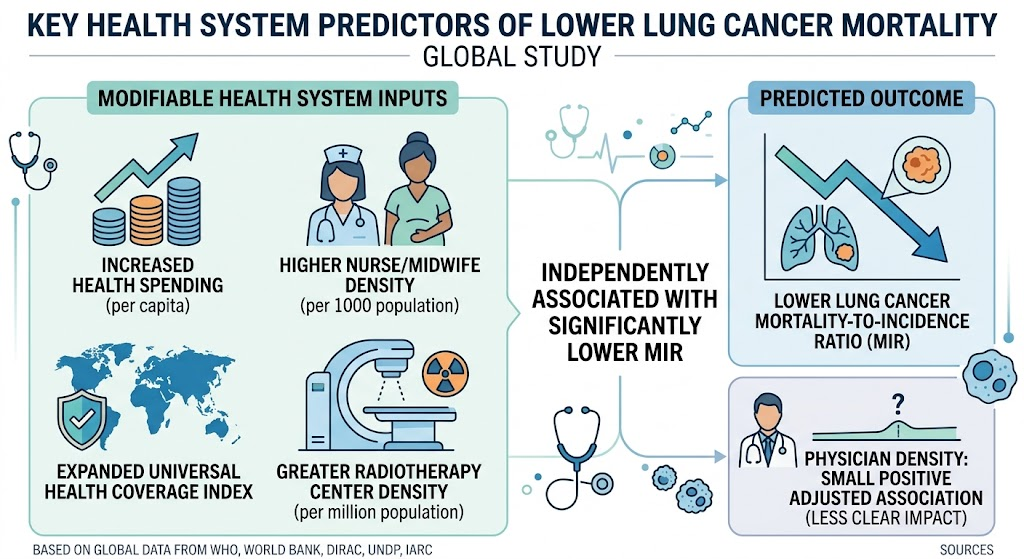
Highlight
- Global lung cancer mortality varies significantly with national health system factors.
- Higher health spending, nurse/midwife density, universal health coverage, and radiotherapy center density correlate with lower mortality-to-incidence ratios.
- Physician density shows a small positive association with mortality-to-incidence ratio, indicating complexity in workforce impact.
- These insights can guide healthcare policy and resource allocation in countries with a high or rising lung cancer burden.
Study Background
Cancers of the trachea, bronchus, and lung remain the leading causes of cancer-related mortality worldwide despite advances in diagnosis and treatment. Lung cancer’s burden is pronounced in both developed and developing countries, reflecting diverse epidemiologic patterns, access to care, and treatment infrastructure. Mortality-to-incidence ratio (MIR) is a valuable population-level metric indicating cancer lethality and the effectiveness of health systems in reducing fatal outcomes. Understanding health system components that influence lung cancer mortality can identify levers to improve clinical outcomes globally.
Study Design
This study utilized an ecological, multivariable modeling approach based on aggregated national-level data from several global repositories: the World Health Organization (WHO), World Bank, Directory of Radiotherapy Centres (DIRAC), United Nations Development Programme (UNDP), and International Agency for Research on Cancer (IARC). The primary endpoint was the mortality-to-incidence ratio for cancers of the trachea, bronchus, and lung. Predictor variables included health spending per capita, densities of nurses/midwives and physicians, universal health coverage (UHC) index, and radiotherapy center availability per population, allowing adjustment for confounders and evaluation of independent associations.
Key Findings
The multivariable analysis revealed significant independent associations of several health system factors with lung cancer outcomes at the population level:
- Health Spending Per Capita: Higher national health expenditures were strongly associated with reduced mortality-to-incidence ratios, reflecting better overall cancer care infrastructure, diagnostic capabilities, and treatment access.
- Nurse and Midwife Density: Greater nursing workforce availability correlated with improved outcomes, likely due to enhanced patient care coordination, education, and supportive cancer care services.
- Universal Health Coverage Index: Countries with higher UHC scores experienced lower lung cancer MIRs, underscoring the importance of equitable access to essential health services in improving survival.
- Radiotherapy Center Density: Increased availability of radiotherapy facilities was significantly linked to lower mortality among patients with lung and related cancers, highlighting radiotherapy’s critical role in lung cancer treatment.
- Physician Density: Interestingly, a small positive adjusted association was found between physician density and mortality-to-incidence ratio, which may reflect complexities such as urban-rural disparities, quality of care, or survivorship biases within datasets.
These findings collectively suggest that investments in comprehensive health system strengthening—beyond solely increasing physician numbers—are pivotal to reducing lung cancer mortality globally.
Expert Commentary
Experts emphasize that successful lung cancer control requires multidimensional health system optimization. While physician workforce growth is essential, this study highlights the critical roles played by nursing staff and infrastructure like radiotherapy centers. The challenge remains in expanding universal health coverage to ensure timely diagnosis and treatment access. Limitations of the ecological design include potential residual confounding and inability to account for individual patient factors such as smoking prevalence, stage at diagnosis, or molecular subtype variations. Nonetheless, these population-level insights are consistent with clinical knowledge on lung cancer management and reinforce the importance of system-level innovations.
Conclusion
This comprehensive global analysis establishes that national health system attributes—particularly financial investment, nursing workforce density, universal coverage, and radiotherapy availability—substantially influence lung cancer mortality on a population scale. Policymakers in countries facing high lung cancer burdens should prioritize these areas for targeted health system strengthening. Future research should incorporate patient-level data to refine understanding and expand these findings with longitudinal outcome evaluations. In sum, holistic health system reforms are indispensable for reducing lung cancer mortality worldwide.
Funding and ClinicalTrials.gov
The referenced study was published based on publicly available international health data sources and did not specify direct funding disclosures or clinical trial registrations.
References
- Gorantla N, Dee EC, Willmann J, et al. The impact of national health systems on lung cancer mortality. Chest. 2026 Aug 29. PMID: 42668063.
- World Health Organization. Global Health Observatory. Available at: https://www.who.int/data/gho
- International Agency for Research on Cancer. Cancer Today. 2020. Available at: https://gco.iarc.fr/today/
- Farrell D, Lim E. Lung Cancer: Past, Present and Future. Thorac Surg Clin. 2020;30(1):1-7.
This article was created using several editorial tools, including AI, as part of the process. Human editors reviewed this content before publication.