Metabolic Regulation of Human Hematopoietic Stem and Progenitor Cell Regeneration by l-Carnitine: Mechanistic Insights and Therapeutic Implications
Highlights
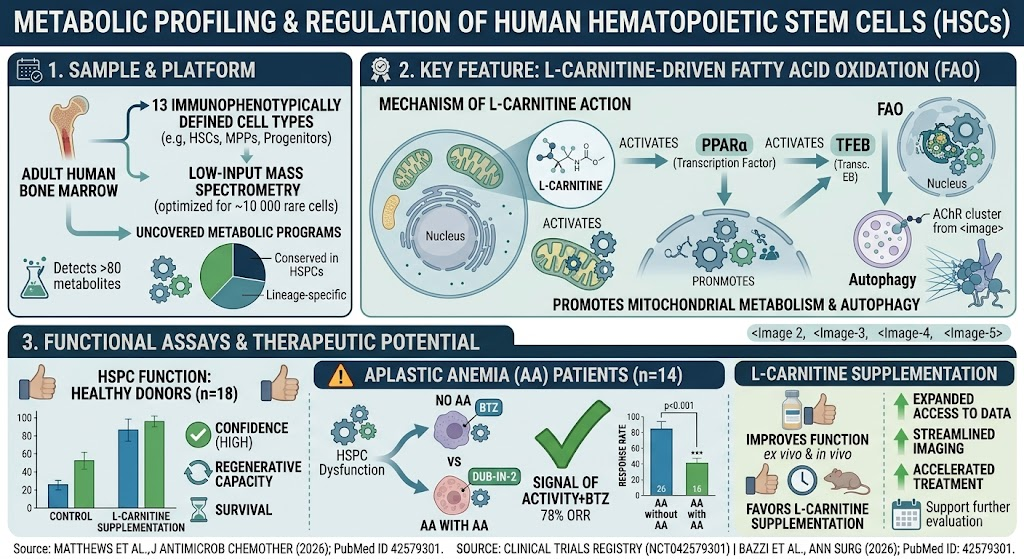
Application of ultra-sensitive mass spectrometry metabolomics to profile rare human hematopoietic stem and progenitor cells (HSPCs) has uncovered conserved and lineage-specific metabolic programs.
l-Carnitine-driven fatty acid oxidation emerges as a critical metabolic axis sustaining HSPC regenerative function via activation of the PPAR-alpha-TFEB signaling pathway.
l-Carnitine supplementation enhances mitochondrial metabolism and autophagy in primary human CD34+ HSPCs, improving their function both ex vivo and in vivo, including in disease contexts such as aplastic anemia.
This work establishes a novel targetable metabolic circuit with significant therapeutic potential to augment stem cell-based regenerative therapies in hematopoietic disorders.
Background
Human hematopoietic stem cells (HSCs) residing in the bone marrow are essential for lifelong blood cell production and immune system maintenance. Despite their critical clinical importance, HSCs are extremely rare, limiting direct molecular studies. Understanding the metabolic underpinnings of HSC maintenance and regeneration is essential for optimizing hematopoietic stem cell transplantation and developing novel regenerative interventions, especially for diseases like aplastic anemia and myelodysplasias.
Until recently, metabolic research in human HSCs was challenging due to technical constraints and low cell numbers. Rodent models provided preliminary insights, but human HSCs exhibit distinct metabolic features that necessitate direct investigation. Advances in low-input metabolomics technologies now enable comprehensive metabolic profiling of purified human hematopoietic populations, creating unprecedented opportunities to elucidate metabolic control mechanisms.
Key Content
Advances in Metabolic Profiling of Human Hematopoietic Cells
Duan et al. (2026) leveraged a low-input mass spectrometry-based metabolomics platform optimized for rare cell populations, profiling 13 immunophenotypically defined hematopoietic subsets from adult human bone marrow using as few as ~10,000 cells per sample. They identified over 80 metabolites and delineated conserved metabolic programs in primitive HSPCs, including a reliance on fatty acid oxidation pathways, contrasting with lineage-specific metabolic adaptations in more differentiated cells.
This work constitutes a methodological breakthrough, overcoming previous limitations and enabling detailed metabolic landscapes that inform both basic biology and therapeutic targeting.
Role of l-Carnitine-Driven Fatty Acid Oxidation in HSPC Function
A major finding is the identification of l-carnitine as a key regulator of HSPC metabolism. l-Carnitine facilitates mitochondrial fatty acid transportation and oxidation, a critical energy source supporting stem cell maintenance and self-renewal.
Mechanistically, l-carnitine supplementation activates the peroxisome proliferator-activated receptor alpha (PPARα) and transcription factor EB (TFEB) signaling axis. This axis enhances mitochondrial metabolism and autophagy, which are essential for clearing damaged organelles and preserving cellular homeostasis, thus sustaining regenerative capacity.
These mechanistic insights align with rodent studies implicating fatty acid oxidation and autophagy in HSC quiescence and longevity but importantly demonstrate their relevance and therapeutic potential in human HSPCs.
Functional Validation in Primary Human CD34+ HSPCs
Functional assays conducted on primary human CD34+ HSPCs derived from healthy donors and patients with aplastic anemia demonstrate that l-carnitine supplementation enhances stem cell proliferation, colony-forming capacity, and regenerative function in xenotransplantation models.
This translational evidence substantiates l-carnitine as a metabolic modulator capable of improving HSPC fitness ex vivo and potentially enhancing clinical stem cell transplantation outcomes, especially in conditions characterized by compromised stem cell function.
Expert Commentary
The integration of ultra-sensitive metabolomics applied to rare human HSPCs sets a new standard for hematopoietic metabolic research, overcoming previous barriers imposed by limited cell numbers and methodological complexities.
l-Carnitine’s identification as a metabolic enhancer opens avenues for novel metabolic interventions aimed at boosting hematopoietic regeneration. Enhancing fatty acid oxidation and autophagy complements existing knowledge about mitochondrial function being central to stem cell biology.
However, several questions remain regarding optimal dosing, timing, and long-term effects of l-carnitine supplementation in clinical settings. Additionally, mechanistic work should explore how l-carnitine interacts with other signaling pathways involved in hematopoiesis and whether benefits extend across broader hematologic disease spectrums or aging-related stem cell dysfunction.
Clinical translation will require carefully designed trials to confirm safety, efficacy, and potential synergy with current hematopoietic stem cell mobilization and transplantation protocols.
Conclusion
This foundational study elucidates a targetable metabolic circuit governing human HSPC regenerative fitness, underscoring l-carnitine-driven fatty acid oxidation as a pivotal metabolic axis. By activating PPARα-TFEB signaling, l-carnitine promotes mitochondrial metabolism and autophagy critical for stem cell function.
The translational implications include potential metabolic supplementation strategies to enhance hematopoietic stem cell therapies for bone marrow failure syndromes and other hematological disorders.
Future directions involve expanding metabolic profiling across disease states, optimizing l-carnitine delivery, and integrating these findings into personalized regenerative medicine approaches.
References
Duan H, Wang B, Zheng Y, Lv Y, Lu T, Li H, Li P, Li R, Xie X, Yang Z, Sun G, Zhao X, Yang M, He Y, Xu C, Pu S, Zhang L, Shi J, Jiang E, Cheng T, Hu Z, Cheng H. l-Carnitine regulates regeneration of human hematopoietic stem and progenitor cells. Blood. 2026 Aug 6;148(6):693-709. PMID: 42189862.
This article was created using several editorial tools, including AI, as part of the process. Human editors reviewed this content before publication.