We use cookies

Our website uses essential cookies and, with your consent, additional cookies to measure performance and improve our services. Cookie Policy.

You can change your choice at any time.

MMedXYNews
HomeVideos
MedXY AI/MedXY News/Section: news

Menopause Management in Patients with Cancer: A Symptom‑Based, Risk‑Stratified Framework
MedXY Editorial Team•Aug 12, 2026•news
genitourinary syndromehot flashesがんサバイバーシップMenopause

Introduction and Context

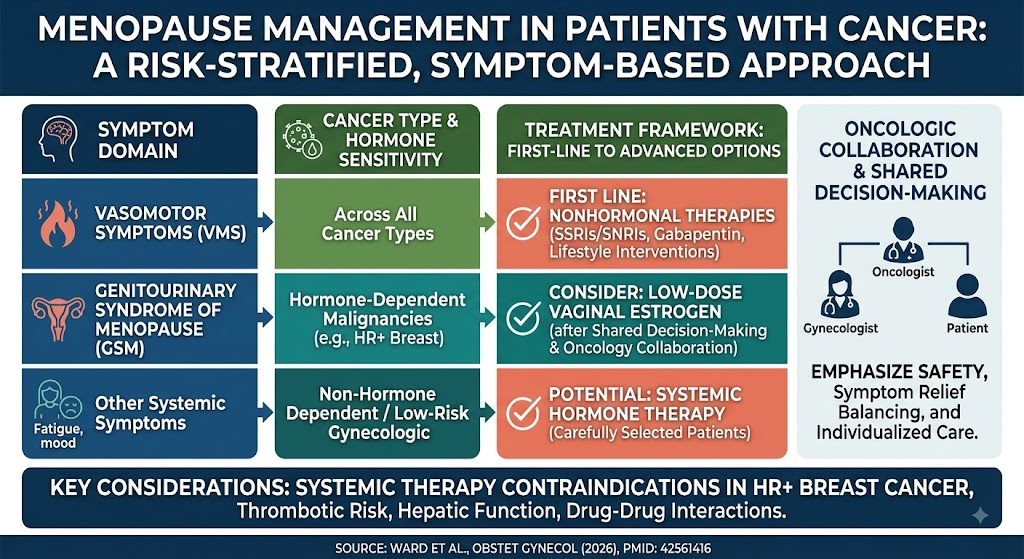
Menopausal symptoms—vasomotor symptoms (hot flashes, night sweats), genitourinary syndrome of menopause (GSM), sexual dysfunction, mood changes, sleep disturbance, and long‑term cardiometabolic bone health issues—are common in people with cancer. Symptoms may be present at baseline and can be magnified by cancer treatments (chemotherapy, ovarian suppression, pelvic radiation, surgical oophorectomy, and endocrine therapy). The 2026 narrative review by Ward, Mitchem, and Harichand‑Herdt in Obstetrics & Gynecology synthesizes randomized trials, observational studies, systematic reviews, and society statements to produce a practical, symptom‑based, risk‑stratified framework for menopause management in patients with cancer (Ward et al. 2026). This article summarizes the core recommendations and expert perspectives from that review and links them to existing society guidance.

Why this guidance matters now
– Improved cancer survival and growing numbers of young and midlife cancer survivors mean clinicians must manage menopausal symptoms that substantially reduce quality of life.
– New data and growing consensus about nonhormonal therapies, the safety of local vaginal estrogen in many cancer contexts, and the importance of drug–drug interactions (notably with tamoxifen) have clarified safer, individualized approaches.
– Oncologic safety considerations vary by cancer type and hormone sensitivity; a unified, symptom‑based, risk‑stratified approach helps gynecologists and oncologists collaborate effectively.

MedXY registered readers

Sign in free to continue reading

Create or use your MedXY account to unlock the complete article.

This article was created using several editorial tools, including AI, as part of the process. Human editors reviewed this content before publication.

Related articles

Open language-specific specialty feeds and department pages.

Evaluating Voice Disorder Risks in Peri- and Post-Menopausal Women Using Hormone Replacement Therapy: Insights from a Large TriNetX CohortThis study investigates the association between peri- and post-menopausal hormone replacement therapy (HRT) and the risk of voice disorders, revealing transiently increased dysphonia risk within the first nine months but no sustained clinicSep 7, 2026Menopausal Transition and Thyroid Function: Deciphering the Impact Beyond Aging in Midlife WomenA comprehensive longitudinal study reveals that menopausal transition does not significantly alter thyroid function beyond normal aging effects in healthy women, clarifying the interplay between menopause and thyroid health.Aug 21, 2026Integrative Medicine Approaches for Menopause: Evidence-Based Nonhormonal Strategies for Symptom ManagementThis article reviews evidence-based integrative medicine approaches for menopause, including lifestyle, mind-body therapies, nutrition, botanicals, and acupuncture, emphasizing nonhormonal options for symptom relief and health optimization.Aug 18, 2026
Loading comments...
MedXY briefing

Get the free newsletter

Evidence-led clinical news, trends, and analysis—delivered to your inbox.

Ask MedXY AI

Most popular

Intimate Health
Five Benefits for Women Continuing Sexual Activity After Menopause
Intimate Health
Why Some Women Have a Strong Sex Drive—And Why Men Shouldn't Worry About It
Nursing & care
How often should a couple have sex?
Intimate Health
Classic Intimacy Recommendations: How to Help Women Reach Orgasm and Enjoy Mutual Pleasure
Intimate Health
What Makes a Woman "Physiologically Addicted" Is Never Money, But These Two Relationship Qualities
© 2026 MedXY
Contact usAbout usPrivacy PolicyMedXY story
Can Postmenopausal Women Still Have a Sex Life? Stop Worrying About Weekly Frequency—Comfort, Safety, and Mutual Desire Matter Most
Menopause isn't a "stop button" for intimacy, nor is there any medical rule dictating that you must retire your sex life at a certain age. What truly
Aug 7, 2026
Disparities and Persistence in Systemic Hormone Therapy Among Menopausal Women: Insights from a Large Real-World AnalysisA comprehensive study reveals initiation rates, duration, and racial disparities in systemic hormone therapy use among menopausal women, emphasizing critical care gaps and the need for equitable interventions.Aug 18, 2026
Safety and Long-Term Benefits of Hormone Therapy After Chemoradiation in Young Cervical Cancer SurvivorsHormone therapy initiated within one year after chemoradiotherapy in young patients with locally advanced cervical cancer is associated with reduced metabolic, skeletal, and cerebrovascular risks, and improved survival without increased oncAug 18, 2026