Medicaid Expansion and Severe Maternal Morbidity: Evaluating the Impact of the Affordable Care Act on Delivery Outcomes
Highlight
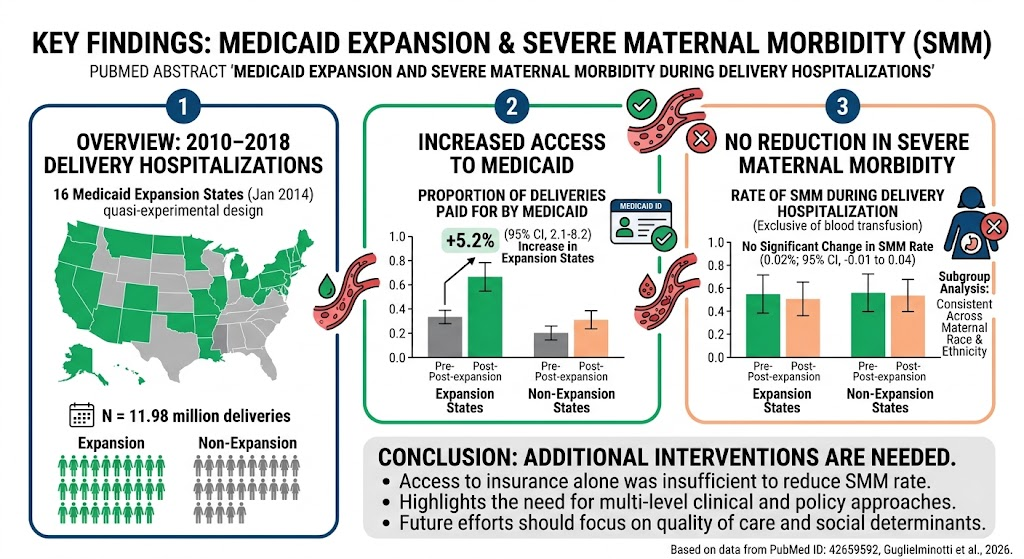
- The Affordable Care Act (ACA) Medicaid expansion increased Medicaid coverage during delivery hospitalizations by 5.2%.
- No significant reduction in severe maternal morbidity (SMM) rates during delivery hospitalizations was observed after Medicaid expansion.
- Findings were consistent across racial and ethnic subgroups and in sensitivity analyses.
- Additional multifaceted clinical and policy approaches are necessary to improve maternal health outcomes beyond insurance coverage expansion.
Study Background
Severe maternal morbidity (SMM) refers to unexpected outcomes of labor and delivery that result in significant short- or long-term consequences to a woman’s health. Despite advances in healthcare, the United States has experienced troubling trends in maternal outcomes, with SMM rates rising and persistent disparities across racial and ethnic groups. These trends impose notable burdens on public health systems and contribute to increased healthcare costs and maternal mortality.
Access to health insurance is a critical determinant of maternal health outcomes, influencing timely prenatal care utilization, management of pregnancy-related complications, and delivery outcomes. The Affordable Care Act (ACA), implemented in 2010, included a Medicaid expansion component starting in 2014 aimed at increasing insurance coverage among low-income populations, including reproductive-aged women.
This study investigates whether the ACA Medicaid expansion has translated into improved clinical maternal outcomes, specifically focusing on SMM during delivery hospitalizations, a key indicator of severe adverse maternal events.
Study Design
This retrospective, repeated cross-sectional analysis utilized data from the Healthcare Cost and Utilization Project (HCUP) managed by the Agency for Healthcare Research and Quality (AHRQ). The study included delivery hospitalizations from 2010 to 2018 in 26 U.S. states; 16 of these states expanded Medicaid by January 2014, whereas 10 states did not.
The primary endpoint was the rate of severe maternal morbidity during delivery hospitalization. SMM was defined based on the Centers for Disease Control and Prevention (CDC) criteria, excluding cases where blood transfusion was the sole morbidity indicator, to minimize confounding by transfusion coding practices.
Researchers employed a quasi-experimental difference-in-differences design comparing preexpansion (2010–2013) and postexpansion (2015–2018) periods between expansion and nonexpansion states. Generalized synthetic control models adjusted for confounders and estimated the average treatment effect on the treated (ATT).
Subgroup analyses were conducted by maternal race and ethnicity to explore potential disparities, and several sensitivity analyses assessed the robustness of results.
Key Findings
The study encompassed nearly 12 million delivery hospitalizations, with 82,903 (69.2 per 10,000) experiencing SMM. After Medicaid expansion, the proportion of Medicaid-paid delivery hospitalizations rose by 5.2% (95% CI, 2.1–8.2), confirming successful increase in insurance coverage among low-income pregnant women.
However, the SMM rate did not show a significant decline postexpansion. The estimated change was minimal at 0.02% (95% CI, –0.01 to 0.04), lacking statistical significance. The absence of effect was consistent across all examined racial and ethnic subgroups, indicating no differential impact of Medicaid expansion on reducing SMM disparities.
Sensitivity analyses, including alternative modeling approaches and exclusion criteria adjustments, upheld the primary findings.
These outcomes suggest that while insurance coverage improved, it did not directly translate into measurable reductions in severe adverse maternal outcomes during delivery hospitalization within the timeframe studied.
Expert Commentary
The findings from Guglielminotti et al. underscore the complexity of maternal health challenges beyond insurance coverage alone. Expanding Medicaid under the ACA is an important step toward reducing financial barriers and potentially enhancing access to prenatal and delivery care. However, SMM is influenced by a multifactorial interplay of clinical, social, and structural determinants including underlying maternal health, quality of prenatal and obstetrical care, provider practices, and systemic inequities.
Experts advocate for integrative strategies that combine insurance access with initiatives to improve care coordination, risk factor management, patient education, and culturally competent care delivery to effectively mitigate SMM. The persistence of racial and ethnic disparities in maternal outcomes also demands targeted interventions addressing social determinants of health.
Limitations of the study include reliance on administrative data, which may be subject to coding inaccuracies, and the inability to capture outpatient or prehospital care quality. Moreover, the relatively short postexpansion observation period may limit detection of longer-term health benefits from improved insurance coverage.
Nevertheless, this study provides high-level evidence that insurance expansion alone, while vital, is insufficient to achieve significant reductions in severe maternal morbidity during delivery hospitalizations.
Conclusion
The ACA Medicaid expansion successfully increased Medicaid coverage among women delivering in hospitals but was not associated with a reduction in severe maternal morbidity during delivery hospitalizations between 2014 and 2018. This highlights an urgent need for additional clinical and health policy interventions to improve maternal outcomes. Future efforts should integrate enhanced clinical protocols, improve healthcare quality, address social determinants, and reduce systemic inequities to meaningfully reduce severe maternal morbidity and improve maternal health equity.
Funding and Trial Registration
The study did not report specific funding sources or clinical trial registration.
References
1. Guglielminotti J, Daw JR, Friedman AM, Samari G, Li G. Medicaid Expansion and Severe Maternal Morbidity During Delivery Hospitalizations. Obstet Gynecol. 2026 Aug 27. PMID: 42659592.
2. Centers for Disease Control and Prevention. Severe Maternal Morbidity in the United States. Available at: https://www.cdc.gov/reproductivehealth/maternalinfanthealth/severematernalmorbidity.html
3. Howell EA. Reducing Disparities in Severe Maternal Morbidity and Mortality. Clin Obstet Gynecol. 2018 Mar;61(1):387-399.
4. Daw JR, Sommers BD. Access To Care and Health Insurance Itself May Not Be Enough To Improve Outcomes: The Case of Maternal Morbidity. Health Affairs Blog. March 2021.
This article was created using several editorial tools, including AI, as part of the process. Human editors reviewed this content before publication.