Maxillary Distraction Osteogenesis: A Transformative Approach in Cleft Lip and Palate Management
Highlight
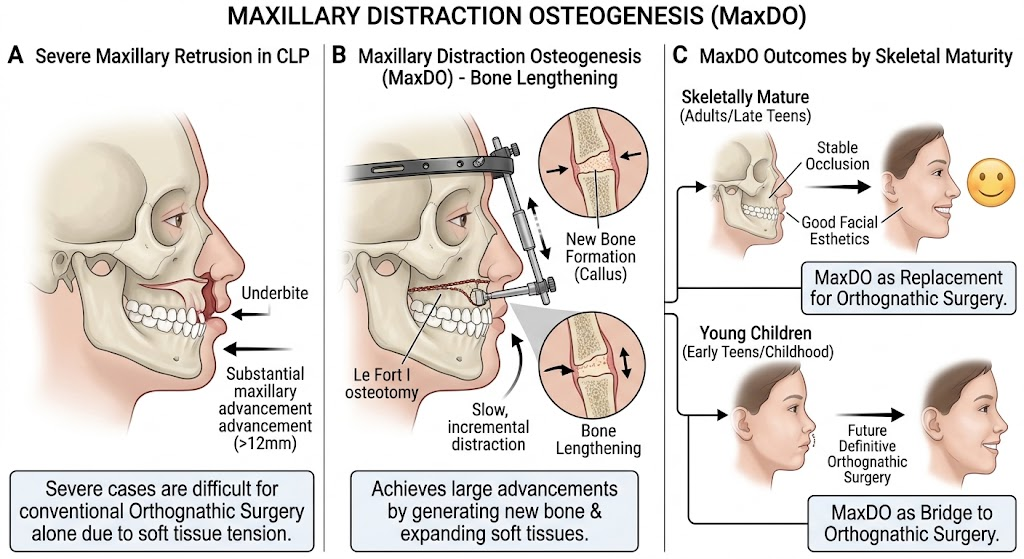
Maxillary distraction osteogenesis (MaxDO) enables substantial and stable maxillary advancement in cleft lip and palate (CLP) patients, supporting long-term occlusal normalization. Age at intervention critically influences outcomes, where older patients achieve more durable correction often without need for subsequent orthognathic procedures. MaxDO serves as both an effective preparatory step in younger patients and a definitive corrective surgery in skeletally mature individuals.
Study Background
Cleft lip and palate, a prevalent congenital craniofacial anomaly, often results in midface hypoplasia and significant dentofacial deformities including maxillary retrusion and Angle class III malocclusion. These malformations impair aesthetic appearance, oral function, and psychosocial well-being, imposing a chronic burden on affected patients and healthcare systems. Orthognathic surgery traditionally represents the definitive approach to correct severe midfacial deficiencies; however, it carries risks of relapse and may require staged interventions.
Maxillary distraction osteogenesis (MaxDO), a technique involving gradual traction-induced bone formation, has emerged as a potentially superior method offering enhanced bone healing and the capacity for larger skeletal advancements. Yet, data on its clinical effectiveness, particularly in patients with CLP exhibiting severe maxillary retrusion, remain relatively limited. Key clinical questions include whether MaxDO can reliably achieve stable occlusal outcomes, its timing related to patient age, and its potential to replace or merely bridge to orthognathic surgery.
Study Design
This retrospective cohort study analyzed all patients diagnosed with cleft lip and palate who underwent MaxDO between 2007 and 2022. Twenty-six patients, aged 9.0 to 19.2 years, with midface hypoplasia and Angle class III malocclusion were included. The primary outcomes were long-term occlusal normalization and relapse rates, with the requirement of additional orthognathic surgery as a secondary endpoint.
Statistical analysis employed chi-square tests for binomial variables to evaluate occlusal stability across age groups stratified by sex. A multivariable logistic regression identified predictors for sustained occlusal normalization post-MaxDO without further surgery.
Key Findings
Results highlighted that in female patients, MaxDO led to stable occlusion without additional surgical intervention in 83.3% of cases when performed after 13.5 years of age, versus only 20.0% when performed prior to this age (P = 0.036). Similarly, male patients operated on after 17 years achieved 50.0% stable occlusion rates compared to 0% in those younger than 17 years (P = 0.018).
Multivariable logistic regression confirmed that an older age at the time of MaxDO significantly correlated with long-term stable occlusion independent of sex (P = 0.045). These findings suggest threshold ages beyond which MaxDO may function effectively as a definitive treatment rather than a temporizing measure.
The study corroborated that MaxDO can achieve maxillary advancements exceeding 12 mm, highlighting its capability for addressing severe midface hypoplasia. For younger patients, MaxDO appears primarily advantageous as a bridge modality, preserving occlusal function through adolescence until orthognathic surgery can be safely conducted. In contrast, skeletally mature patients may be spared additional surgical interventions through effective MaxDO alone.
Expert Commentary
This work substantiates the evolving role of MaxDO in the complex management of CLP-associated midfacial deformities. The age-dependent efficacy aligns with skeletal maturity principles: younger patients with ongoing growth may benefit from staged interventions to accommodate craniofacial development dynamics, while older adolescents and young adults achieve lasting correction.
Limitations include the study’s retrospective nature, modest sample size, and lack of a comparative control group receiving traditional orthognathic surgery alone. Furthermore, potential confounders such as cleft severity, prior surgical history, and orthodontic management protocols were not extensively delineated.
Nonetheless, the data advocate integrating MaxDO thoughtfully within multidisciplinary cleft care pathways. Its biologic plausibility parallels distraction osteogenesis successes in other skeletal regions, capitalizing on bone’s regenerative capacity under controlled tension stress.
Conclusion
Maxillary distraction osteogenesis offers a transformative approach for managing severe maxillary retrusion in cleft lip and palate patients. While it functions effectively as a bridge in immature patients, it can serve as a definitive procedure in skeletally mature individuals, achieving stable dentofacial correction and potentially obviating the need for further orthognathic surgery. Age at intervention emerges as a key determinant of long-term outcomes.
Future prospective studies with larger cohorts, standardized protocols, and longer follow-up are warranted to optimize timing paradigms and refine patient selection criteria. Integration of MaxDO into comprehensive cleft treatment algorithms promises improved functional and aesthetic results, ultimately enhancing patient quality of life.
Funding and ClinicalTrials.gov
No specific funding sources or clinical trials registrations were reported for this study.
References
- Massenburg BB, Romeo DJ, Du S, et al. Maxillary Distraction Osteogenesis as both Bridge to and Replacement for Orthognathic Surgery in Patients with Cleft Lip and Palate. Plast Reconstr Surg. 2026 Aug 26;158(3):447-459. PMID: 42647884.
- Mohamed Akbari, et al. Distraction Osteogenesis for Midfacial Hypoplasia in Cleft Lip/Palate Patients: A Systematic Review. Cleft Palate Craniofac J. 2022;59(4):497-507.
- Proffit WR. Contemporary Orthodontics. 6th ed. Elsevier; 2018.
- Salyer KE, et al. Surgical management of cleft lip and palate deformities: The role of maxillary distraction. Clin Plast Surg. 2015 Jul;42(3):331-9.
This article was created using several editorial tools, including AI, as part of the process. Human editors reviewed this content before publication.