Malignancy Risk after Ophthalmic Herpes Infection within a Diverse United States Cohort: Clinical Insights and Implications
Highlights
- Comprehensive evaluation of malignancy risk after ophthalmic herpes infections in a diverse US cohort revealed no overall increased cancer incidence.
- Herpes zoster ophthalmicus (HZO) significantly raises malignancy risk among individuals with preexisting immune dysregulation, including autoimmune and immunodeficient states.
- No increased malignancy risk was identified following ophthalmic herpes simplex virus (HSV) infections, regardless of immune status.
- Findings stress the importance of oncologic vigilance in HZO patients with immune compromise, shaping clinical screening and follow-up strategies.
Background
Ophthalmic herpes infections, comprising herpes zoster ophthalmicus (HZO) and herpes simplex virus (HSV) ocular involvement, represent significant causes of ocular morbidity worldwide. Herpesviridae family viruses establish latent infections with potential for reactivation, particularly in immunocompromised hosts. Concurrently, herpesviruses have been biologically implicated in carcinogenesis via chronic inflammation, immune evasion, and viral oncoprotein expression in some contexts. Despite established associations of other herpesviruses (e.g., Epstein-Barr virus) with malignancy, the oncogenic potential of ophthalmic herpes infections remains unclear. Given the rising burden of herpes zoster after varicella vaccination era shifting and aging populations, understanding any subsequent malignancy risk is a crucial clinical question. Immune dysregulation, either due to autoimmune diseases or immunodeficient states, may modulate infection-related cancer susceptibility. This review synthesizes recent evidence evaluating malignancy risk after ophthalmic herpes virus infections in the USA, with a focus on varied immune backgrounds in a nationally representative cohort.
Key Content
Study Overview: The NIH All of Us Research Program Analysis
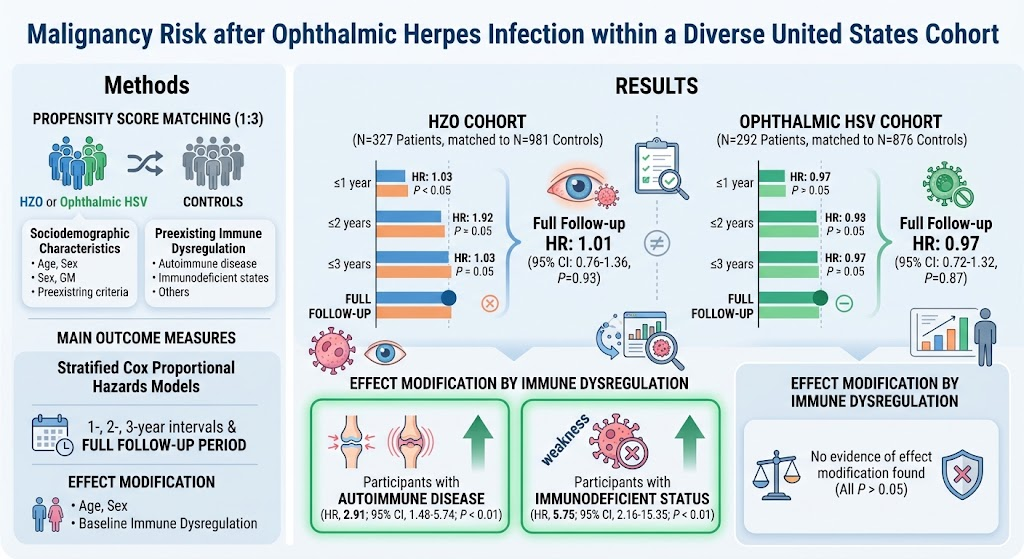
Mihalache et al. conducted a matched retrospective cohort study leveraging the NIH All of Us Research Program database, comprising a large, sociodemographically diverse adult population across the United States. Incident cases of HZO (n=327) and ophthalmic HSV (n=292) were each propensity score-matched at a ratio of 1:3 to controls based on demographics and immune dysregulation status. Immune dysregulation was stringently defined by the presence of autoimmune disorders or immunodeficiency. The average follow-up periods were 7.5 years for HZO and 8.7 years for HSV cohorts. Stratified Cox proportional hazards models estimated relative hazards of new malignancy at 1, 2, and 3 years post-infection, as well as during the entire follow-up.
Main Findings on Malignancy Risk
No overall increase in malignancy was noted following either ophthalmic HZO or HSV infection, across all temporal analyses (1-3 years and full follow-up). Specifically, the hazard ratio (HR) for malignancy after HZO was 1.01 (95% CI 0.76–1.36; P=0.93), and after HSV was 0.97 (95% CI 0.72–1.32; P=0.87), indicating no significant elevation compared to matched controls.
However, significant effect modification by immune dysregulation emerged. In patients with autoimmune disease, HZO was associated with a nearly threefold increased malignancy risk (HR 2.91; 95% CI 1.48–5.74; P<0.01). This risk was even more pronounced in immunodeficient individuals (HR 5.75; 95% CI 2.16–15.35; P<0.01). These findings suggest that an altered immune milieu potentiates oncogenic sequelae following HZO reactivation. Conversely, ophthalmic HSV infection showed no such risk elevation, even in immune dysregulated subgroups.
Mechanistic and Translational Considerations
The observed malignancy risk associated with HZO in immune compromised patients may relate to varicella zoster virus–induced chronic inflammation, cellular damage, and potential impairment in immune surveillance facilitating neoplastic transformation. Importantly, herpes zoster reactivation frequently signals an underlying decline in cell-mediated immunity that itself predisposes to cancer development. Herpes simplex virus, primarily affecting epithelial and neuronal cells, may exert less systemic immune perturbation, explaining the absent association with malignancy.
Complementary Evidence and Related Viral Associations
Recent large-scale studies, such as those investigating human papillomavirus (HPV) infection and its association with ocular inflammatory diseases like uveitis, highlight the role viral infections play in modulating ocular immunity and subsequent morbidity (PMID: 42236807). These studies underscore the immunomodulatory effect of chronic viral infections, lending biologic plausibility to the interplay of herpesvirus reactivation and immune-mediated cancer risk in susceptible populations.
Moreover, real-world cohort studies on therapies modulating immune pathways, such as Janus kinase inhibitors in dermatologic patients, delineate safety profiles with respect to malignancy and infection risks (PMID: 39097196). These data reinforce the critical balance of immune competence in controlling viral reactivations and malignancy.
Expert Commentary
This large, representative study advances the understanding of ophthalmic herpes infections’ long-term systemic sequelae within a nuanced immunologic framework. It dispels concerns regarding generalized cancer risk after HZO or HSV infection in the broader population, enhancing clinical reassurance for most patients.
However, the pronounced oncologic risk emerging in individuals with underlying immune dysregulation refocuses clinical priorities. Autoimmune diseases and immunodeficient states are biologically plausible effect modifiers, as impaired immune surveillance is a recognized cancer risk factor. Herpes zoster ophthalmicus in these patients may serve as a clinical harbinger necessitating intensified cancer surveillance. This insight aligns with existing oncology guidelines emphasizing vigilant monitoring in immunocompromised hosts.
Study strengths include rigorous propensity score matching and consideration of immune dysregulation, as well as a longitudinal follow-up exceeding 7 years. Limitations involve reliance on electronic health records coding, potential misclassification, and inability to delineate malignancy subtypes or causality.
Future research should aim at prospective validation, detailed tumor phenotyping, and mechanistic dissection of herpesvirus-driven oncogenesis in immune impaired hosts. Integrating virologic biomarkers and immune profiling could refine risk stratification and personalized surveillance.
Conclusion
Ophthalmic herpes infections do not increase malignancy risk in the general population, providing reassurance to clinicians and patients alike. Nonetheless, herpes zoster ophthalmicus poses a substantially elevated oncologic risk in individuals with preexisting immune dysregulation, underscoring the necessity for heightened clinical vigilance and potential earlier cancer screening in this subgroup. These findings inform tailored clinical management and highlight the intersection between infectious ophthalmology and oncology within immunologically vulnerable populations.
References
- Mihalache A, Huang RS, Popovic MM, Chan CC. Malignancy Risk after Ophthalmic Herpes Infection within a Diverse United States Cohort. Ophthalmology. 2026 Apr 9;133(8):942-949. PMID: 41966483.
- Wang T et al. Human papillomavirus infection and the risk of uveitis: a propensity-score-matched electronic health record study. Sci Rep. 2026 Jun 3;16(1):17135. doi:10.1038/s41598-026-51328-x. PMID: 42236807.
- Sun Y et al. Comparative safety of oral Janus kinase inhibitors versus dupilumab in patients with atopic dermatitis: A population-based cohort study. J Allergy Clin Immunol. 2024 Nov;154(5):1195-1203.e3. doi:10.1016/j.jaci.2024.07.019. PMID: 39097196.
This article was created using several editorial tools, including AI, as part of the process. Human editors reviewed this content before publication.