Low-dose Blinatumomab Therapy in Multidrug-Resistant Rheumatoid Arthritis: A Case Series Analysis
Patient Information
This case series included 15 patients (median age 55 years), all diagnosed with multidrug-resistant rheumatoid arthritis (MDR-RA). Each patient had a long-standing history of active disease measured by a high 28-joint disease activity score using C-reactive protein (DAS28-CRP 5.0) and clinical disease activity index (CDAI 28) despite extensive prior treatments. The patients had failed to achieve adequate response or remission with multiple classes of disease-modifying antirheumatic drugs (DMARDs), including Janus kinase inhibitors, abatacept, and tumor necrosis factor inhibitors.
Diagnosis
All patients presented with refractory rheumatoid arthritis characterized by persistent synovitis, elevated clinical disease activity scores, and inflammatory symptoms refractory to standard therapy. Key diagnostic confirmation was through clinical assessment and imaging, including ultrasound and fibroblast activation protein inhibitor (FAPI)-positron emission tomography/computed tomography (PET/CT), which demonstrated active tissue inflammation consistent with RA. Synovial biopsy and tissue sampling confirmed B-cell infiltration, a hallmark of synovial inflammation in RA. Multidrug resistance was defined by inefficacy of at least three distinct DMARD classes.
Differential Diagnosis
Differential diagnoses for patients presenting with chronic joint inflammation and resistance to therapy included:
– Other inflammatory arthropathies such as psoriatic arthritis or reactive arthritis ruled out based on clinical features and serological markers.
– Septic arthritis was excluded via clinical, laboratory, and imaging data.
– Other autoimmune disorders (e.g., systemic lupus erythematosus) were considered but clinical, serological, and histopathological findings supported RA.
– Fibromyalgia or osteoarthritis, which do not involve significant synovial B-cell infiltration or elevated inflammatory markers.
Treatment and Management
Patients were treated with low-dose blinatumomab, a bispecific T-cell engager (TCE) that targets CD19-positive B cells, at doses considerably lower than those used in hematologic malignancies, aiming to minimize adverse effects while exerting immunomodulatory effects. Treatment was administered under named patient use, with careful monitoring for safety endpoints including cytokine release syndrome (CRS) and immune effector cell-associated neurotoxicity syndrome (ICANS).
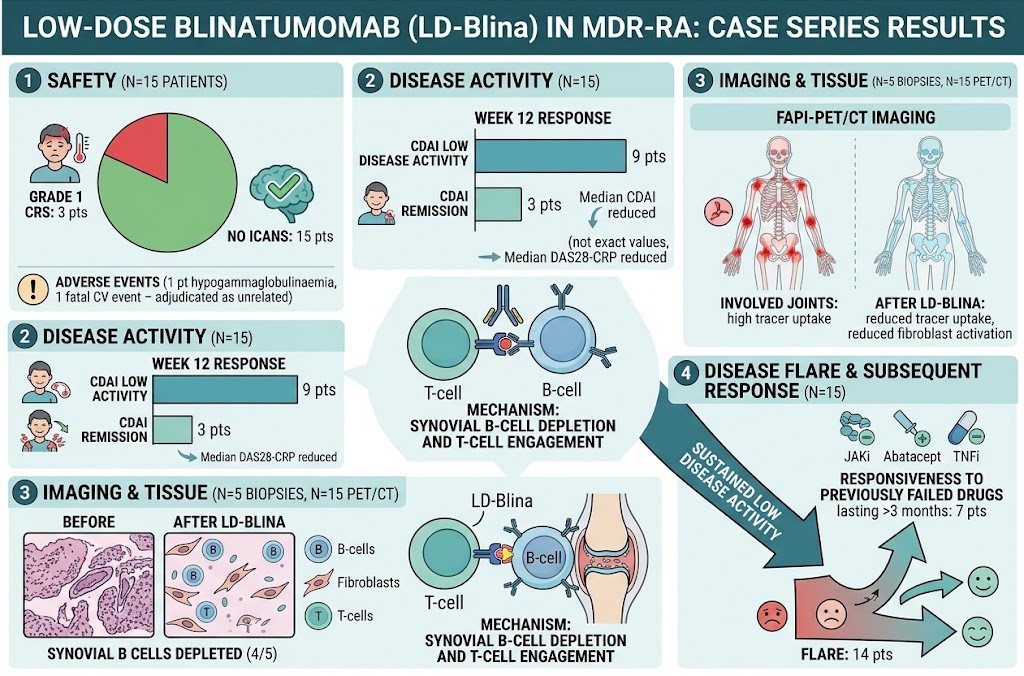
Safety monitoring revealed grade 1 CRS in 3 patients, manifesting as mild and self-limited symptoms; no cases of ICANS were recorded. One patient developed hypogammaglobulinemia. A single fatal cardiovascular event occurred approximately one year post-treatment but was adjudicated as unrelated to blinatumomab by treating physicians, though no independent review was performed.
The therapeutic effect was monitored by clinical disease activity scores, ultrasound examinations, and FAPI-PET/CT imaging. Synovial B-cell depletion was demonstrated in 4 of 5 biopsy samples post-treatment; lymph node B cells were not significantly depleted.
Outcome and Prognosis
By week 12, significant clinical improvements were observed. Nine patients achieved CDAI low disease activity status, and 3 achieved clinical remission. Although flare episodes occurred in 14 of 15 patients following blinatumomab administration, overall disease activity remained significantly reduced compared to baseline.
Importantly, 7 of 15 patients regained responsiveness to previously ineffective DMARDs (including Janus kinase inhibitors, abatacept, and TNF inhibitors), suggesting a potential reset of immune responsiveness post-TCE therapy. Reduced FAPI tracer uptake on PET/CT confirmed diminished fibroblast activation and synovial inflammation.
Discussion
This case series demonstrates that low-dose blinatumomab, a T-cell engager conventionally used in hematologic cancers, may provide an innovative therapeutic strategy for patients with MDR-RA by targeting synovial B cells and modulating tissue inflammation.
The observed synovial B-cell depletion correlates with clinical response, supporting the pathogenic role of B cells in RA persistent inflammation. The lack of substantial lymph node depletion suggests localized synovial targeting, potentially reducing systemic immunosuppression risks.
Low-dose protocols appear to offer a favorable safety profile, with only mild CRS and no neurotoxicity noted, highlighting an improved benefit-risk balance compared to high-dose regimens. The occurrence of disease flares yet improved DMARD responsiveness indicates that blinatumomab may synergize with conventional therapies by resetting immune pathways.
Nonetheless, this study’s limitations include small sample size, absence of a control group, and limited independent event adjudication. The fatal cardiovascular event underlines the necessity for vigilance, although causality to therapy was not established.
Future randomized controlled trials are essential to validate efficacy, safety, optimal dosing, and long-term outcomes of low-dose TCE therapy in MDR-RA. These findings align with evolving immunotherapy paradigms shifting from broad immunosuppression to targeted cellular therapies.
References
1. Bucci L, et al. Low-dose blinatumomab in multidrug-resistant rheumatoid arthritis—a case series. Ann Rheum Dis. 2026 Aug 13. PMID: 42595657.
2. Smolen JS, et al. Rheumatoid arthritis. Lancet. 2016;388(10055):2023–2038.
3. Aletaha D, et al. 2010 Rheumatoid arthritis classification criteria: an American College of Rheumatology/European League Against Rheumatism collaborative initiative. Arthritis Rheum. 2010;62(9):2569–2581.
4. Neelapu SS, et al. Chimeric antigen receptor T-cell therapy — assessment and management of toxicities. Nat Rev Clin Oncol. 2018;15(1):47–62.
—
This case series offers promising evidence for low-dose blinatumomab as a novel treatment avenue in MDR-RA, underscoring the importance of innovative immunotherapies in improving patient outcomes in otherwise refractory autoimmune conditions.
This article was created using several editorial tools, including AI, as part of the process. Human editors reviewed this content before publication.