Highlight
Children born very preterm (VP) exhibit persistent executive function (EF) deficits compared to full-term (FT) peers from early childhood into adolescence. These EF difficulties span multiple domains, including cognitive flexibility, inhibition, working memory, emotional control, and planning. The study also identified sex and socioeconomic status as modifiers of EF trajectories. Longitudinal tracking utilizing parent-reported measures underscores the necessity for continuous developmental surveillance and early intervention strategies in the VP population.
Study Background
Executive function encompasses a set of high-level cognitive processes essential for goal-directed behavior, including inhibitory control, working memory, cognitive flexibility, planning, and emotional regulation. These functions underpin academic achievement, social adaptation, and overall quality of life. Children born very preterm, defined here as less than 32 weeks’ gestational age—and specifically in this cohort as less than 30 weeks—face heightened risks for neurodevelopmental impairments, notably in EF domains.
Although prior research has documented EF difficulties in VP children, gaps remain concerning their developmental course from toddlerhood through adolescence. Understanding the trajectory of EF challenges is crucial for guiding monitoring, tailoring interventions, and informing families and clinicians about long-term outcomes.
Study Design
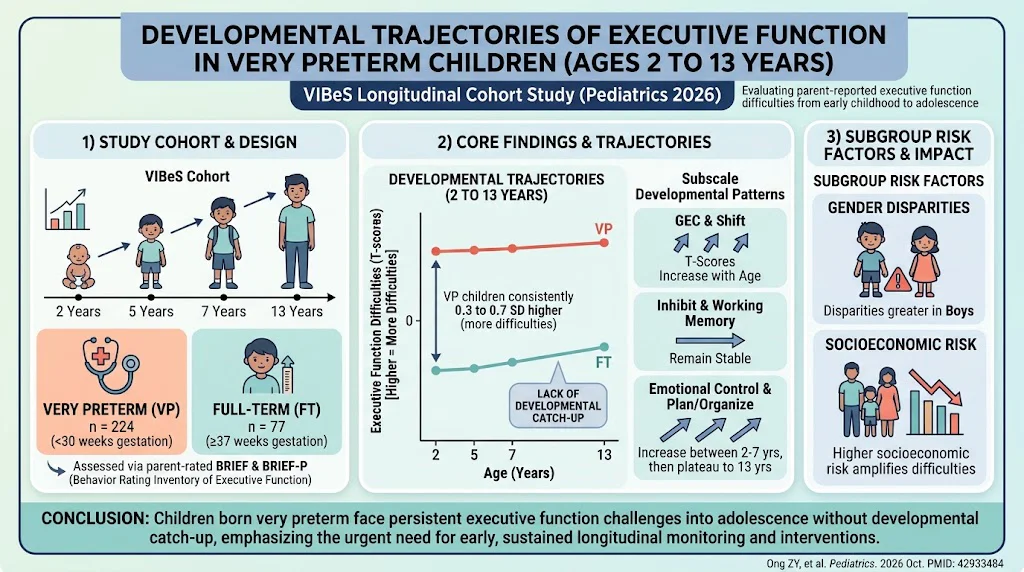
This research analyzed data from the Victorian Infant Brain Study (VIBeS), a longitudinal cohort comprising 224 children born very preterm (<30 weeks gestation) and 77 matched full-term controls (≥37 weeks gestation). Participants underwent serial assessments of EF at ages 2, 5, 7, and 13 years.
Executive function was evaluated through parent-reported questionnaires using the Behavior Rating Inventory of Executive Function (BRIEF) for school-aged children and its preschool version at earlier timepoints. This inventory quantifies EF difficulties based on behavioral manifestations across domains such as inhibition, shifting, emotional control, working memory, and planning/organization.
Longitudinal data were analyzed employing multilevel mixed-effects models to estimate developmental trajectories, allowing for intra-individual change and inter-individual variability, while adjusting for covariates including sex and socioeconomic risk.
Key Findings
Across the developmental span from 2 to 13 years, children born very preterm consistently showed EF difficulties 0.3 to 0.7 standard deviations higher than full-term peers on all BRIEF scales. This indicates a medium effect size, signifying clinically meaningful differences.
Sex differences emerged, with boys demonstrating greater EF impairments compared to girls within the VP group. Socioeconomic risk further exacerbated EF challenges, suggesting interplay between biological vulnerability and environmental factors.
Regarding developmental trajectories, the Global Executive Composite (GEC) and the Shift domain scores increased over time in both groups, indicating that parental ratings of cognitive flexibility difficulties become more pronounced as children age. Inhibit and Working Memory domain scores remained relatively stable over the ages studied, suggesting these difficulties are persistent but not necessarily progressive.
Emotional Control and Plan/Organize T-scores increased from 2 to 7 years then plateaued through adolescence. This pattern may reflect emerging emotional regulation and planning demands as children progress through early school years, with stabilization later in development.
Notably, despite some variation in individual domains, there was little evidence of developmental catch-up by the VP group compared to full-term children. The persistence of EF impairments underlines the chronic nature of these difficulties.
Expert Commentary
This study provides robust longitudinal evidence supporting persistent executive function deficits in children born very preterm, reinforcing the importance of early diagnosis and sustained intervention approaches. The use of parent-reported BRIEF scales aligns with ecological validity, capturing functional behaviors across environments rather than isolated cognitive tests.
However, the reliance on parent report may introduce subjective bias; future studies incorporating objective neuropsychological assessments and neuroimaging could further elucidate underlying neural correlates and validate findings.
The observed modulation by sex and socioeconomic factors suggests a biopsychosocial model in which biological prematurity interacts with environmental context and sex-specific developmental pathways to shape EF outcomes. Such insights promote personalized care strategies and emphasize addressing socioeconomic disparities as part of comprehensive management.
Limitations include the potential for attrition bias over the extended follow-up and generalizability restricted to a high-resource setting. Nonetheless, the VIBeS cohort’s rigorous longitudinal design and substantial sample size strengthen confidence in the conclusions.
Conclusion
Children born very preterm are at significant risk for enduring executive function difficulties from toddlerhood to adolescence, with no evidence of normalization relative to term-born peers. These challenges span multiple cognitive domains critical for academic, behavioral, and social success.
Early identification and continuous monitoring of EF deficits are imperative. Intervention programs should be initiated as early as possible and tailored to individual risk profiles, including accounting for sex and socioeconomic background.
Future research should aim to delineate biological mechanisms, explore effective intervention modalities, and assess long-term impacts into adulthood. Integrating multidisciplinary care approaches could improve outcomes and quality of life for this vulnerable population.
Funding and ClinicalTrials.gov
The VIBeS longitudinal study was supported by institutional and governmental research grants; specific funding sources were not detailed in the abstract. Clinical trial registration data were not provided.
References
1. Ong ZY, Spencer-Smith M, Kirk HE, et al. Developmental Trajectories of Executive Function From 2 to 13 Years in Children Born Very Preterm. Pediatrics. 2026 Oct 27; PMID: 42933484.
2. Anderson PJ, Doyle LW. Executive functioning in children born preterm: risk factors and outcomes. Semin Perinatol. 2004;28(6):425-434.
3. Mulder H, Pitchford NJ, Marlow N. Processing speed and executive function predict classroom behavior in very preterm and/or very low birth weight children. Child Neuropsychol. 2009;15(3):227-241.
4. Taylor HG, Hack M. Executive function deficits in children born preterm and their relationship to social adjustment. Dev Neuropsychol. 2009;33(6):680-691.